Joint MOU signed last January in Casablanca, Morocco
Building a “multi-layered space” spanning physical and virtual realms
AI performs economic and leisure activities on behalf of users
Combining “integrated AI agents” with “serverless” technology
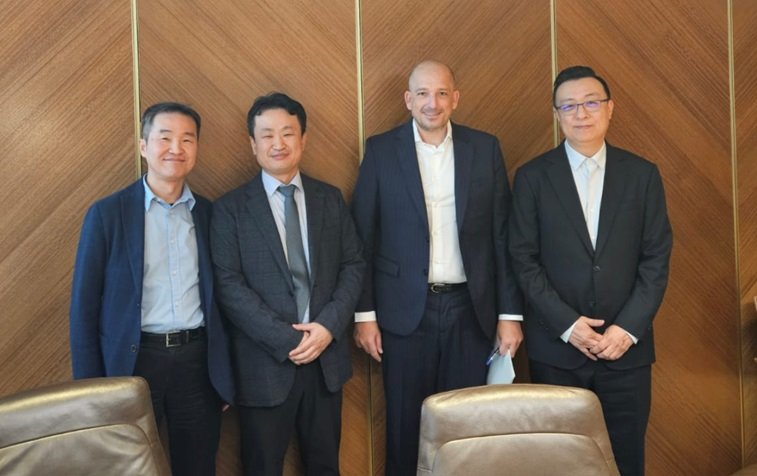
At the signing ceremony for a joint memorandum of understanding (MOU) to build “Project DI,” held in Casablanca, Morocco, in January, key stakeholders pose for a commemorative photo. From left: Naver co-founder and E.O. Ground CEO Kwon Hyuk-il; Han Sang-young, Executive Director of Global DX & Innovation at Naver Cloud; Lloyds Capital CIO David Aim; Bloom Technology CEO Lee Sang-yoon.
Naver Cloud, Bloom Technology, Creta, E.O. Ground, Lloyds Capital, and Nexus Core Systems—six companies in total—signed a memorandum of understanding (MOU) in Casablanca, Morocco, in January to build “Project DI (Project Digital Integration),” an integrated AI platform.
The project is a joint initiative promoted not under the leadership of a single company, but through an alliance of firms in different areas such as technology, planning, content, and business development.
The core vision of Project DI is “expansion of life in multi-layered spaces.” This refers to a concept in which the real world and the virtual world are not separated but are connected as a single, massive universe. Users create numerous “AI avatars” and “personas” according to their purposes and simultaneously handle everything from real-world administrative and financial tasks to virtual games and entertainment activities.
Project DI aims to supplement the existing connection methods of virtual reality and address the lack of content by leveraging AI-based digital twins and multiverses. AI personas learn user preferences and, even when the user is offline, conduct production, economic activities, and social interactions in virtual spaces.
Its core competitiveness lies in Naver Cloud’s strong data management capabilities and the “integrated AI agent” technology built on that foundation. Naver Cloud securely accumulates and manages vast amounts of data and unique information spanning users’ entire lifetimes on Naver Cloud, and based on this, generates optimized AI agents that understand users best.
These AI agents do not rely on a single model; instead, they perform the role of an “orchestrator” that selectively links a variety of external generative and inference AI models as appropriate to each situation and purpose.
This advanced AI agent system creates powerful synergies when combined with Bloom Technology’s “Locus Chain” technology. Locus Chain is responsible not only for DID (Decentralized Identifier) authentication and the trading of decentralized assets (including RWA), but also for providing proprietary serverless distributed network technology. This resolves data traffic bottlenecks and astronomical cost issues that can arise when hundreds of millions of users and billions of AI agents simultaneously use various services, based on user data managed by Naver Cloud.
By combining Naver Cloud’s AI agent technology with Locus Chain’s infrastructure, the partners are working to build an AI platform that supports B2G, B2B, B2C, and M2M (machine-to-machine) transactions. Through this, they plan to manage centralized and decentralized assets and services in an integrated manner.
The project is being carried out in a structure where leading companies in each field optimize their technology, experience, and capital to enhance the completeness of the platform. Creta will initially serve as a key axis connecting AI, games, and digital culture. Industry veterans in the global and Korean gaming sectors, including Thomas Vu, who contributed to the success of “League of Legends,” Yoon Suk-ho, known as the father of “Fortress,” and Jang Joo-hyung of “Aion,” have joined Creta and are developing interactive content combined with AI. Through this content, they will play a key role in increasing users’ time on the platform and shaping the identities of avatars.
E.O. Ground, led by Chairman Kwon Hyuk-il, a founding member of Naver who has designed search, community, and commerce services, will translate human experience into AI and spearhead user experience (UX) design. Based on the technology accumulated through the “Kuavata” service currently under development, the company will design the overall system architecture and set the direction so that AI avatars can naturally permeate human life.
Lloyds Capital will be responsible for global business development and financial structuring, supporting connections with governments (B2G) and large private-sector projects. Its subsidiary Nexus Core Systems, under the leadership of Jaap Zuiderveld, former Vice President in charge of Europe, the Middle East, and Africa at NVIDIA, will be in charge of formulating global AI data center strategies and providing hardware infrastructure.
A project official stated, “Project DI will create a practical and innovative digital ecosystem that infinitely expands human experience and time through AI avatars, from public-sector tasks such as government document processing to self-realization within games.”
The official added, “Unlike existing AI platforms that remain simple assistants, Project DI will go beyond providing integrated services that support all stages of human life and enable three-dimensionally connected lives across numerous digital worlds,” emphasizing, “This will ultimately become the starting point of the next stage of civilization, in which we live with ‘multi-layered social identities and personalities’ expanded beyond anything we can currently imagine.”
ⓒ dongA.com. All rights reserved. Reproduction, redistribution, or use for AI training prohibited.
Popular News