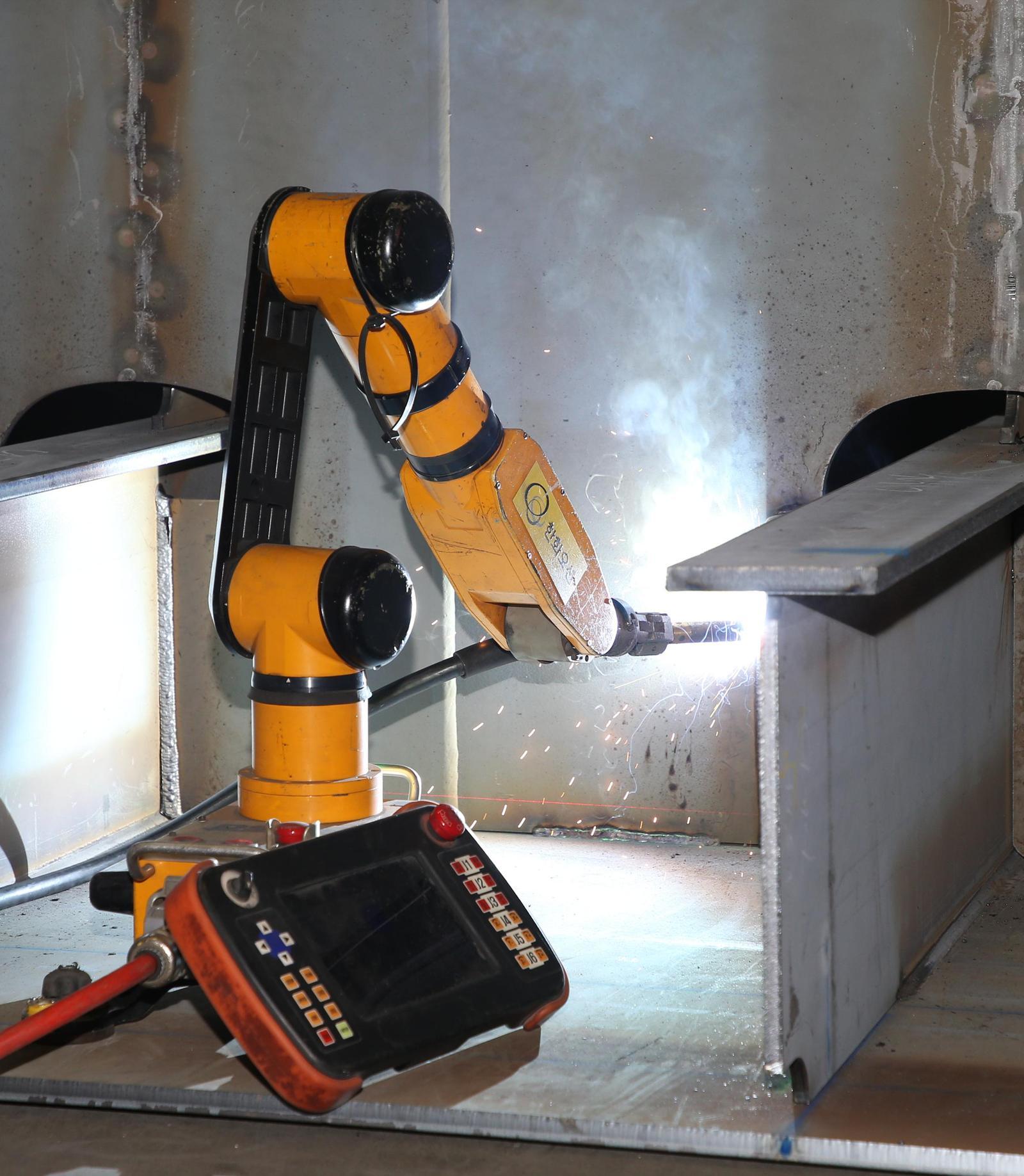
At the Hanwha Ocean Geoje Shipyard in Geoje, South Gyeongsang Province, which was recently visited, a welding robot is hard at work. Provided by Hanwha Ocean
At Hanwha Ocean’s Geoje plant in Geoje, South Gyeongsang Province, which was recently visited. Inside the hull assembly shop, a 17 kg-class portable welding robot was emitting electric sparks. The instant temperature of these sparks reaches 5,000 degrees Celsius, comparable to the surface of the sun. At such extreme heat, even thick steel plates can be joined in an instant.
The welding robot continued its work amid the sparks. While the robot’s arm moves constantly, on-site personnel only need to supervise the robot. Kim Tae-gon, head of Hanwha Ocean’s Smart Production Promotion Team, said, “As robots take on repetitive and hazardous tasks, working conditions for operators improve, and because robots can operate 24 hours a day, output more than doubles.”
Hanwha Ocean is promoting AI- and robot-based automation at its shipyards, with the Geoje Shipyard at the center. A Hanwha Ocean official explained, “This helps prepare for the aging of skilled workers and prevents musculoskeletal disorders that may occur during work.” The company’s automation rate for indoor welding processes is around 67%, and it aims to achieve 100% unmanned welding processes by 2030. It plans to increase robot application to 50% in pre-treatment painting processes and 60% in cable-laying processes.
The robot used by Hanwha Ocean at the Geoje plant is also scheduled to be introduced around the end of 2027 at Philly Shipyard in the United States, the symbol of MASGA, a Korea-U.S. shipbuilding cooperation project. This robot can work in narrow spaces where it is difficult for humans to enter when welding steel plates from the inside. It is assessed as having the skills of a third-year experienced welder. Starting with this robot, Hanwha Ocean plans to introduce intelligent robots in stages in line with the expansion and modernization schedule for Philly Shipyard.
Among shipyard tasks that humans previously carried out at personal risk, “ship draft measurement” (measuring the depth to which a ship is submerged) has become fully unmanned. Draft measurement is essential to identify in advance any issues related to the center of gravity and weight of a completed vessel. In the past, three to four workers had to board a small boat and measure the draft close to the hull on choppy seas, constantly exposed to the risk of accidents. Now, drones circle around the vessel to take photographs, and vision AI measures the draft. Since AI was introduced, working time has been reduced from two hours to within 30 minutes, and personnel no longer have to go out onto dangerous waves.
Hanwha Ocean’s ultimate goal is to build a “smart shipyard” that resolves labor shortages and enhances safety through the introduction of AI and robots. Beyond having physical AI replace dangerous tasks, the company aims to be prepared for the aging of skilled workers by enabling even low-skilled new hires to maintain a certain level of work quality in the field. A Hanwha Ocean official projected, “If we can advance the intelligence of robots deployed at worksites and turn skilled workers’ task patterns and decision criteria into data, AI will be able to support decisions on processes, quality, and safety.”
ⓒ dongA.com. All rights reserved. Reproduction, redistribution, or use for AI training prohibited.
Popular News