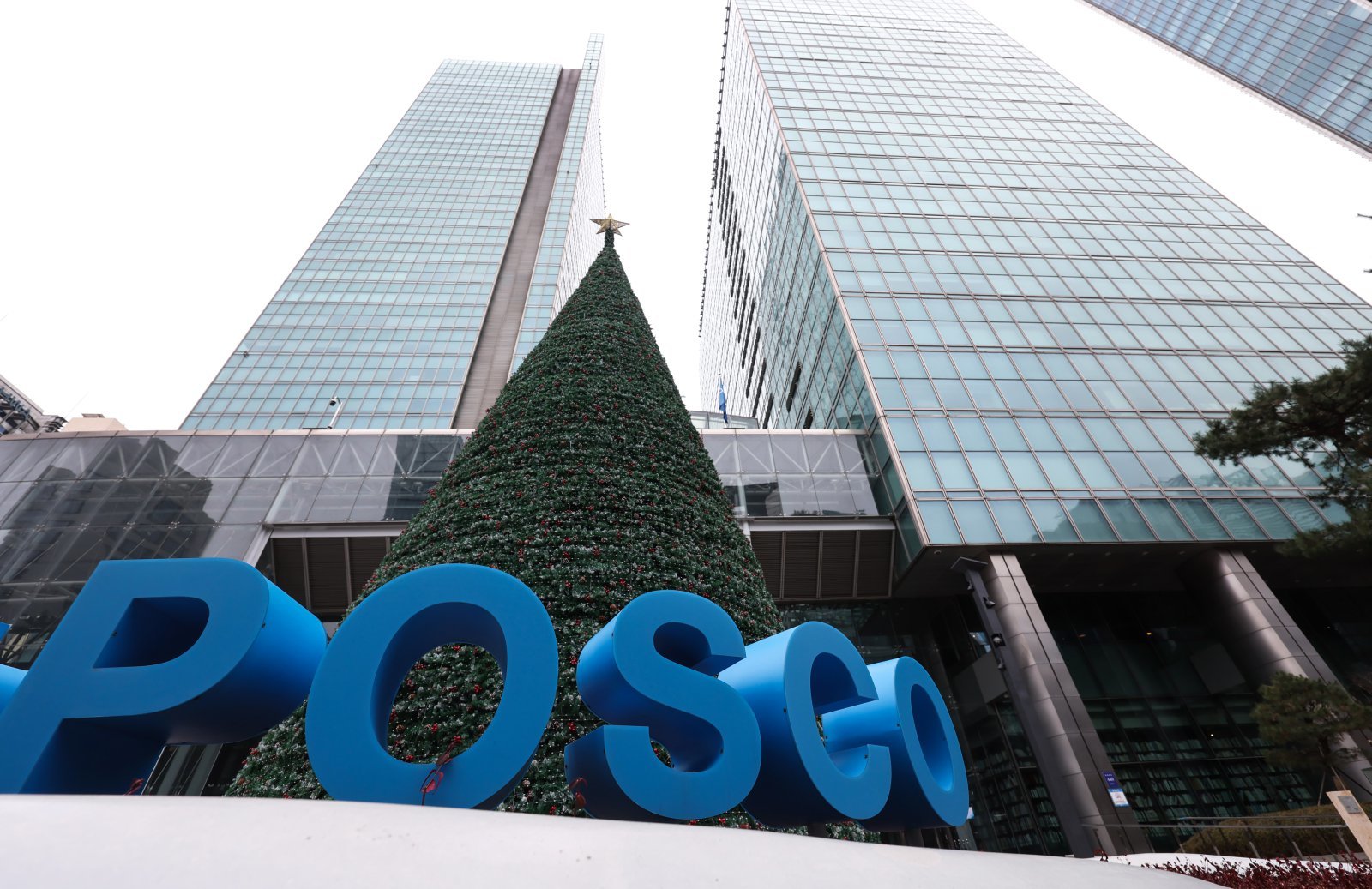
View of POSCO headquarters in Gangnam-gu, Seoul. News1
POSCO announced on the 12th that it has developed, for the first time in Korea, high-ductility steel and armor steel for naval vessels and obtained classification approval from the Korean Register (KR) last month.
This KR approval covered the entire process from the steel development stage through weldability verification to securing protection performance for naval vessels. A classification society is an institution that technically evaluates and certifies the safety and quality of materials, design, and overall manufacturing of ships and offshore structures, and materials related to naval vessels must also meet the standards set by the society.
The high-ductility steel developed by POSCO is characterized by an improvement in elongation of more than 35% compared with existing shipbuilding thick steel plates. It is a steel material that does not fracture easily but stretches and deforms when subjected to external impact or load. Naval vessel collision simulation results showed that impact absorption improved by approximately 58%.
POSCO expects that the high-ductility steel will be used as a key material to maximize the degree of deformation of naval vessels in collisions with ships or floating bodies, thereby minimizing damage and enhancing overall survivability.
In addition, POSCO has developed armor steel whose thickness has been reduced by about 30% compared with existing shipbuilding thick steel plates. This armor steel can be applied to areas such as the wheelhouse and radar on the upper parts of naval vessels, where advanced weapon systems are concentrated, thereby ensuring protection performance against external threats.
POSCO explained that, in particular, the lightweight upper structure can increase resistance to hull motion and make a significant contribution to improving the vessel’s stability.
POSCO disclosed the status of this technology development at the “2025 International Maritime Defense Industry Exhibition (MADEX)” and the “Naval Technology and Weapon Systems Seminar” held in May last year, receiving a positive response from domestic and overseas defense industry officials.
This project was carried out under a “One Team” system led by the POSCO Technical Research Laboratories, with participation from all in-house departments including production, quality, and marketing. POSCO stated that it successfully completed the development of new materials for naval vessels through interdepartmental collaboration.
A POSCO official said, “This achievement can be applied to a variety of overseas projects, including naval vessels for South American and Southeast Asian navies as well as maintenance, repair and overhaul (MRO) and construction projects for U.S. Navy vessels,” adding, “It is expected to contribute to expanding K-defense exports and advancing into the global naval vessel market.”
Meanwhile, POSCO Group Chairman Jang In-hwa emphasized in his New Year’s address that “it is necessary to complete a product portfolio essential for future industries to strengthen market leadership and optimize the profit structure.” POSCO plans to use this classification approval as an opportunity to expand the application scope of high-performance steel for naval vessels and continue related technology development.
ⓒ dongA.com. All rights reserved. Reproduction, redistribution, or use for AI training prohibited.
Popular News