Coronary intervention being performed.
Hallym University Kangnam Sacred Heart Hospital announced that it has become the first among hospitals under Hallym University Medical Center to introduce the latest artificial intelligence (AI)-based coronary blood flow analysis system, “μFR AngioPlus Core” (μFR). Since January this year, the hospital has been applying this system in clinical practice to enhance safety and treatment accuracy for patients requiring coronary intervention.
Coronary artery disease is a condition in which the vessels supplying blood and oxygen to the heart become narrowed or blocked. When blood flow decreases, it can cause chest pain and, in severe cases, lead to myocardial infarction. The challenge is that even when a vessel appears to be severely narrowed, there may be no actual blood flow impairment, while conversely, a lesion that looks mild on the surface can significantly reduce blood flow and create a dangerous situation. Accordingly, in the treatment of coronary artery disease, accurately assessing the presence of actual blood flow impairment is considered more critical than simply evaluating the degree of stenosis.
Until now, assessing blood flow status required an invasive test in which a thin wire was inserted into the coronary artery and drugs were administered. This process placed a substantial burden on patients, and decisions on whether to perform an intervention largely depended on the experience and visual assessment of the medical staff, posing inherent limitations.
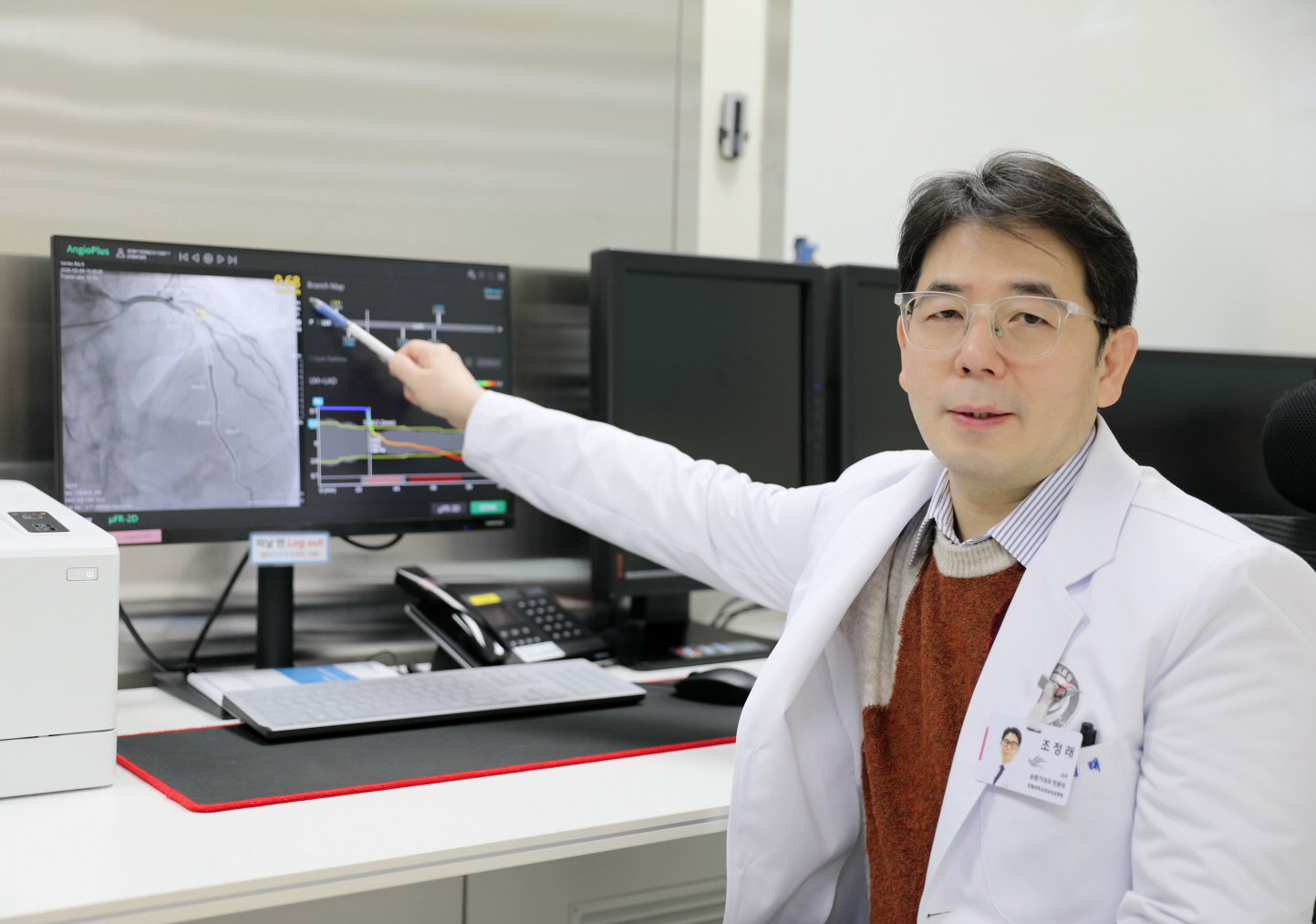
Professor Cho Jung-rae of the Division of Cardiology at Hallym University Kangnam Sacred Heart Hospital explains the AI-based coronary blood flow analysis system “μFR.” Courtesy of Hallym University Kangnam Sacred Heart Hospital
μFR is a noninvasive test that addresses these issues by quantifying and analyzing blood flow status within about one minute using only coronary angiography images. It enables assessment of the need for an interventional procedure without additional invasive steps or pain, making it safe to use even for emergency cases and high-risk patient groups. In particular, it reduces concerns about side effects related to invasive procedures and drug administration, and allows precise planning of whether to perform stent implantation and where to place the stent through its simulation function. The system determines treatment strategies based on μFR values. Referring to the value of around 0.8, which is commonly used as a threshold, clinicians decide between stent intervention and medical therapy. This approach helps reduce unnecessary procedures and ensures that only patients who truly need it receive tailored percutaneous coronary intervention (PCI).
The μFR technology is an AI-based system trained on data from hundreds of thousands of patients, and its accuracy and safety have been validated through large-scale clinical studies conducted in Korea, China, Europe, Japan, and other regions. Overseas studies have reported that treatment guided by AI-based blood flow analysis reduces the risk of major cardiovascular events, including myocardial infarction.
Professor Cho Jung-rae of the Division of Cardiology at Hallym University Kangnam Sacred Heart Hospital stated, “It is now possible to verify in numerical terms whether treatment is actually required, rather than relying only on visually observed stenosis,” adding, “By reducing unnecessary procedures and making treatment decisions precisely tailored to each patient, both diagnostic efficiency and patient safety have improved.”
The Cardiovascular Center at Hallym University Kangnam Sacred Heart Hospital, in addition to AI-based precision diagnostics, has established a golden-time care system linking the cardiac catheterization laboratory and the coronary care unit (CCU), enabling rapid response to complex and emergency cardiovascular interventions.
ⓒ dongA.com. All rights reserved. Reproduction, redistribution, or use for AI training prohibited.
Popular News