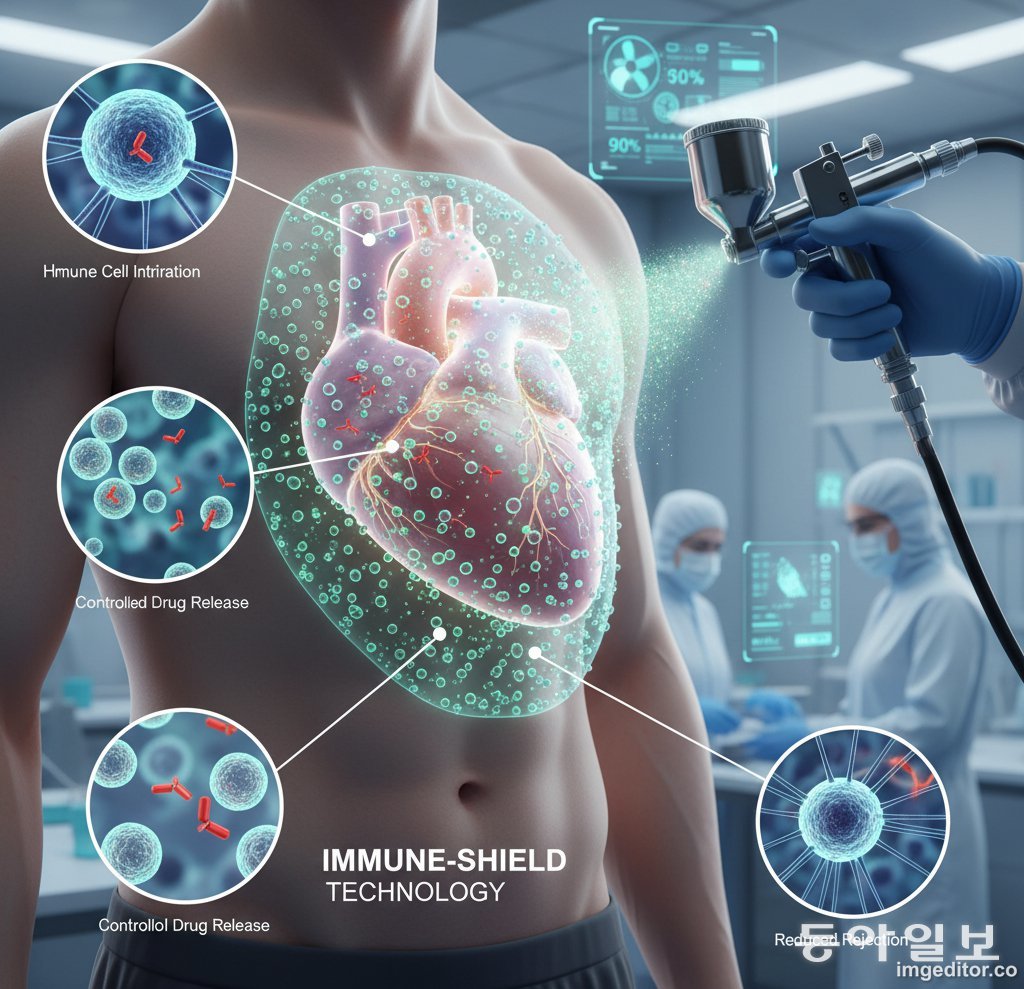
The most significant challenge in organ transplantation, immune rejection, may be suppressed without side effects thanks to a newly developed technology. Pohang University of Science and Technology (POSTECH) announced on the 9th that, together with a research team from Ewha Womans University, it has developed an “Immune-Shield” technology that sprays an immunosuppressant onto the surface of a transplanted organ using an adhesive material derived from mussels.
Organ transplantation is the most effective treatment method for restoring organs damaged by accidents or disease. However, as transplantable organs are severely lacking worldwide, xenotransplantation, in which animal organs are transplanted into humans, is being highlighted as an alternative. The problem is that the human immune system triggers a rejection response by recognizing the transplanted organ as a foreign invader. To prevent this, patients must continuously take immunosuppressants, which entails a high risk of side effects such as nephrotoxicity and increased susceptibility to infections.
Professor Hyung Joon Cha of the Department of Chemical Engineering and the Graduate School of Convergence Science and Technology (Medical Science major) at POSTECH, doctoral candidates Sangmin Lee and Hyuntaek Woo (Department of Chemical Engineering), Dr. Geunho Choi, and Professor Gyeil Joo of the Department of Chemical Engineering and Materials Science at Ewha Womans University focused on a method of delivering immunosuppressive drugs not to the “whole body” but specifically to the “transplanted organ.” The research team leveraged the mechanism by which mussels adhere strongly even underwater to develop a technique that directly attaches microscopic hydrogel particles containing immunosuppressants to the organ surface. Using adhesive microgels to coat the surface of biological tissue, the team named this approach “Immune-Shield.”
The Immune-Shield is applied in a spray-like manner. It forms a stable coating even on moisture-rich organ surfaces, and the microgels slowly release the immunosuppressant. In xenotransplantation experiments, application of the Immune-Shield significantly reduced immune cell infiltration and inflammatory responses, while extending the survival time of the transplanted tissue. The research findings were recently published in the Journal of Controlled Release, an international academic journal in the fields of pharmacology and drug delivery.
Jeon Hye-jin
AI-translated with ChatGPT. Provided as is; original Korean text prevails.
ⓒ dongA.com. All rights reserved. Reproduction, redistribution, or use for AI training prohibited.