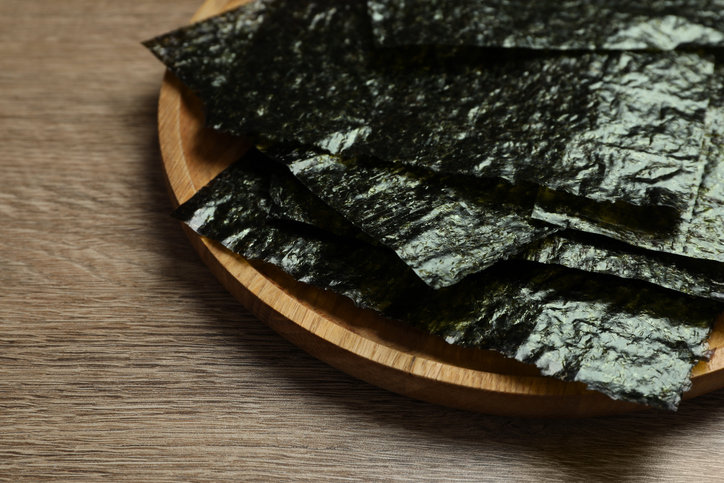
Gim. Getty Images Bank
The BBC has placed a spotlight on the phenomenon in which the recent boom in Korean gim (dried seaweed) overseas has instead become a factor driving up domestic prices.
On the 4th (local time), the BBC reported, “The black, crispy, flat square sheets of gim are a modest side dish in ordinary Korean households, but as prices have risen in line with its growing global popularity, Korean gim enthusiasts are becoming worried.” It added, “Korea is the world’s largest producer and exporter of gim, supplying it across Asia, North America, and Europe,” explaining, “Some even refer to gim as Korea’s ‘black semiconductor,’ implying the significant share Korea holds in the global semiconductor industry.”
Mr. Lee, in his 60s, who said he has been selling gim for 47 years at a market in Seoul, told the BBC, “In the past, Westerners said Koreans were eating a strange food that looked like ‘black pieces of paper’ and I never thought we would be selling gim to them. Now everyone comes and buys it.”
Miki, 22, from Japan, told the BBC, “I learned that gim is one of Korea’s representative foods because it often appears in Korean dramas,” adding, “We have a similar food in Japan, but it tastes completely different. Korean gim is lighter and crispier and is usually roasted with sesame oil and salt.” Viola, in her 60s from New York, said, “I enjoy gim as a snack,” adding, “I eat it like potato chips, but it feels much healthier (than chips).”
Recently, driven by the popularity of K-food such as gimbap, gim exports have increased sharply. According to the Ministry of Oceans and Fisheries, exports of gim reached USD 1.13 billion (about KRW 1.6339 trillion) last year, setting a new all-time high. As supply failed to keep up with demand, gim prices have risen. According to price data from the Korea Agro-Fisheries & Food Trade Corporation (aT) on the 6th, the average retail price of gim was KRW 1,403 for 10 sheets, or about KRW 140 per sheet. The BBC reported, “As recently as 2024, gim cost about KRW 100 per sheet.”
The BBC reported that the Korean government and related companies are preparing measures to curb the rise in gim prices in order to reduce the burden on domestic consumers. The Ministry of Oceans and Fisheries has pledged to monitor the situation for price stabilization, and food companies are pushing ahead with the establishment of land-based aquaculture systems capable of year-round production and research and development (R&D) centers, the report said.
ⓒ dongA.com. All rights reserved. Reproduction, redistribution, or use for AI training prohibited.
Popular News