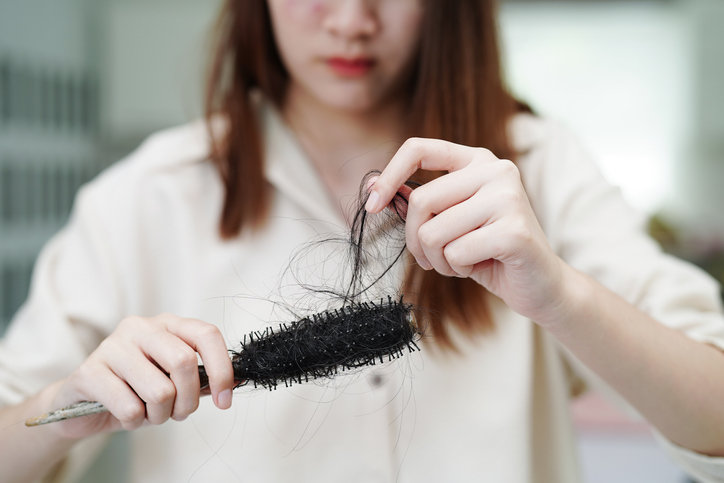
In recent academic discourse, there is growing recognition of hair loss as a disease of modern people. Getty Images Bank
After President Lee Jae-myung stated during the Ministry of Health and Welfare’s year-end 2025 policy briefing that “hair loss is a matter of survival,” controversy has reignited in political circles over whether hair loss treatment should be covered by the National Health Insurance. At the time, Minister of Health and Welfare Jeong Eun-kyeong drew a line, saying, “It is difficult to regard hereditary hair loss as a target for medical treatment.”
Recent academic findings indicate that the academic view of hair loss differs somewhat from that stance. The perception of hair loss as a disease of modern people is gaining traction. In particular, there is a view that research on hair loss treatment could become a new breakthrough in regenerative medicine, which aims to replace and regenerate cells, tissues, and organs.
● Hair loss is the result of damage to an organ called the ‘hair follicle’
The hair follicle, which houses the hair shaft, is classified as an organ composed of about 20 types of cells. Academia views hair loss as a “disease in which an organ is damaged.” Sung Jong-hyuk, CEO of Epibiotech (former professor at Yonsei University College of Pharmacy), said, “The hair follicle is a mini-organ connected to blood vessels, nerves, and immune cells that responds to external stimuli and hormonal signals,” adding, “Even hereditary hair loss is a typical disease in which the androgen receptor in the hair follicle overreacts, leading to fibrosis of the follicle and the accumulation of inflammation.”
Globally, hair loss is also recognized as a disease. Kim Beom-jun, professor of dermatology at Chung-Ang University Hospital, said, “Hair loss persists for more than three months, repeats cycles of improvement and worsening, requires lifelong management, and has a significant impact on quality of life, thereby meeting all four criteria of a chronic disease,” and added, “If social withdrawal, anxiety disorders, and depression caused by hair loss interfere with social life, this means that the state of health as defined by the World Health Organization (WHO)—physical, mental, and social well-being—has been compromised, and thus medical intervention is required.”
Under the current National Health Insurance system in Korea, reimbursement is provided only for acute hair loss conditions such as alopecia areata. Chronic hereditary hair loss, including male pattern and female pattern hair loss, is categorized as non-reimbursable, and patients must bear the full cost of treatment. The hair loss population in Korea is estimated at about 10 million, or roughly one in five people. Globally, it is estimated to exceed 1 billion. There are realistic concerns over the financial burden associated with full National Health Insurance coverage for hair loss.
Experts, while acknowledging the constraints of limited insurance finances, propose “selective welfare” that distinguishes and supports the negative impact of hair loss on mental health. This approach would introduce a “dermatology quality of life index” to selectively provide welfare benefits based on the severity of hair loss for each patient. Professor Kim said, “Attempting partial insurance coverage based on functional impairment and psychological severity is meaningful from the standpoint of safeguarding public health,” and added, “This could become a test bed for advanced medical welfare.”
● Could hair loss research become a new breakthrough in regenerative medicine?Hair loss research has recently attracted attention in academia from the perspective of regenerative medicine. Professor Kim explained, “In the past, the focus was on suppressing androgens to prevent hair from falling out, whereas current hair loss treatment research focuses on regeneration to induce lost hair to grow again.”
In April 2025, an international joint research team from Australia, Singapore, China and other countries published in the international journal Nature Communications research findings that the protective protein “MCL-1” is necessary for hair follicle stem cells to function properly. The study found that in the absence of MCL-1, hair follicle stem cells experience stress and die, leading to hair loss. In December 2025, a domestic joint research team including the Korea Institute of Science and Technology (KIST) developed a gel-type drug containing substances such as carboxymethyl chitosan and presented a therapeutic mechanism that induces hair follicle regeneration.
Experts forecast that conquering hair loss will become a new breakthrough driving Korea’s future regenerative medicine technologies. Professor Kim stressed, “The hair follicle is the only regenerative organ in the human body that repeatedly undergoes a lifelong cycle of growth, regression, rest, and regrowth,” and added, “Technology capable of regenerating hair follicles is the key to regenerative medicine that can be extended to the regeneration of skin, nerves, and further to other organs.” CEO Sung likewise said, “It has been only about 10 years since hair loss came to be recognized as a disease and studied in earnest,” and added, “There is strong interest in hair loss in Korea and East Asia, so the development of regenerative medicine-based hair loss treatments will become a new future growth engine.”
ⓒ dongA.com. All rights reserved. Reproduction, redistribution, or use for AI training prohibited.
Popular News