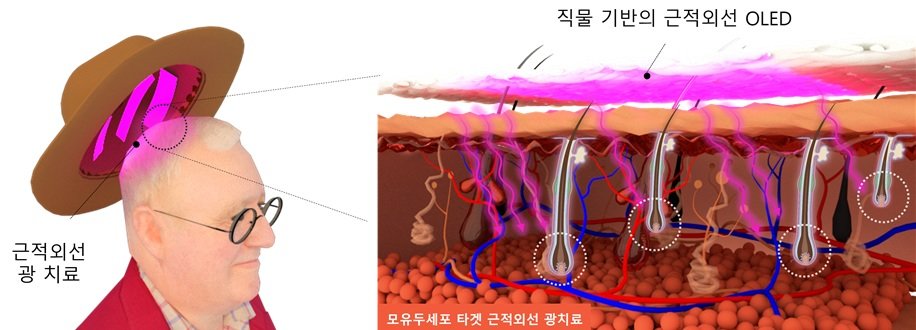
Instead of heavy, rigid helmet-type hair-loss treatment devices, an organic light-emitting diode (OLED)-based hair-loss treatment device that can be worn in everyday life like a “cap” is expected to be introduced.
On 1 February, KAIST announced that a research team led by Professor Choi Kyung-cheol of the School of Electrical Engineering, together with a team led by Professor Chi Yuen of the Hong Kong University of Science and Technology, has developed a non-invasive hair-loss treatment technology by applying a special OLED light source to a flexible, cap-type wearable platform.
Non-invasive treatment refers to a treatment method that does not involve incising the skin or causing direct physical damage to the body, and in recent years “phototherapy techniques” in particular have drawn attention. However, existing light devices for hair-loss treatment have been manufactured in heavy, helmet-type structures, limiting their use to indoors. In addition, because they adopt a laser-based “point light source” method, they have had limitations in delivering light uniformly across the entire scalp.
In response, the research team applied a surface-emitting OLED that emits light evenly across a broad area. By inserting a near-infrared (NIR) OLED based on a flexible material similar to fabric into the inside of the cap so that the light source naturally conforms to and closely contacts the contours of the scalp, the device was designed to deliver uniform light stimulation to the entire scalp.
Focusing on inhibiting follicle cell aging, which is cited as a key cause of hair loss progression, the research team adapted wavelength-control technology originally used for display OLEDs for therapeutic purposes. Through this, they implemented a customized OLED that selectively emits only near-infrared light in the 730–740 nm band, which is optimal for activating “dermal papilla cells,” the key cells at the bottom of hair follicles that regulate hair growth. According to the research team, experimental results confirmed a cell-aging inhibition effect of approximately 92%. Professor Choi Kyung-cheol stated, “Through future preclinical studies, we plan to verify safety and efficacy and sequentially confirm the potential for actual therapeutic application.”
Jeon Hye-jin
AI-translated with ChatGPT. Provided as is; original Korean text prevails.
ⓒ dongA.com. All rights reserved. Reproduction, redistribution, or use for AI training prohibited.