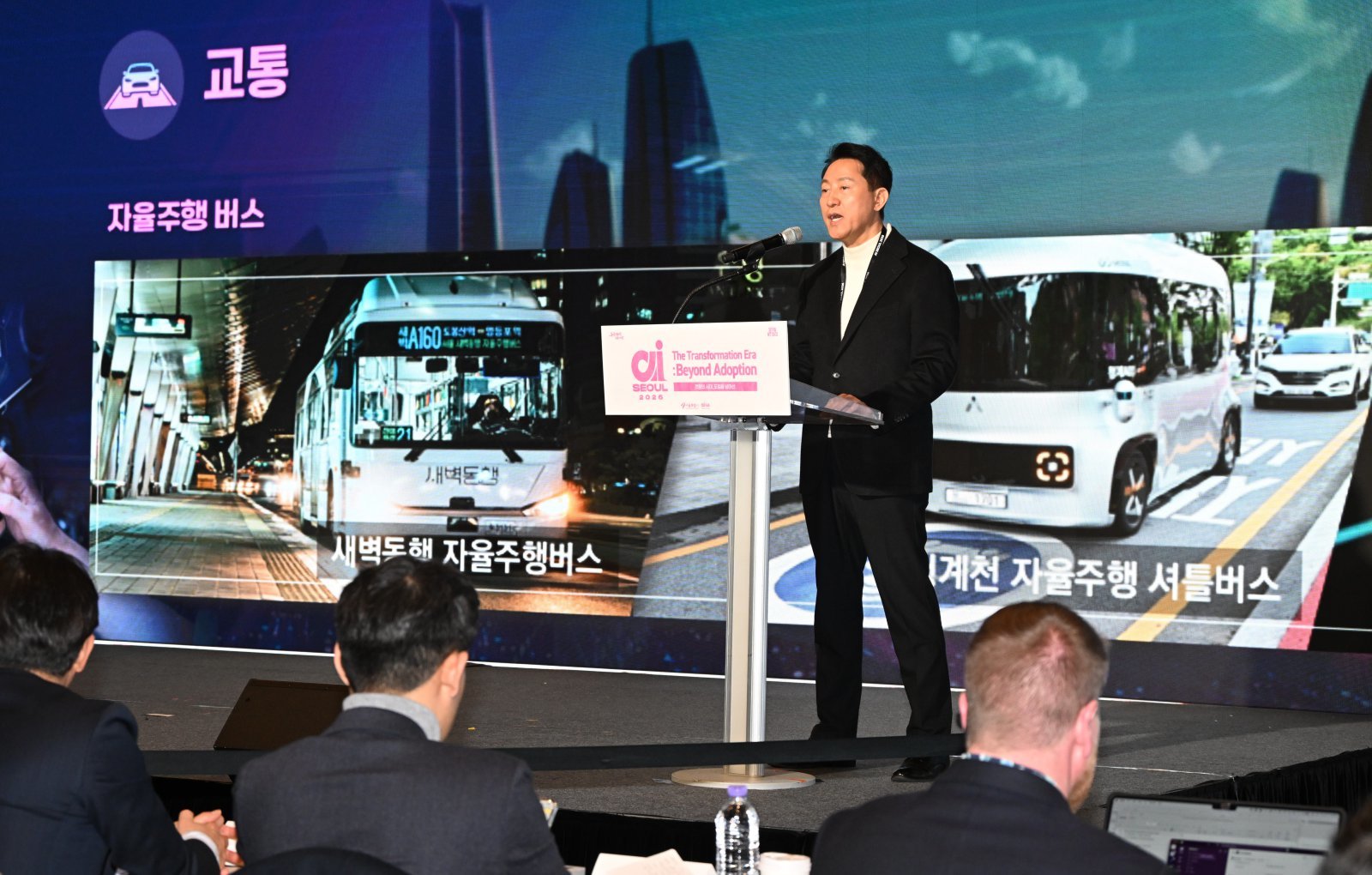
On the 30th of last month, Seoul Mayor Oh Se-hoon delivers a speech at the international AI conference “AI SEOUL 2026” held at COEX in Gangnam-gu, Seoul. On this day, the Seoul Metropolitan Government unveiled its strategy to foster the AI and robotics industry linking Yangjae and Suseo. Provided by the Seoul Metropolitan Government
“Seoul will take the lead as a global city for ‘physical artificial intelligence (AI).’”
Mayor Oh Se-hoon of Seoul emphasized this at the international AI conference “AI SEOUL 2026,” held on the morning of the 30th of last month at COEX in Gangnam-gu, Seoul. AI SEOUL is an international event organized by the Seoul Metropolitan Government to share trends in the artificial intelligence industry and the city’s strategy, and was held for the eighth time this year. The event brought together domestic and overseas AI companies as well as researchers and policymakers in the fields of robotics, semiconductors, and autonomous driving, who discussed trends in next-generation technologies including physical AI and ways to apply them in cities.
Physical AI is technology that extends existing software-centered AI so that it can perceive the real physical world and make judgments and take actions autonomously. It emerged as a core theme at CES, the world’s largest electronics and information technology (IT) trade show, this year, triggering full-scale technological competition among countries.
●
Seoul to attract physical AI talent On this day, the Seoul Metropolitan Government announced a spatial strategy to attract AI talent and companies simultaneously. The core of the physical AI strategy is built on three pillars: infrastructure, industrial ecosystem, and citizens’ daily lives. The city plans to take the lead in technology demonstration and industrial diffusion and to open the entire city as a testbed for technology experimentation.
The key hubs will be Yangjae and Suseo. The area around Yangjae-dong in Seocho-gu will be developed as “Seoul AI Tech City.” Centered on the Seoul AI Hub, the city will link nearby available sites to create an integrated complex, aiming to begin construction in 2028. Earlier, in 2024, the Seoul Metropolitan Government designated approximately 400,000 ㎡ in the Yangjae–Umyeon-dong area as the nation’s first AI Regional Special Development Zone. Currently, more than 430 startups, an AI graduate school, and national research bases are located in the Seoul AI Hub.
The area around Suseo Station will be developed as the “Suseo Robot Cluster.” By 2030, the city plans to establish functions for robot research and development (R&D) and demonstration, corporate clustering, and citizen experience in stages, cultivating it into a hub for the robot industry based on physical AI. In addition, the city will create the Seoul Robot Tech Center to provide one-stop support from technology development to demonstration and start-up, and will sequentially establish a venture town for robot companies and experience spaces for citizens.
The Seoul Metropolitan Government intends to connect these hubs with existing industrial bases such as Hongneung (bio), Yeouido (fintech), Namsan (creative industries), Dongdaemun (fashion), G Valley (manufacturing), and Magok (pharmaceuticals and bio) to expand the physical AI industrial ecosystem. Mayor Oh explained, “To make physical AI blossom, there must be a space where researchers and engineers can come together and share their experiences and insights,” adding, “The Yangjae–Suseo belt will provide young elites not only with research space but also with an environment where they can enjoy culture and leisure, creating a ‘work–live–play’ setting that will generate synergy effects in research and development.”
●
Robots to be tested in public facilities and parks To drive industrial diffusion, the Seoul Metropolitan Government will use the entire city as a test bed. Centered on a testbed demonstration center to be established in the second half of the year, public facilities and parks will be opened as spaces for technology testing. Using the Yongsan International Business District as a standard model, the city plans to gradually apply physical AI technologies in areas such as urban operations, safety, transportation, logistics, and energy.
The city will also expand the use of physical AI in citizens’ daily lives. It will increase the introduction of physical AI in the areas of transportation, care, and safety. In October this year, Seoul plans to operate the nation’s first Level 4 (fully autonomous) unmanned robotaxi and to increase the number of early-morning autonomous bus routes from one to four. The city will also expand the supply of rehabilitation and walking-assistance robots for the elderly and wearable robots for muscle support, and will introduce fire patrol robots and safety inspection drones for use in urban safety management.
ⓒ dongA.com. All rights reserved. Reproduction, redistribution, or use for AI training prohibited.
Popular News