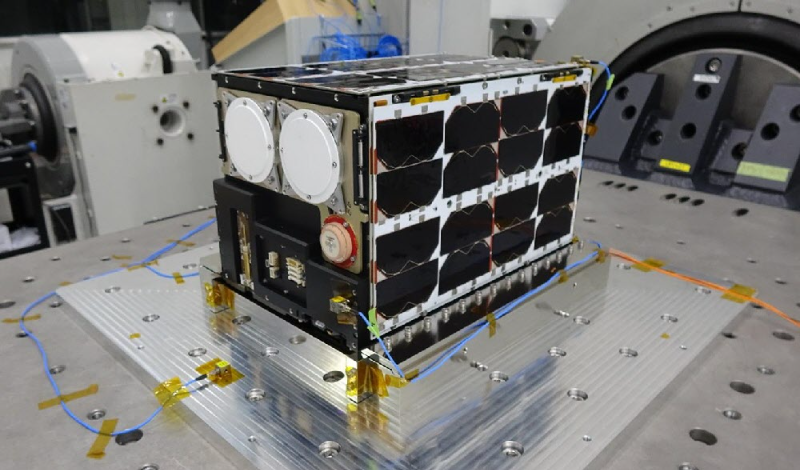
K-RadCube, overseen by the Korea Astronomy and Space Science Institute and equipped with Naraspace’s satellite platform. (Provided by the Korea Aerospace Administration, resale and DB prohibited) 2025.5.2/News1
A Korean artificial satellite will head into space mounted on the rocket for the United States’ crewed lunar exploration project “Artemis II.” It is scheduled to carry out a mission measuring intense ultraviolet rays emitted from the Sun. Samsung Electronics and SK hynix plan to load memory semiconductors onto the satellite to test the effects of the space environment on semiconductors.
The Korea Aerospace Administration and the Korea Astronomy and Space Science Institute announced on the 29th that the CubeSat “K-RadCube,” which will be loaded onto NASA’s Artemis II, has completed all preparations. If the plan proceeds as scheduled, it will be launched on the 6th of next month (local time) from Kennedy Space Center in Florida, United States.
Artemis II is the United States’ first crewed lunar project in 54 years. Four astronauts will board the Orion spacecraft, orbit the Moon, and then return to Earth. K-RadCube will be mounted on the Orion Stage Adapter located directly beneath the Orion spacecraft and will measure space radiation by altitude in the “Van Allen radiation belts,” the regions of strong magnetic fields surrounding Earth. The observation data will be used to analyze the impact of space radiation on astronauts in the transit corridor between Earth and the Moon.
This launch is in accordance with the Korea-U.S. implementation agreement signed in May last year. The Korea Astronomy and Space Science Institute is responsible for development of the radiation-measuring payload and management of operational data, while domestic space startup Nara Space Technology is in charge of developing the satellite bus. In addition to radiation measurement equipment, K-RadCube will also carry memory semiconductors from Samsung Electronics and SK hynix as secondary payloads, in order to verify the effects of the high Earth orbit radiation environment on semiconductors.
After being deployed from high Earth orbit, K-RadCube will use its own propulsion maneuvers to reach its mission orbit, initially raising its perigee altitude to 150 km, and subsequently ascending to about 200 km.
Choi Ji-won
AI-translated with ChatGPT. Provided as is; original Korean text prevails.
ⓒ dongA.com. All rights reserved. Reproduction, redistribution, or use for AI training prohibited.