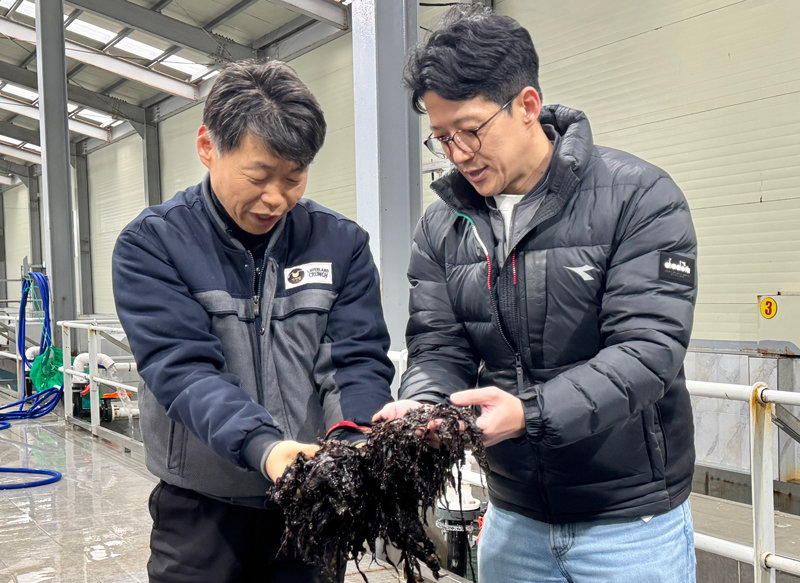
On the 19th at Manjeon Food’s plant in Mokpo, South Jeolla Province, Manjeon Food Executive Director Ko Dae-jun (left) and Lotte Department Store chief seafood buyer Pyo Seung-wan inspect freshly harvested raw seaweed brought in from the sea. Courtesy of Lotte Department Store
At 11 a.m. on the 19th, at the Su-pum Port National Federation of Fisheries Cooperatives auction house in Jindo County, South Jeolla Province, the sound of a whistle signaled the start of the auction. Around 100 middlemen and plant owners converged between about 50 15-ton vessels lined up along the pier. Each boat had just-harvested raw seaweed stacked in 120–150 kg nets, and people grabbed handfuls of seaweed and rubbed it between their fingers to check for foreign matter and texture. Pyo Seung-wan, Lotte Department Store’s chief seafood buyer, who was examining the seaweed on site, said, “The quality of premium seaweed is determined at the raw seaweed stage,” adding, “That is why participation was necessary in the raw material selection process at the auction house in person for planning Lunar New Year gift sets.”
The seaweed sold at auction is transported around 3–4 p.m. to Manjeon Food’s plant in Mokpo, South Jeolla Province. It undergoes a pretreatment process in which the raw seaweed is circulated in seawater tanks for 24 hours, followed by two rounds of foreign matter selection, cutting, and aging. After drying at 40 degrees Celsius for about two hours, dried laver sheets weighing 2.8 g each are produced. The seaweed produced in this way is sold as a premium product through department stores. Manjeon Food Executive Director Ko Dae-jun said, “With rising demand for seaweed, inquiries about premium seaweed at department stores have increased, and more effort is being devoted than before to securing high-quality raw seaweed.”
As seaweed, once the quintessential side dish for ordinary households, has come to be called the “black semiconductor” and has emerged as a flagship K-food export item, department stores are directly entering the premium seaweed market. Ahead of the Lunar New Year holiday, they are rolling out a series of in-house high-priced seaweed gift sets in a bid to capture demand for high-end products.
According to the retail industry on the 27th, Lotte Department Store has launched two types of premium seaweed gift sets for this Lunar New Year under its in-house grocery brand “L’Epicerie.” This is the first time Lotte Department Store has been involved not only in straightforward purchasing but also in the entire process from product planning to raw seaweed selection.
The products are made with “gopchang dol-gim,” harvested only for about 20 days around November, in collaboration with traditional seaweed producer Manjeon Food. Gopchang dol-gim, which has a twisted shape resembling pork intestines (gopchang), is regarded as a raw seaweed variety with less fishy odor and superior sweetness and texture compared with regular seaweed. Prices are set at KRW 120,000 for Set No. 1 (four cans of seasoned seaweed, 45 g each, and six packs of full-sized seasoned sheets, 20 g each) and KRW 85,000 for Set No. 2 (four cans of seasoned seaweed, 45 g each). The strategy is to target the premium market by pricing the sets higher than standard seaweed gift sets, which are typically in the KRW 50,000 range.
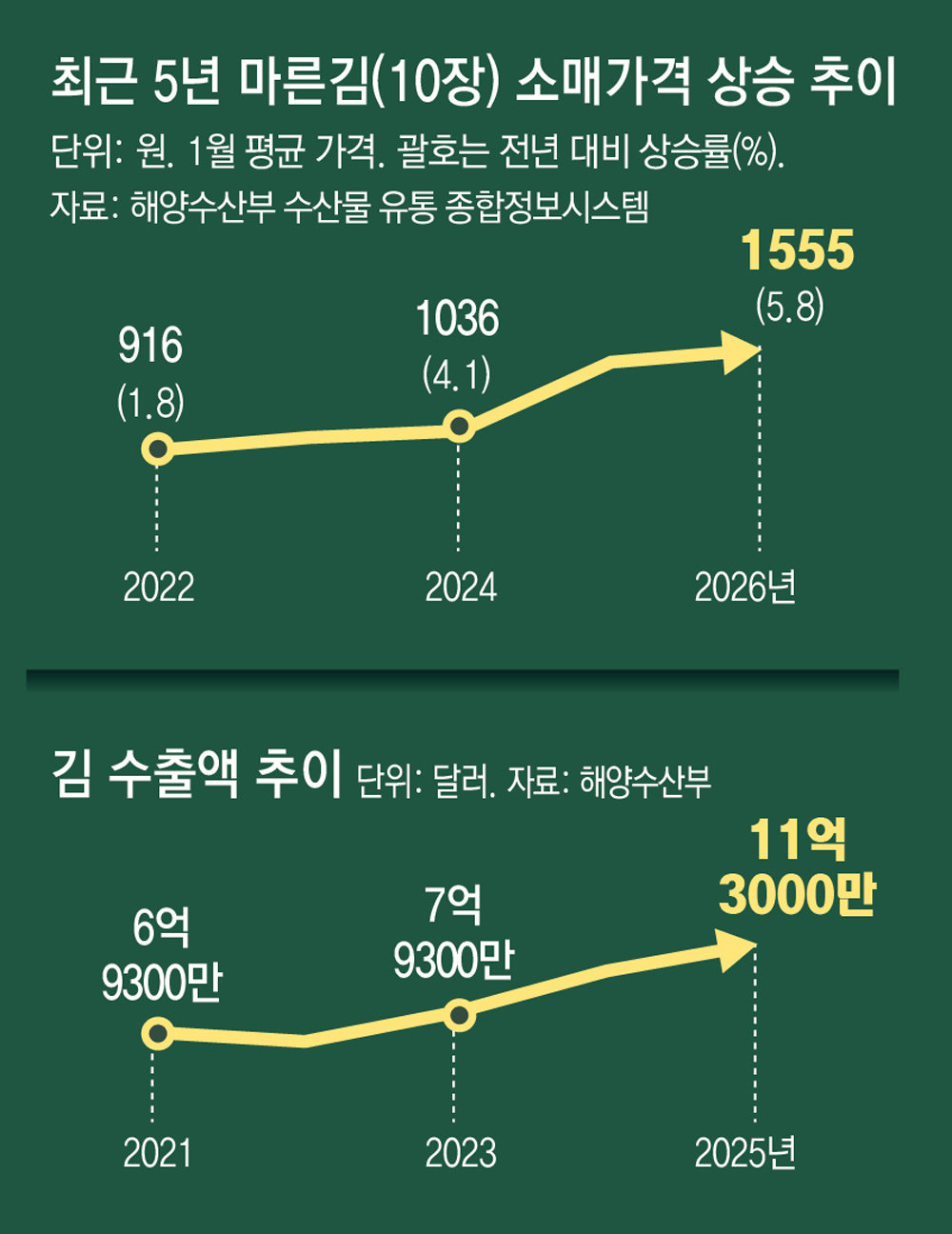
The driving force behind department stores’ leadership in seaweed product planning is the recent surge in the popularity of K-gim. According to the Ministry of Oceans and Fisheries, seaweed exports reached a record high of USD 1.13 billion (approximately KRW 1.6339 trillion) last year. Export volume has increased by more than 60% in four years, from USD 693 million (approximately KRW 1.0023 trillion) in 2021. There are also projections that seaweed export conditions will further improve, as it became the only item among top K-food export categories at the end of last year to receive tariff exemptions in the U.S. market.
Sales of seaweed to foreign customers are also growing every year at domestic department stores. At Lotte Department Store’s main branch, seaweed sales to foreign customers increased 30% year-on-year last year, and the share of foreign customers in seaweed sales expanded from around 3% in 2021 to 30% last year. The number of seaweed products carried rose from 94 in 2020 to 122 last year. As the status of seaweed has risen, domestic retail prices have also surged. According to the Ministry of Oceans and Fisheries’ Fisheries Distribution and Information Service System (aT KAMIS), the average retail price of a 10-sheet pack of dried seaweed was KRW 916 in January 2022 but had risen about 70% to KRW 1,555 as of the 26th of this month. Lee Eun-hee, a professor in the Department of Consumer Science at Inha University, analyzed, “As seaweed has emerged as a key export item and prices have climbed, a premium seaweed market will form separately from the mass-market seaweed segment.”
ⓒ dongA.com. All rights reserved. Reproduction, redistribution, or use for AI training prohibited.
Popular News