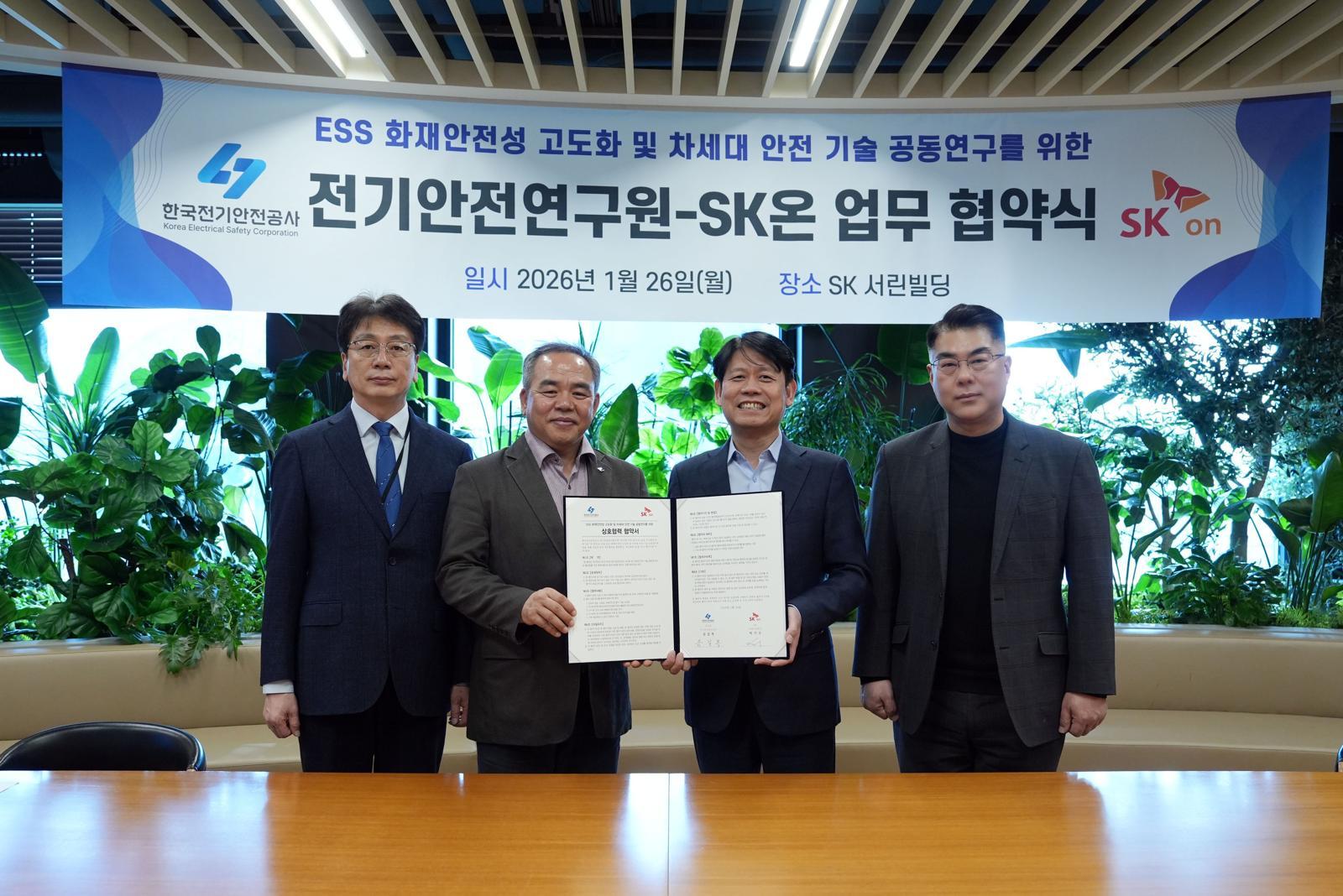
From left: Bang Sun-bae, Head of the Energy Storage Research Center at the Korea Electrical Safety Research Institute; Song Gil-mok, President of the Korea Electrical Safety Research Institute; Park Ki-soo, Head of the Future Technology Institute at SK On; and Kim Tae-ui, Head of ESS Sales at SK On, pose for a commemorative photo after signing a business agreement for “Advanced ESS Fire Safety and Joint Research on Next-generation Safety Technology” at the SK Seorin Building in Jongno-gu, Seoul, on the 26th.
SK On announced on the 27th that it signed a memorandum of understanding (MOU) with the Korea Electrical Safety Corporation’s Electrical Safety Research Institute at the SK Seorin Building in Jongno-gu, Seoul, on the 26th for “Advanced ESS Fire Safety and Joint Research on Next-generation Safety Technology.” The agreement aims to strengthen fire safety for energy storage systems (ESS).
Attending the signing ceremony were Song Gil-mok, President of the Electrical Safety Research Institute; Baek Kyung-rae, Head of Research Planning; and Bang Sun-bae, Head of the Energy Storage Research Center, along with Park Ki-soo, Head of the Future Technology Institute at SK On; Park Cheol-beom, Head of Future Technology Strategy; Choi Sang-gyu, Head of ESS Cell Development; Kim Tae-ui, Head of ESS Sales; and Yoon Young-doo, Head of Growth Support at SK Innovation.
The two organizations will cooperate on advancing ESS fire safety research and evaluation technologies, conducting joint research on new battery materials, and establishing an international cooperation network centered on G-SAFE (Global Safety Alliance Forum for Electric Grids and Energy Storage).
SK On will use the infrastructure of the Energy Storage Research Center at the Electrical Safety Research Institute to enhance verification levels for next-generation safety technologies. Electrochemical impedance spectroscopy (EIS) is a diagnostic technology that sends alternating current signals of various frequencies into a battery to identify internal resistance and reaction characteristics. Unlike conventional battery management systems (BMS), which monitor the temperature of only some cells, EIS can detect internal changes across all battery cells. Immersion cooling is a technology that suppresses temperature rise inside the pack by submerging battery cells in a non-conductive coolant.
The Energy Storage Research Center in Wanju, Jeollabuk-do, completed at the end of last year, can verify ESS performance and safety in extreme environments ranging from -40 degrees Celsius to 80 degrees Celsius.
The two organizations will also promote joint research on new material development, including improving the performance of existing LFP (lithium iron phosphate) batteries. The two sides have continued exchanges across ESS and battery safety technologies, including an SK On Daejeon Future Technology Institute tour held during the first G-SAFE event, hosted by the Electrical Safety Research Institute last year.
Song Gil-mok, President of the Electrical Safety Research Institute, said, “Through technological cooperation that encompasses safety evaluation in the ESS sector and responses to international standards, we will take the lead in restoring the domestic ESS industry ecosystem and achieving global technological leadership.”
Park Ki-soo, Head of the Future Technology Institute at SK On, said, “Safety and technology are the core of ESS competitiveness,” adding, “By advancing next-generation safety technologies while expanding collaboration with the domestic ESS ecosystem across infrastructure, materials, and components, we will contribute to the growth of the battery industry.”
SK On’s ESS batteries incorporate both preventive and post-incident measures. The company has applied an EIS-based diagnostic technology—an industry first—that detects early warning signs to identify fire risks at least 30 minutes in advance, and enables only the modules with abnormal signs to be separated and replaced like blocks.
Post-incident measures include a thermal spread prevention solution using thermal barriers and cooling plates; an explosion prevention solution with a dual safety mechanism combining a ventilation system and explosion panels; and an immersion system in which coolant is injected directly into the interior of the modules.
Meanwhile, SK On plans to establish the country’s largest ESS battery production line with an annual capacity of 3 GWh this year by converting a line at its plant in Seosan, Chungcheongnam-do. The company also intends to take the lead in building a domestic LFP battery supply chain ecosystem by localizing key materials such as cathode materials, separators, and electrolytes used in ESS LFP batteries.
ⓒ dongA.com. All rights reserved. Reproduction, redistribution, or use for AI training prohibited.
Popular News