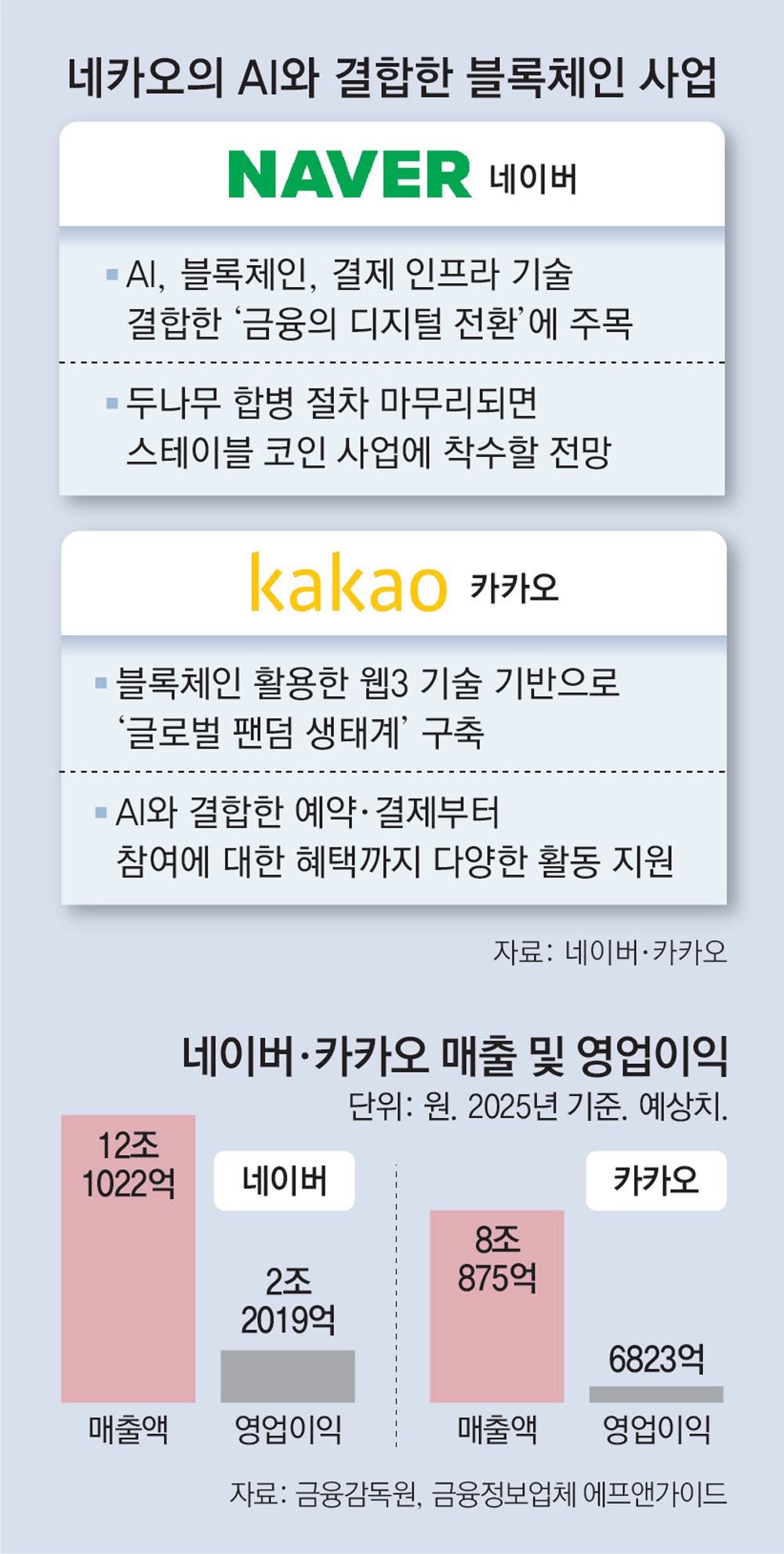
The KOSPI has been setting new all-time highs day after day, ushering in the 5,000 era. However, Naver and Kakao, once regarded as “national stocks,” have been relatively sluggish and are receding from investors’ attention. Earnings are not in bad shape, with the combined annual revenue of the two companies expected to surpass KRW 20 trillion for the first time last year, and Naver and Kakao are seeking to restore their reputations this year. Both companies are pursuing a strategy that emphasizes “growth” by combining artificial intelligence (AI)-based services with Web3 (a decentralized internet based on blockchain and related technologies).
Naver is first focusing on “digital transformation” that integrates AI, blockchain, and payment infrastructure technologies. It plans to build a financial technology ecosystem that links AI and Web3 by combining the capabilities of Naver Financial, which handles annual payment volumes of KRW 80 trillion, and Dunamu, a leading blockchain technology company.
Naver is expected to begin full-scale operations in the stablecoin business once the merger procedures between Naver Financial and Dunamu, the operator of Upbit, are completed in the first half of this year. While specific plans will be announced after the merger, the industry predicts the emergence of “reward mechanisms” that automatically calculate compensation via blockchain whenever creators’ content such as “webtoons” or “video” is consumed, as well as “on-chain AI agents” that assist with content ownership management. This would inevitably be an attractive mechanism for content creators.
“Commerce” will also change. Naver plans to introduce this year a user-customized AI agent platform called “AgentN.” The AI shopping agent will be applied to Naver Plus Store. As stablecoins are increasingly likely to become a key means of payment in the commerce domain, Naver’s strategy is to move quickly to secure the market.
Kakao has also identified “AI” and a “global fandom OS” as its key growth pillars for this year. The company intends to maximize the strengths it has gained from “KakaoTalk,” the national app with 50 million users. Chairwoman Jung Shin-a stressed that “AI will evolve from a tool that simply executes commands into agentic AI that first understands users’ intentions and circumstances and then connects them to their next actions.”
The strategy is to combine that AI with a global fandom ecosystem that supports a wide range of activities, from reservations and payments to benefits for participation. Kakao Entertainment, which produces and distributes intellectual property (IP) such as music, webtoons, video, and performances, is slated to play a central role. As the scale of fandom-related transactions has expanded recently, issues have emerged in the scalping and resale markets, but the use of blockchain-based Web3 technology is expected to enable a transparent and fair trading structure. For example, when purchasing concert tickets or merchandise for singer IU, the transactions would be supported in a Web3 environment.
According to Kakao, the global fandom OS is not simply an expansion of the entertainment business. The plan is to create a technology-based “global fandom ecosystem” by leveraging Kakao’s assets, including IP and platforms that connect fans and artists. The core infrastructure will be Web3, using blockchain. The vision is for Web3 to encompass everything from reservations and payments handled by AI agents to benefits for fan participation.
ⓒ dongA.com. All rights reserved. Reproduction, redistribution, or use for AI training prohibited.
Popular News