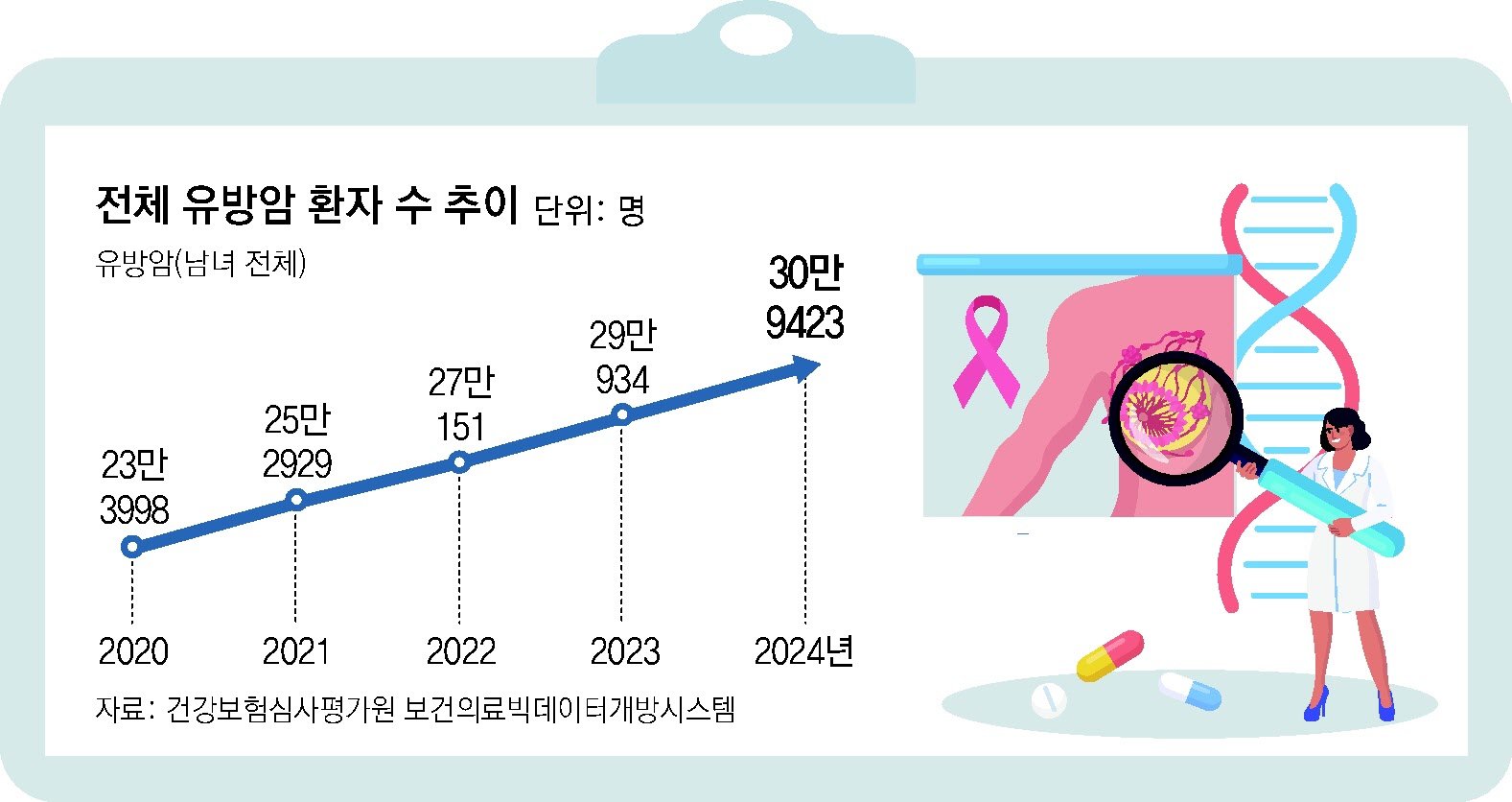
According to the recently released “2023 National Cancer Registration Statistics,” breast cancer is the cancer with the highest prevalence among women, with 29,715 patients diagnosed in a single year. Breast cancer occurs most frequently in women in their 40s and 50s, who are often at the center of family life and active in society, resulting in substantial losses not only for individual patients but also for society as a whole.
The 5-year survival rate for breast cancer exceeds 90%, and it is often referred to as a “good cancer.” This is because, when detected early, treatment close to complete cure is possible.
However, this represents only a very small part of the many faces of breast cancer. Once the disease progresses to the stage of “distant metastasis,” in which cancer cells spread to other organs, the situation changes completely. The 5-year survival rate for metastatic breast cancer drops sharply to 50.4%. Depending on the stage of disease progression and the patient’s individual genetic characteristics, breast cancer can present a completely different picture, ranging from a “90% survival rate” to “half the survival rate.”
Even a “good cancer” becomes dangerous with gene mutations and metastasis About 70% of all breast cancer patients fall into the type that is hormone receptor–positive (HR+) and human epidermal growth factor receptor 2–negative (HER2-). This type has been regarded as a “manageable cancer,” as prognosis has been favorable when hormone therapy is combined with targeted anticancer drugs.
However, recent studies show that in about half of patients with this type, specific gene mutations such as “PIK3CA,” “AKT1,” and “PTEN” are present. Once these mutations occur, previously indolent cancer cells transform into cells with completely different characteristics.
In normal cells, a braking system that controls growth is in operation, but PIK3CA and AKT1 mutations are characterized by dramatically stepping on the accelerator pedal of cancer cell growth. In addition, PTEN mutations completely break down the braking function that should suppress cancer proliferation. When such metastasis and genetic mutations overlap, breast cancer enters a highly dangerous state, like a runaway train with its brakes broken.
“Personalized second-line treatment” is key to improving survival Currently, for this type of metastatic breast cancer, targeted anticancer agents or hormone therapy are used as standard first-line treatments. In actual clinical practice, however, many patients fail treatment due to resistance, and about 50% of patients with metastasis die within five years of diagnosis.
To address this, the medical community has recently focused on finding personalized strategies at the second-line treatment stage that take genetic mutations into account. With the emergence of new second-line treatment options such as “capivasertib,” which directly inhibit the malfunctioning brake system associated with PIK3CA, AKT1, and PTEN mutations, treatment technology is evolving to a new level.
Professor Son Joo-hyuk of the Division of Medical Oncology at Yonsei Cancer Center said, “Gene mutations identified in half of patients are equivalent to a state in which the control mechanism for cancer cell survival is no longer functioning,” adding, “Even if the type appears to have a good prognosis on the surface, if genetic mutations are present, it is in fact a high-risk group with rapid disease progression and a high likelihood of resistance.” He continued, “If treatment is not swiftly switched to a mutation-targeted therapy once resistance develops after first-line treatment, there are limits to improving survival,” emphasizing, “Now that the latest treatments are available, improving patients’ access to therapy, including through coverage under the National Health Insurance, is a remaining task for society.”
ⓒ dongA.com. All rights reserved. Reproduction, redistribution, or use for AI training prohibited.
Popular News