Beyond use in manufacturing and services… deploying robots in all areas that can replace human labor
Building on software capabilities accumulated on the factory floor
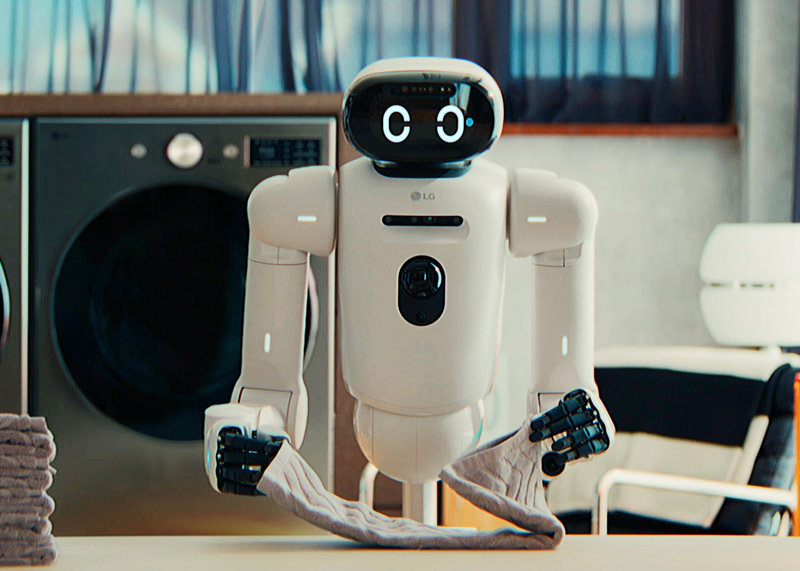
Home robot CLOi, capable of delicate tasks… aiming for a robot that does housework like a person
Home-use robot
“I’m hungry. Please prepare some spaghetti.” On the way home after work. After a full day of heavy workload, there is no energy left to prepare a meal, but a single spoken sentence solves everything. The household robot maid at home independently determines what ingredients are needed and begins cooking. It opens the refrigerator, takes out ingredients one by one, washes and prepares them, then places them in the oven and quickly completes cheese oven spaghetti. It sets the table with dishes and the food it has cooked to coincide with the time the user arrives home.
This is the image of an artificial intelligence (AI) robot in the future home envisioned by LG Electronics. LG Electronics has focused on AI robot development with the goal of “zero labor,” a life free from mundane daily tasks. The company aims to reduce reliance on human labor not only in factories and restaurants, but also in the home.
This is why LG Electronics declared its entry into the home robot market by unveiling LG CLOiD at “CES 2026,” the world’s largest information technology (IT) and home appliance exhibition, held this month. LG Electronics Chief Executive Officer (CEO) Ryu Jae-cheol described CLOiD as “the final puzzle piece of the AI home and ‘zero-labor’ home that LG Electronics pursues.”
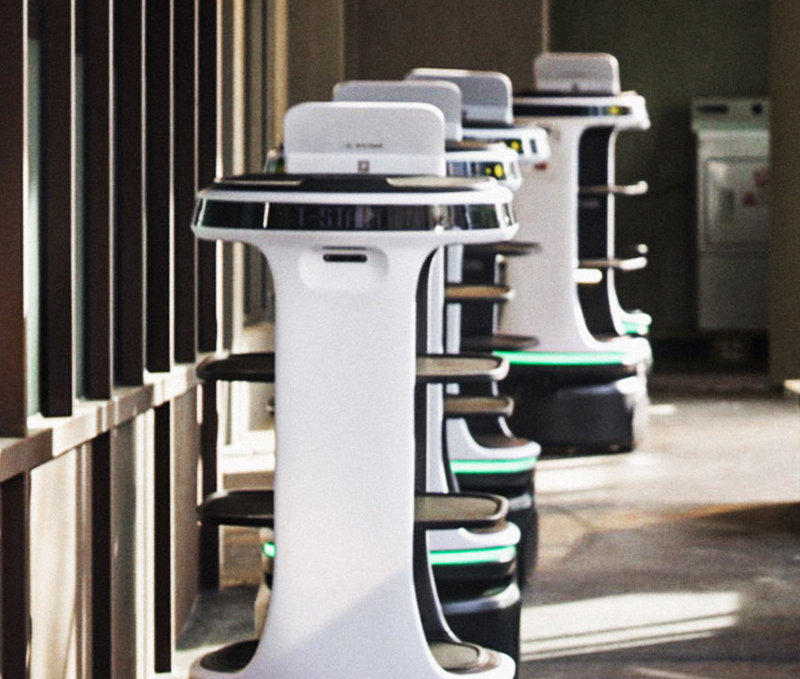
Commercial robot
Building on the technological capabilities accumulated in existing industrial and commercial robots, LG Electronics is expanding its AI robot manufacturing portfolio into home-use robots. By pushing robots to the forefront not only on manufacturing sites but also as “products,” expectations are rising that the “era of robots making robots” is drawing closer.
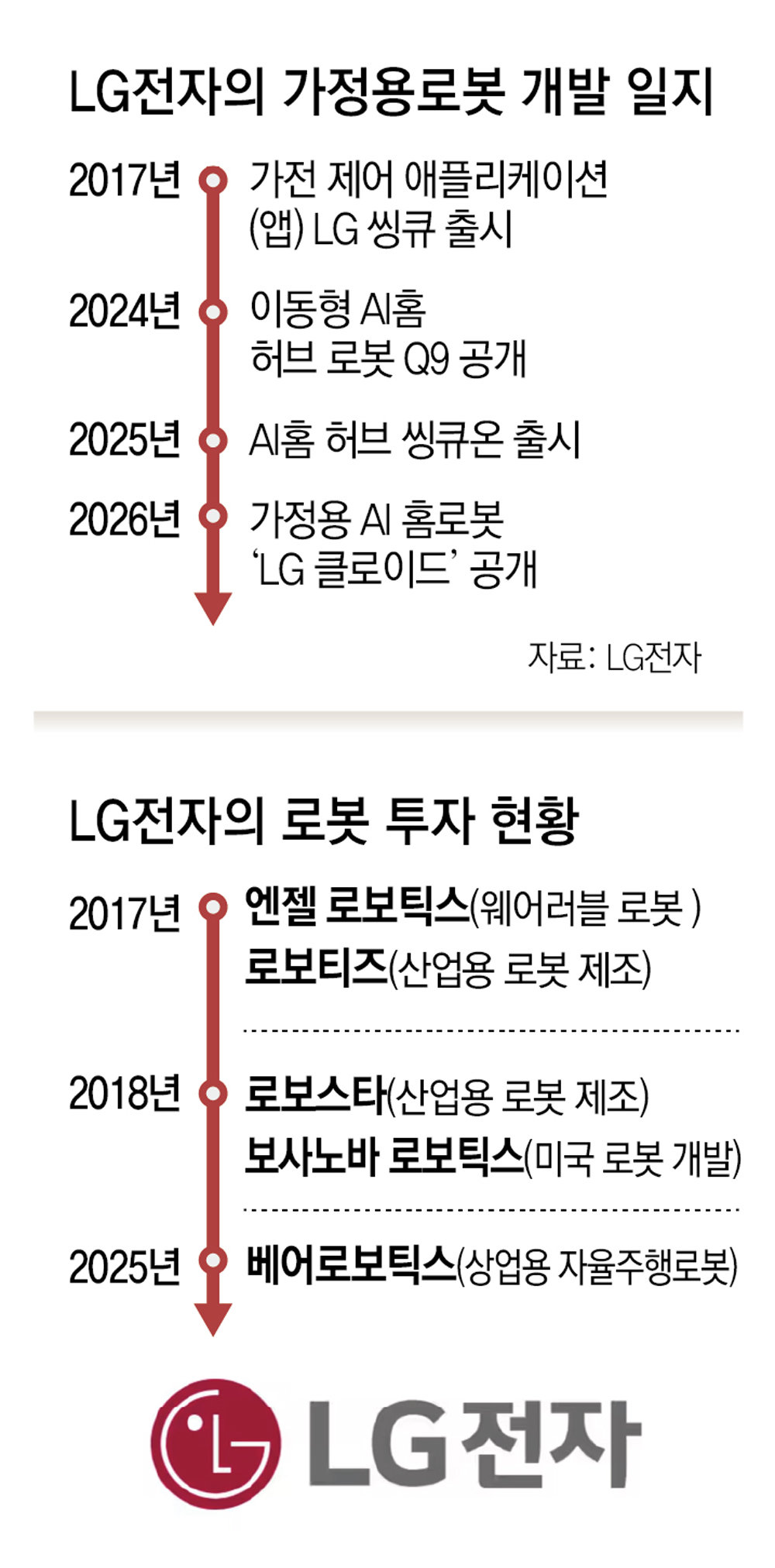
● Robot technologies accumulated in industrial and commercial marketsThe home robot CLOiD was created based on the technological capabilities LG Electronics has accumulated over a long period through industrial and commercial robots. LG Electronics entered the robot business in 2017 by investing in shares of the domestic industrial robot manufacturer “Robotis.” In the same year, it also launched “LG ThinQ,” an application (app) that enables users to control home appliances with a smartphone. This can be considered the first puzzle piece of CLOiD. Robotis, in which LG Electronics is currently the second-largest shareholder, is a specialized company in actuators (power drive devices) that serve as the joints of robots and contributed to the development of CLOiD. In fact, CLOiD’s arms contain seven actuators and its hands about 20. The more actuators a robot has, the more diverse and delicate the tasks it can perform. CLOiD can rotate its shoulders and wrists, move them forward and backward and from side to side, and bend and straighten its elbows.
LG Electronics has steadily expanded its robot ecosystem, acquiring the industrial robot arm specialist “Robostar” in 2018 and securing management control of the commercial autonomous mobile robot company “Bear Robotics” last year.
Industrial and commercial robots have successfully been commercialized and are now on track. In particular, since 2023, when generative AI began in earnest, LG Electronics has been using AI to train robots and improve efficiency. Logistics robots are a representative example. Until now, logistics robots mainly played the role of simply transporting products and parts and delivering them to humans. Now, they are being directly deployed into production lines and participating in product assembly processes.
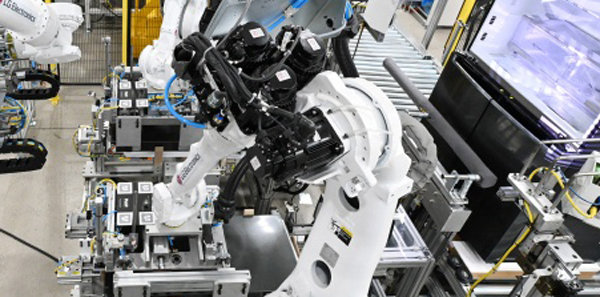
Baek Byung-joo, CEO of Robostar, said, “As robots are increasingly able to perform tasks without human involvement, lead time (the time from order to delivery) has been significantly reduced and process efficiency has improved,” adding, “In the past, humans had to teach robots a variety of scenarios and samples one by one, but AI now performs this role instead, improving the robots’ speed and accuracy across the board.” Industrial robots produced by LG Electronics are actually being used not only by LG Electronics but also at various sites of LG Group affiliates such as LG Display and LG Energy Solution.
● Is the era of robots making robots coming?
Industrial robot
The industrial and commercial robot technologies accumulated by LG Electronics to date are expected to be applied to home robots and create synergies. For example, when CLOiD brings a glass of water to a person at home or prepares food ingredients, it can use technologies from industrial robots. Home robots must move delicately so as not to break a glass or damage ingredients, and this is where industrial robot technologies such as screw fastening and parts assembly come into play.
In addition, CLOiD must be able to control home appliances such as running the washing machine and operating the oven. For commercial robots as well, integration with surrounding devices is key, such as autonomously taking elevators to move between floors. Technologies for reliably controlling other devices in commercial spaces are being utilized in home robots. Bear Robotics, an LG Electronics affiliate, has strengths in robot software (SW) technology and can generate synergies in this area.
There are also expectations for the use of industrial robots in the mass production phase of CLOiD. As LG integrates AI into manufacturing sites across its affiliates, industrial robots could contribute to making home robots, generating additional synergies.
Home robots are particularly regarded as a high-difficulty field that comes after industrial and commercial robots. In factories and restaurants, surrounding facilities and robot routes are standardized, so variables such as movement paths are limited. In contrast, homes differ significantly in family composition, lifestyle patterns, interior structure, and furniture layout, resulting in far more variables that must be addressed. An LG Electronics official said, “Households may include children, the elderly, and pets that require meticulous attention, so home robots must be especially mindful of safety issues.” LG Electronics plans to begin on-site pilot applications of CLOiD as early as next year.
ⓒ dongA.com. All rights reserved. Reproduction, redistribution, or use for AI training prohibited.
Popular News