Pursuing five projects for a “future-oriented safe city” to shift to a prevention-centered management system
Introducing a “prediction and maintenance system” within two years
Forecasting early signs of battery explosion accidents in industrial complexes
Training personnel to respond to industrial and natural disasters
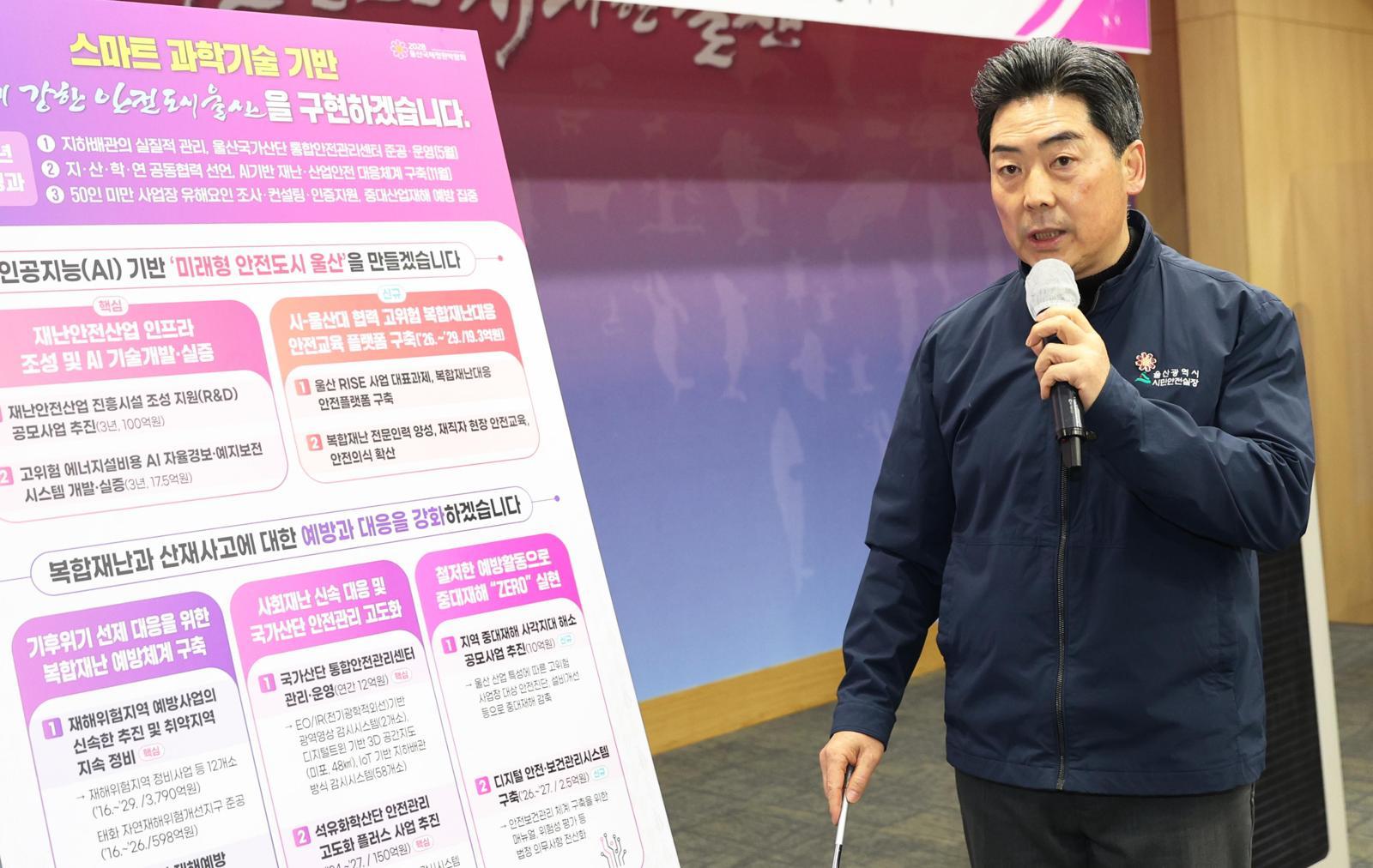
Ulsan Metropolitan City is introducing artificial intelligence (AI) for “citizen safety.” Park Soon-cheol, Director General for Citizen Safety of Ulsan City, is holding the 2026 New Year press briefing at the City Hall press center on the 22nd, explaining this year’s key initiatives. Provided by Ulsan City
Ulsan Metropolitan City will introduce artificial intelligence (AI) technology for integrated disaster response to natural and industrial disasters. The aim is to shift from accident-handling-oriented “post-incident safety management” to a “prevention-centered management” system that predicts and manages disaster response risks.
Ulsan City announced on the 27th that it will implement a “2026 Future-Oriented Safe City Construction” plan, centered on AI-based safety policies.
Ulsan is an industrial-residential mixed city where national industrial complexes and general industrial complexes in sectors such as automobiles, shipbuilding, petrochemicals, and nonferrous metals are clustered together with large-scale commercial and residential areas. Safety accidents such as explosions and fires occur continuously, and because it is difficult to predict when accidents will happen, citizens’ anxiety has been high.
In response, Ulsan City will push forward in earnest with five core new projects led by AI technology. First, by 2028, it will establish an “AI Predictive Maintenance System” for high-risk energy facilities and major industrial facilities. Ulsan has a high concentration of battery installations such as energy storage systems (ESS) and electric vehicle (EV) charging stations, leaving it exposed to the risk of thermal runaway in lithium-ion batteries. In addition, demand for ESS is expected to increase further with the expansion of AI data centers. Once the AI predictive maintenance system is completed, it is expected to drastically reduce the likelihood of accidents by achieving 95% accuracy in early fire-sign detection and a warning transmission success rate of 98% or higher.
The city will also seek to attract a government-funded project worth KRW 10 billion to establish an “AI Heatwave Prediction Center and Promotion Facility” in response to the climate crisis.
Safety management in national industrial complexes will likewise identify risk factors at an early stage through real-time monitoring and analysis using digital technology, with plans to improve the speed and accuracy of response.
The city will also strengthen its response capabilities to increasingly severe natural disasters. It will continue projects to improve disaster-prone areas in preparation for more frequent heatwaves and typhoons due to climate change, and will expand citizen-experienced preventive projects to focus on minimizing casualties.
Alongside building the disaster response system, the city will also foster professional personnel. In cooperation with the University of Ulsan, it has decided to strengthen training for complex disaster response, assuming situations in which industrial and natural disasters occur simultaneously. The plan is to enhance disaster response capabilities through field-practice-oriented education.
Digital safety and health systems will be introduced in safety-vulnerable sectors such as small workplaces to eliminate blind spots in local safety and to pursue the goal of achieving “zero” serious industrial accidents.
The Ulsan Fire Headquarters will also support disaster response. To advance disaster response, it plans to establish an AI-based drone rescue and search system by this year. From this year, it will operate a priority traffic signal system for emergency vehicles to secure the golden time, and will build an Internet of Things (IoT)-based integrated management system for firefighting water supplies carried by fire trucks, thereby increasing on-site response efficiency through smart technologies.
Park Soon-cheol, Director General for Citizen Safety of Ulsan City, stated, “With the goal of making Ulsan a future-oriented safe city based on AI, the city will expand support for the development and demonstration of systems that predict and respond to disaster risks more quickly and more accurately.”
ⓒ dongA.com. All rights reserved. Reproduction, redistribution, or use for AI training prohibited.
Popular News