“Full-scale business development for clinical validation and commercialization of AI-based pain prediction technology”
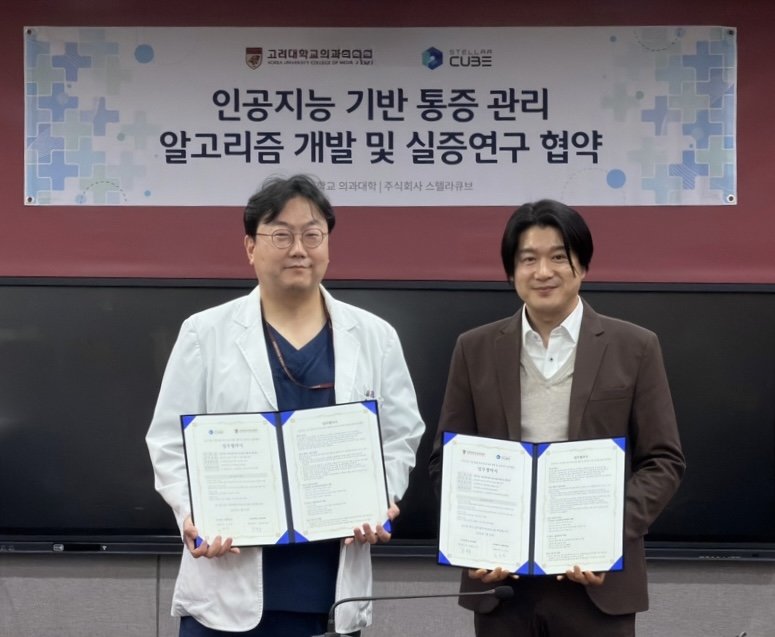
Professor Kim Hee-jung (left) of Korea University College of Medicine and Stellarcube CEO Noh Jin-seop. Photo provided by Stellarcube
AI health-tech company Stellarcube has signed a main contract with the research team of Professor Kim Hee-jung at Korea University College of Medicine (Anam Hospital) to develop and conduct empirical research on an artificial intelligence-based pain management algorithm.
This main contract is intended to fully launch clinical research and commercialization of Stellarcube’s AI pain management solution “PainX.” The two institutions plan to cooperate on the joint development and validation of AI-based pain prediction technology using continuous biosignals and electronic medical records.
Professor Kim, a specialist in cardiovascular and thoracic surgery, serves as principal investigator for multi-center registries in Korea and abroad and oversees the establishment and advancement of a nationwide medical data ecosystem. Through AI time-series analysis and multimodal research in collaboration with the National Health Insurance Service, he has continuously explored the practical clinical application of medical information technology. Building on this, he is in charge of designing and clinically validating next-generation AI clinical decision support models that utilize high-resolution biosignal waveform data.
PainX analyzes various biosignals in real time, including electrocardiogram (ECG) and photoplethysmogram (PPG), to address the limitations of conventional pain management methods that have depended on patients’ subjective descriptions and the clinical experience of medical staff. The goal is to implement an AI-based pain management solution that quantitatively predicts pain status and supports diagnostic and medication decision-making.
Going forward, Professor Kim’s team will be responsible for △conducting clinical studies and collecting medical data △joint development and clinical validation of pain prediction algorithms and provision of medical advisory services △publication of academic papers and dissemination of research findings.
The clinical research will be conducted using a platform capable of collecting and analyzing biosignals from intensive care unit and post-surgery patients in real time. Through this, the project will comprehensively collect and analyze continuous physiological waveform data and medical data from post-surgery patients and, based on these data, carry out the PainX project to predict the occurrence and worsening of postoperative pain. The project aims to verify the clinical validity and applicability of the AI pain prediction algorithm by utilizing high-resolution medical data accumulated in actual clinical settings.
Professor Kim stated, “Despite being a very important indicator in clinical settings, pain has long been an area where systematic management is difficult because it relies on subjective assessment,” adding, “Through this collaboration, we expect to verify the potential of pain prediction technology based on real clinical data and to propose a new pain management paradigm that can support medical staff in their decision-making.”
Stellarcube will lead △research funding support △joint development and implementation of AI algorithms and software △establishment and execution of commercialization strategies △preparation for medical device regulatory approval and productization △intellectual property management and commercialization.
Stellarcube CEO Noh Jin-seop said, “With the signing of this main contract, we have established a cooperative framework to validate and advance Stellarcube’s AI pain prediction technology in real clinical environments,” and added, “We expect to enhance the technical completeness of PainX based on clinically validated medical data and to accelerate the commercialization and market entry of the AI-based pain management solution.”
ⓒ dongA.com. All rights reserved. Reproduction, redistribution, or use for AI training prohibited.
Popular News