Korea Aerospace Administration designates “friction stir welding” as a new space technology
Supply system for the physical AI market now in place
Monolithic structure reduces weight, boosting expected efficiency
Precision engineering solutions specialist NDT Engineering has recently had its new welding technology, which reduces the weight of space launch vehicles, recognized as a “New Space Technology” by the Korea Aerospace Administration, and is now moving to target the “Physical AI” market, including robotics and urban air mobility (UAM).
On 20 January, the Korea Aerospace Administration selected five innovative technologies with technological competitiveness and market potential in the satellite, launch vehicle, and space observation and exploration sectors as the first set of New Space Technologies. NDT Engineering’s friction stir welding (FSW) technology was recognized in the launch vehicle manufacturing field.
Unlike conventional welding, which joins metals by melting them, friction stir welding softens solid-state metal using frictional heat and then stirs it together to form a joint. With low thermal distortion and uniform joint quality, it has strengths in manufacturing precision structures that use lightweight materials. As a manufacturing process technology that simultaneously secures weight reduction and structural reliability for launch vehicle propellant tanks, it is expected to enhance the competitiveness of launch vehicles.
NDT Engineering plans to fully activate its supply system targeting the Physical AI market based on its technological capabilities. Its “monolithic structure” technology, based on friction stir welding, integrates the structure into a single body without rivets or screws, reducing the airframe weight by around 20% while maintaining the strength of the joints at the level of the base material. As a result, it is assessed as a solution that can break through the “physical limits” of Physical AI by increasing the payload capacity (maximum weight a robot can lift) of robots, improving energy efficiency, and extending operating time.
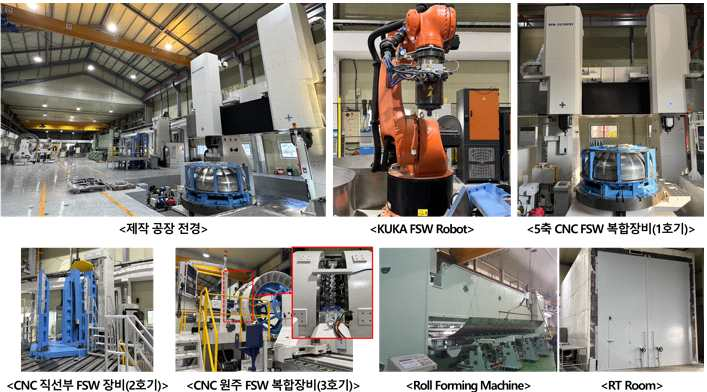
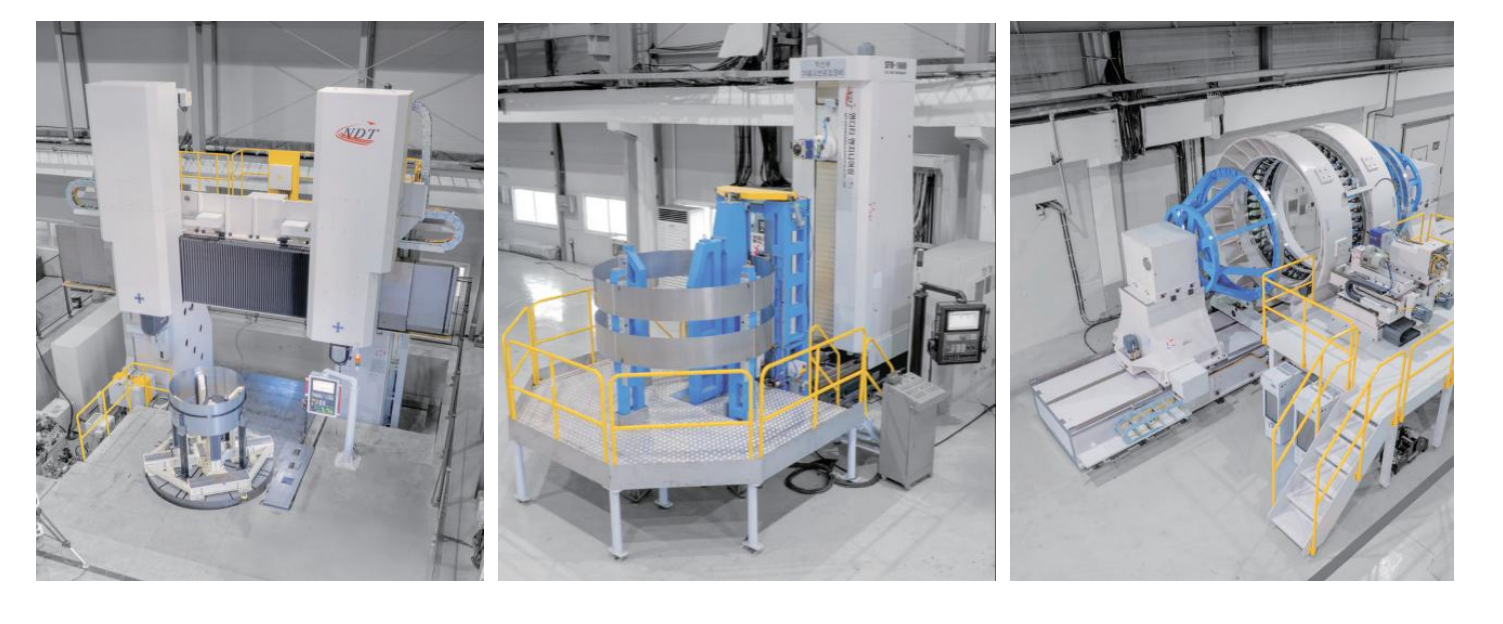
NDT Engineering has already completed the construction of large-scale smart manufacturing infrastructure that can be immediately applied to industry. At its Changwon plant in Gyeongnam Province, the company has established an automated smart manufacturing line equipped with 5‑axis CNC friction stir welding compound machines, dedicated large-cylinder joining equipment, and friction stir welding (FSW) robots. By internalizing the entire process from design through precision machining, mass production, and non-destructive testing (RT), it has built a system capable of swiftly producing and supplying high value-added structures, such as robot frames, on a make-to-order basis.
In the UAM sector, which is attracting attention as a future mode of transportation, the company is expected to contribute to safety by using seamless leak-proof structures to reduce the risk of battery coolant leakage or fuel leakage. In the semiconductor equipment industry, it is also highly regarded for its potential applicability in improving equipment precision through ultra-lightweight, high-rigidity integrated frames that simultaneously suppress weight and vibration.
NDT Engineering is also considering measures to expand its mainstream consumer interface. To this end, it recently signed a stock purchase agreement to acquire shares of NHN and NHN Bugs, becoming the largest shareholder of NHN Bugs.
Regarding this, NDT Engineering CEO Lim Ki-hyun said, “The broad public recognition that Bugs has accumulated is a meaningful asset for expanding the touchpoints where technology meets people,” adding, “We want to demonstrate the potential for precision engineering technology to be communicated in a more familiar way.” The company plans to disclose specific business details once the transaction is finalized.
ⓒ dongA.com. All rights reserved. Reproduction, redistribution, or use for AI training prohibited.
Popular News