K-fashion and K-beauty: Flagship store boom in foreigner-packed hotspots
Musinsa opens back-to-back stores in Hongdae and Seongsu
Kolon Sports launches its first large-format store in Myeong-dong
APR unveils an experiential space in Seongsu-dong
K-fashion and K-beauty companies are successively opening flagship stores (large standalone stores) to attract foreign tourists. With the number of foreign visitors to Korea this year expected to exceed 20 million, their strategy is to draw experience-oriented tourists into stores to simultaneously enhance brand image and increase sales.
According to the fashion industry on the 25th, domestic fashion companies have recently been opening flagship stores one after another in Seoul’s Jung-gu Myeong-dong, Seongdong-gu Seongsu-dong, and the Hongdae area in Mapo-gu, where tourists are concentrated. Musinsa plans to operate “Musinsa Store” in Myeong-dong, regarded as the No. 1 destination for travel in Korea, starting from the 30th. In the first half of the year (January–June), it will open “Musinsa Kicks” and “Mega Store” in Seongsu-dong, a district favored by young travelers. Musinsa currently operates 11 stores in major tourist commercial districts such as Seongsu, Myeong-dong, and Hongdae, with foreign customers accounting for about half of sales at these locations.
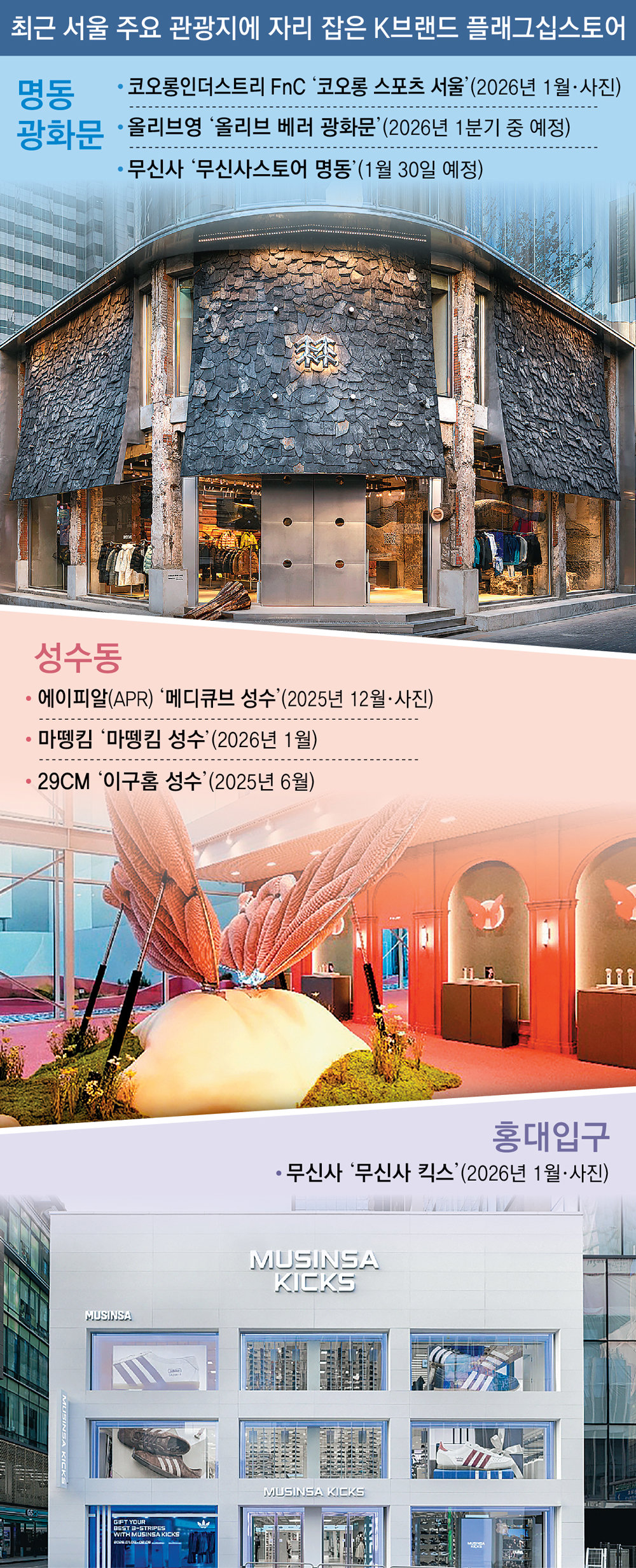
As a “K-hiking” boom among foreigners since last year has heightened interest in Korean hiking wear, outdoor brand Kolon Sport opened its first flagship store “Kolon Sport Seoul” in Myeong-dong this month. The store attracted 15,000 visitors in the first two weeks after opening, with foreign sales accounting for 80%, clearly benefiting from tourist demand.
K-beauty companies are also pursuing differentiation by foregrounding experiential stores. Beauty company APR opened “Medicube Seongsu” on Yeonmujang-gil in Seongsu-dong in December last year, introducing a next-generation beauty experience space. Foreign customers are reported to account for about half of total sales in the first month after opening. CJ Olive Young plans to launch “Olive Better,” a conceptually different format from its existing stores, in Gwanghwamun and Gangnam in the first quarter of this year (January–March).
The expansion of flagship stores by domestic companies is underpinned by changes in foreign consumer spending patterns. Compared to online, foreign tourists place greater weight on offline experiences and impulse purchases, making large stores located along tourism routes both sales channels and brand promotion tools. In addition, flagship stores function not merely as sales spaces but also as testbeds that verify the responses of consumers from around the world. An industry insider said, “Flagship stores are effectively global showrooms that precede overseas expansion,” adding, “They have significant strategic value in that companies can adjust products, prices, and concepts based on foreign customers’ reactions and data.”
With the number of foreign tourists expected to increase year-on-year, the number of flagship stores is also projected to rise. Yanolja Research recently stated at a seminar that the number of inbound foreign tourists to Korea this year is expected to reach 20.36 million, up 8.7% from the previous year (18.73 million). By country, the projected number of tourists is highest from China (6.15 million), followed by Japan (3.84 million), Taiwan (1.93 million), and the United States (1.66 million). Hong Sung-gyu, head of business strategy at Nol Universe, said, “K-content such as beauty and music is a proven tourism product,” and added, “Companies will seek to secure brand influence by meticulously designing travelers’ offline experiences and routes.”
ⓒ dongA.com. All rights reserved. Reproduction, redistribution, or use for AI training prohibited.
Popular News