Korean stock market tops 5,000 intraday for the first time in 70 years
Driven by semiconductors, AI, autos, defense, and shipbuilding
Samsung Electronics’ market cap surpasses KRW 1,000 trillion, 3rd in Asia
“A turning point for easing the Korea discount… sustained gains hinge on supporting economic growth”
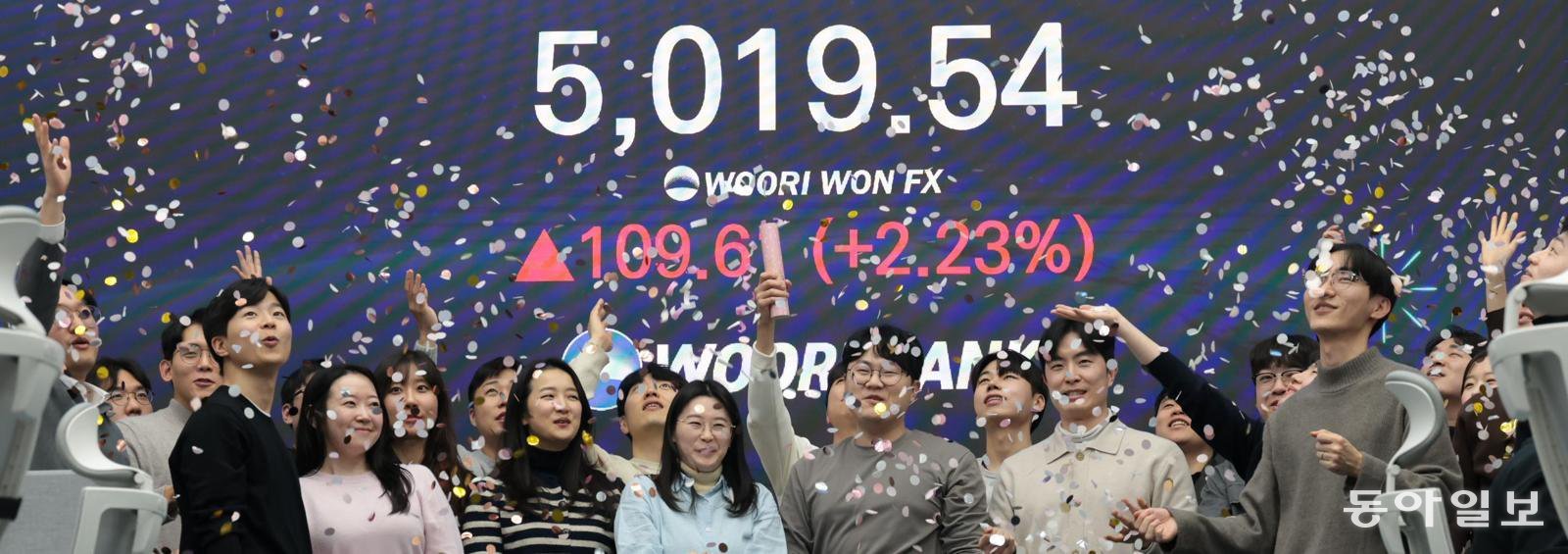
Intraday all-time high ‘5019’ recorded – Employees gathered in the dealing room of Woori Bank in Jung District, Seoul, on the 22nd to celebrate the advent of the ‘KOSPI 5,000 era.’ On this day, the KOSPI rose to an intraday all-time high of 5,019.54. Photo by Park Hyung-ki, oneshot@donga.com
The KOSPI surpassed 5,000 intraday for the first time in history on the 22nd. This marks a new summit 70 years after the official launch of the Korean stock market in 1956 and 43 years after the KOSPI was first calculated in 1983. Strong earnings by large corporations in key industries such as semiconductors have driven the index higher, and some analysts say this has created momentum to resolve the long-standing “Korea discount” (undervaluation) problem that has plagued the Korean stock market.
On this day, the KOSPI expanded its gains in the morning, climbing to an intraday all-time high of 5,019.54. After an afternoon correction, it closed at 4,952.53, up 0.87% from the previous trading day. Individual investors provided support to the index by recording a net purchase of KRW 155.7 billion, while foreign investors and institutions realized profits with net sales of KRW 226.2 billion and KRW 374.0 billion respectively.
As recently as nine months ago, the domestic stock market was bleak. A martial law crisis and the announcement of U.S. tariff policies, among other factors, dragged the KOSPI down to 2,293.7 on 9 April last year. It then found a foothold for a rebound by recovering the 3,000 level in June last year. With the semiconductor industry reviving and government stock market support measures coinciding, the KOSPI surpassed 4,000 for the first time in history on 27 October last year. Riding this momentum, the KOSPI continued a 12-trading-day winning streak at the beginning of this year, more than doubling in nine months and setting a major record by breaking through 5,000. So far this year, the KOSPI has risen 17.5%, the highest among the Group of Twenty (G20) economies.
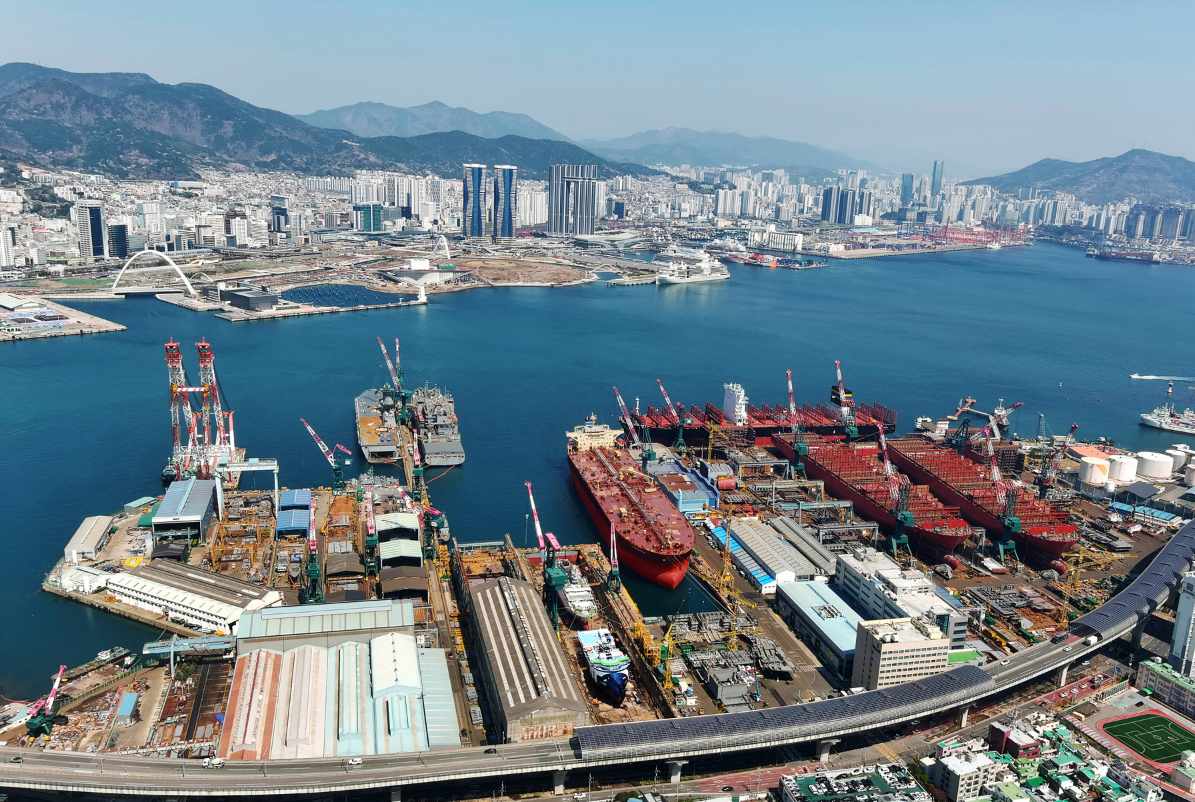
Blue-chip large corporations in semiconductors, automobiles, defense, and shipbuilding—industries that have proven their competitiveness in global markets—are being credited as the main drivers behind the move to 5,000. Market bellwether Samsung Electronics surpassed KRW 1,000 trillion in intraday market capitalization, overtaking China’s Tencent to rank third in Asia by market capitalization.
Overseas, the semiconductor boom fueled by advances in artificial intelligence (AI) and efforts to improve corporate governance have been cited as key factors behind the breakthrough of 5,000. The UK daily Financial Times (FT) assessed, “The Korean market remains undervalued, and the KOSPI’s move beyond 5,000 addresses the main causes of the Korea discount.”
There are also criticisms that the stock price rally is decoupled from real economic growth. The Bank of Korea announced on the 22nd that South Korea’s real gross domestic product (GDP) growth rate last year was 1.0%. This is the lowest level since 2020 (−0.7%), when the economy was hit hard by the spread of COVID-19.
Ahn Dong-hyun, professor of economics at Seoul National University, said, “If future economic growth does not provide support, there should be a clear awareness that foreign investor funds could quickly exit the domestic stock market, causing the KOSPI to decline again.”
ⓒ dongA.com. All rights reserved. Reproduction, redistribution, or use for AI training prohibited.
Popular News