Hyundai Motor Group Metaplant America (HMGMA) in Ellabell, Georgia, United States. Provided by Hyundai Motor Group
Hyundai Motor Group is reportedly considering introducing construction robots for the expansion of its local plants in the United States. Observers say that robot-based automation is emerging as a structural solution in overseas construction environments that have struggled with unstable labor supply, rising labor costs, and visa issuance issues.
According to the construction industry, Hyundai Motor Group plans to inspect plant sites in the United States as early as the first quarter of this year and, together with Hyundai Engineering and key partners, establish detailed strategies for design, construction, and operation.
Previously, Hyundai Motor Group Chairman Chung Euisun met with former U.S. President Donald Trump in March last year and announced an investment plan in the United States worth USD 21 billion (about KRW 29 trillion). The core elements include expanding production at Metaplant America (HMGMA), which has been completed in Georgia, and building a new steel plant in Louisiana. In addition, the group is preparing a robot manufacturing plant with an investment of USD 5 billion (about KRW 7 trillion).
According to this newspaper’s coverage, Hyundai Engineering, which is responsible for constructing Hyundai Motor Group’s U.S. plants, has been in discussions with related companies to introduce autonomous material transport robots in some projects.
The robots are designed to autonomously load and unload heavy construction materials along simple routes. They are capable of transporting two rows of six-tier engineered wood flooring, equivalent to the volume moved by a worker using a hand cart in a single trip. They can surmount 3 cm steps and 10-degree slopes, and their proprietary technology enables safe, damage-free transport and loading/unloading of construction materials. The lower autonomous driving unit withdraws to the rear while the upper load platform descends to floor level and pushes the materials out to complete the task.
This allows for independent operations even in constrained construction sites, such as △night-time material transport and stacking and △elevator-linked inter-floor movement. By deploying robots in night-time or high-risk zones where labor input is difficult in unfamiliar environments, contractors can simultaneously address dependence on skilled workers and the decline in work efficiency.
Higher productivity and task sophistication,
lower labor costs and serious accidents? ?
The scope of construction robot applications is gradually expanding. Recently, it has extended across the entire process to include autonomous heavy equipment, construction robots, completion inspection robots, and demolition robots.
The ecosystem of U.S.-based Built Robotics enables excavators and bulldozers to operate unmanned so that workers can manage processes remotely from safe locations. This system is an autonomous driving module that combines GPS, radar, 360-degree cameras, and a water-cooled computer, and is mounted on existing heavy machinery.
In the construction field, Fastbrick Robotics’ Hadrian X is a representative example. It can lay up to 500 bricks per hour and can automatically build structures up to three stories high. The RPD35, specialized in steel pile installation, autonomously installs up to 300 piles per day, fully unmanning a process with a high risk of human accidents.
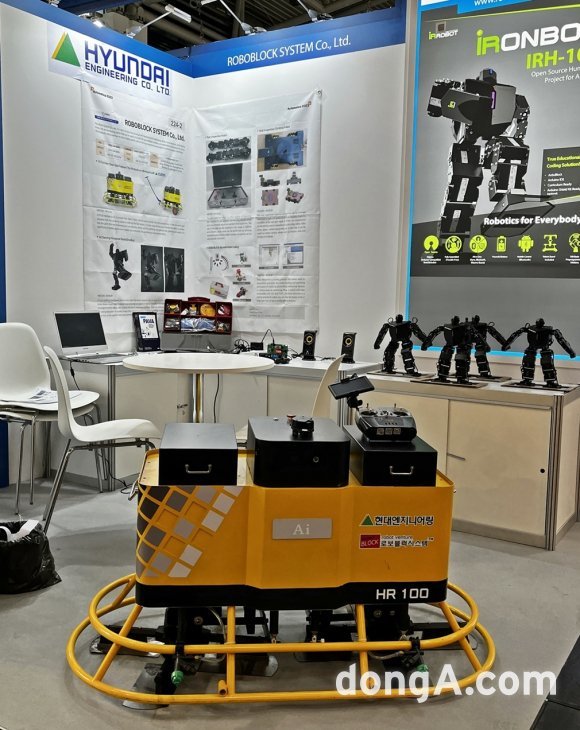
Hyundai Engineering plastering robot.
Among domestic companies, Hyundai Engineering has previously deployed robots that automate exterior wall painting at construction sites. It has also conducted pilot operations of Boston Dynamics’ “Spot” at its U.S. plants. Through these efforts, the company is verifying the applicability of such technologies to domestic and overseas sites and assessing whether to deploy them in actual processes.
The biggest benefit of introducing construction robots is the reduction of serious industrial accidents. Around-the-clock operation and consistent quality improve productivity, while they also help fill labor gaps arising from the aging of skilled workers and young workers’ reluctance to enter the field.
Furthermore, based on digital design data such as BIM (Building Information Modeling), millimeter-level precision construction becomes possible, reducing rework rates and lowering indirect costs through shorter construction periods. Real-time collection and management of on-site data also provide a foundation for accelerating the transition to smart construction.
An industry official said, “Construction robot solutions are already being used at some new apartment construction sites in Korea,” adding, “Cases of deployment in overseas sites will likely continue to spread across both domestic and global construction and manufacturing automation markets.”
ⓒ dongA.com. All rights reserved. Reproduction, redistribution, or use for AI training prohibited.
Popular News