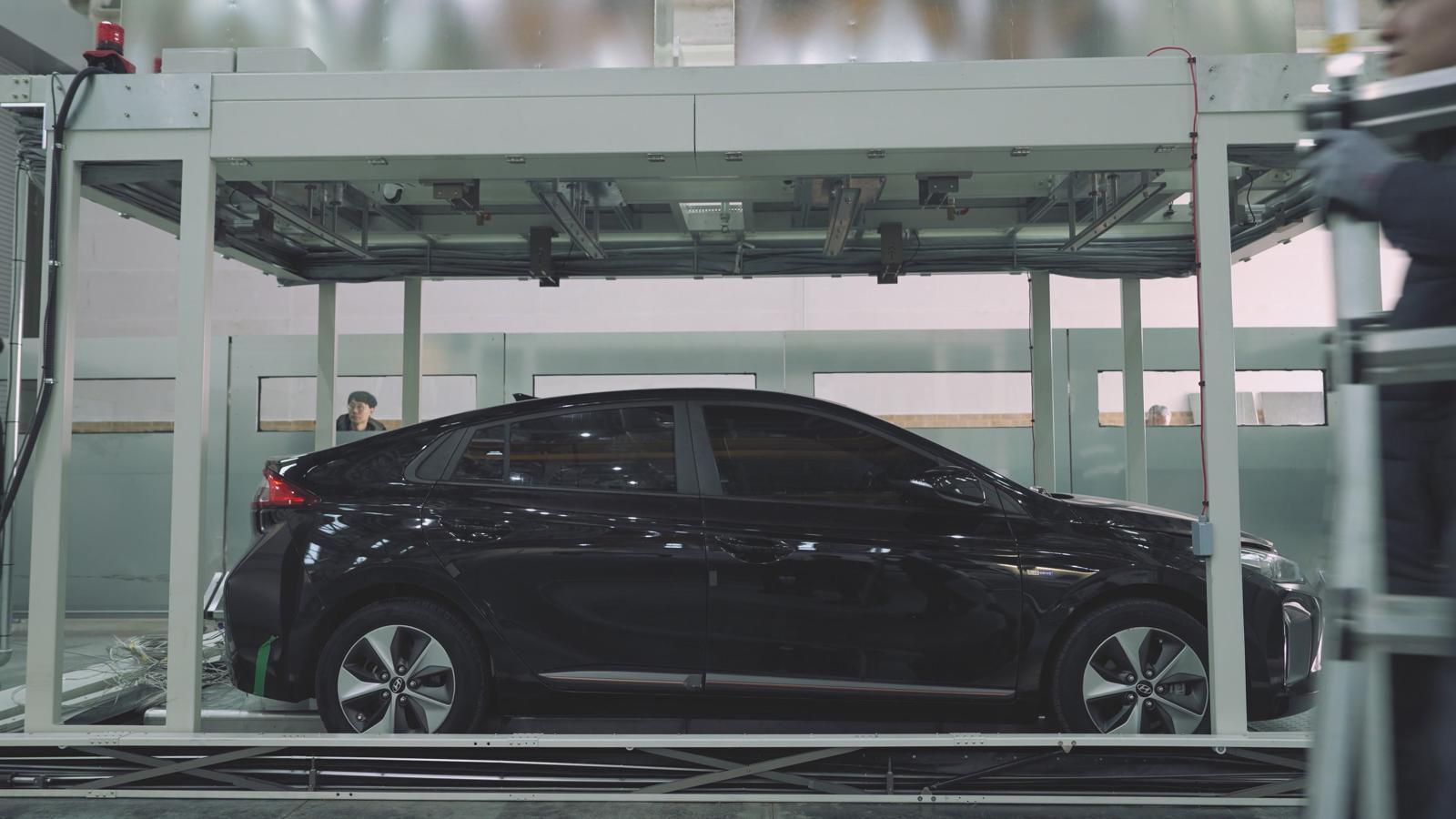
Electric vehicle used in the test within the fire compartment. Photo courtesy of Geosan ENG
Geosan ENG, a company specializing in architectural engineering, announced on the 20th that it conducted a demonstration test of its electric vehicle fire suppression system “GEVF1 (Geosan Electric Vehicle Fire Suppression System No.1)” at the Fire Protection Technology Test Center of the Korea Testing & Research Institute (KTR) in Hongseong-gun, Chungcheongnam-do, and succeeded in completely extinguishing a fire within 1 minute and 12 seconds after detecting signs of thermal runaway.
The demonstration test was carried out in two stages to replicate an actual electric vehicle fire situation. The first test targeted a single battery pack mounted on an electric vehicle manufactured by Company H, and the second test targeted an entire electric vehicle from Company H. After attaching a heating pad inside the battery pack, the temperature was increased by 5 degrees per minute starting from 2:47:38 p.m. to induce thermal runaway conditions.
At 3:44:50 p.m., approximately 57 minutes after the start of the test, off-gas was generated from the battery. This off-gas is released just before the battery enters the thermal runaway stage, and at that point, GEVF1’s integrated smoke, heat, and off-gas sensor was activated.
Thirty seconds after the sensor was activated, the upper fire screen descended and the lower water tank rose to form a fire compartment. Water then began to be discharged from the ceiling sprinkler and the upper tank, and a total of 4 tons of water had fallen within 38 seconds. The lower tank was filled with water to a depth of approximately 490 mm, completely submerging the battery pack, and the fire was extinguished without further spread.
Electric vehicle fires have been criticized as exposing the limitations of conventional firefighting methods, as thermal runaway occurs when the battery temperature exceeds 800 degrees, leading to prolonged combustion and a high risk of re-ignition even after initial suppression. According to the Ministry of Land, Infrastructure and Transport, extinguishing a fire in a single electric vehicle is known to require more than about 10 times the amount of water needed for a conventional internal combustion engine vehicle.
GEVF1, for which Geosan ENG has filed a patent application, detects fire at the pre-thermal-runaway stage and rapidly submerges the battery with a large volume of water, thereby blocking internal reactions within the battery that existing fire suppression systems have difficulty addressing.
Lee Yong-cheol, chairman of Geosan ENG, said, “As the adoption of electric vehicles increases, social demand for fire safety in underground parking lots is growing,” adding, “GEVF1 is a technology that shifts the electric vehicle fire response paradigm from post-fire suppression to preemptive prevention, and we will contribute to advancing field-oriented safety infrastructure.”
Geosan ENG plans to deploy GEVF1 primarily in underground parking lots of apartment complexes nationwide, logistics centers, large buildings, and public facilities, with the goal of commercialization in the first half of 2026. In parallel with commercialization, it also plans to expand into overseas markets. Starting with Vietnam, where electric vehicle adoption is rapidly increasing, the company has set Northern Europe and the United States—markets with strict safety regulations—as its key medium- to long-term targets.
Meanwhile, Geosan ENG obtained the U.S. patent “Screen-type Electric Vehicle Fire Suppression Device (US 12,246,202 B1)” in March 2025 and holds five related patents in Korea as well. It is currently in discussions on installation and cooperation with multiple construction companies, including Company H Construction, as well as logistics and public institutions.
ⓒ dongA.com. All rights reserved. Reproduction, redistribution, or use for AI training prohibited.
Popular News