Photo courtesy of Chosun College of Science & Technology
Chosun College of Science & Technology’s new initiative, aimed at transforming the structure of Gwangju’s tourism industry, has produced its first results. The “2025 Gwangju Tourism Enterprise Jump-Up (CT Incubating)” project promoted by the Chosun College of Science & Technology RISE Project Group (Director Hwang Young-guk) has successfully completed its first-phase process, confirming the potential of a collaboration model between local tourism companies and technology/content firms.
This project focused on enhancing companies’ practical competitiveness by integrating AI and digital technologies into the tourism industry. Rather than simple training or one-off consulting, the key was to derive tangible outputs through a structure in which supply-side and demand-side companies jointly participated in the development process. Haruchae took overall charge of the project, overseeing the entire process from company matching and development/management to performance outcomes.
First visible achievements through company-specific, customized development for the AI era
Three supply-side companies—YouOK, Codex, and Haruchae—and four demand-side companies participated in this Jump-Up project, carrying out development that leveraged their respective strengths. The development content for each demand-side company was specified to reflect on-site needs and individual corporate characteristics.
First, demand-side company Husimjeong expanded the way tourists experience destinations by developing an AR guide app set against the Secret Garden space within Husimjeong, Gwangju’s first registered private garden. Going beyond simple guidance, the focus was on enhancing the quality of the stay experience at the tourist site through immersive content that combines space and storytelling.
Planti concentrated on developing an AI-powered travel guide template generation and document automation system to improve work efficiency for travel agencies. The automation structure, which reflects the workflow of field practitioners, is being evaluated as a case that demonstrates the potential for digital transformation in the travel industry going forward.
Dana Hyun pursued the development of gastronomic content that extends desserts based on Gwangju’s local resources into travel and experiential content. The direction of linking locality with tourism experiences is drawing expectations in terms of future commercialization and tourism connectivity.
Ddanjit Gongjakso advanced the structure of its content around an AI emotional music-box experiential platform and implemented promotional strategies to raise brand awareness. Development proceeded in a way that strengthens online touchpoints, leveraging its characteristics as an experience-centered platform.
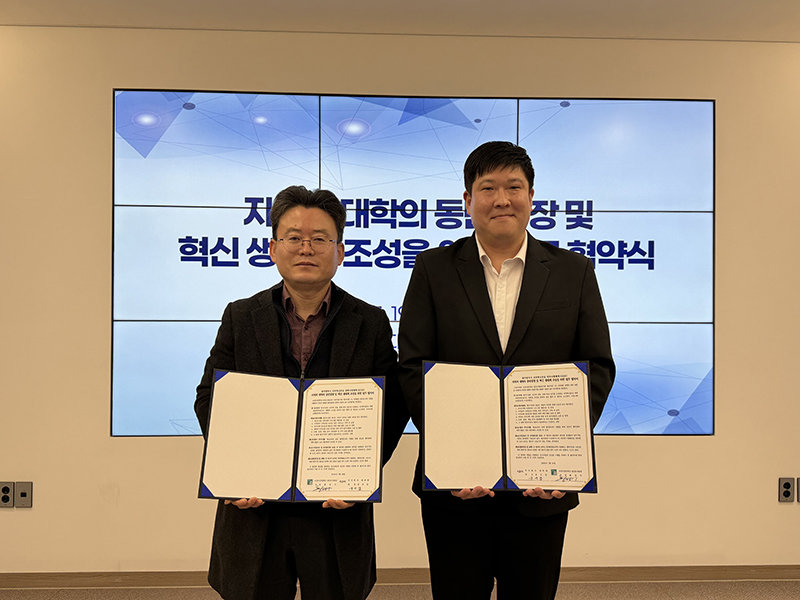
(From left) Hwang Young-guk, head of the RISE Project Group at Chosun College of Science & Technology, and Yoon Eun-gap, CEO of Haruchae. Photo courtesy of Chosun College of Science & Technology
Business agreement signed ahead of project completion… a link toward “sustainable growth”
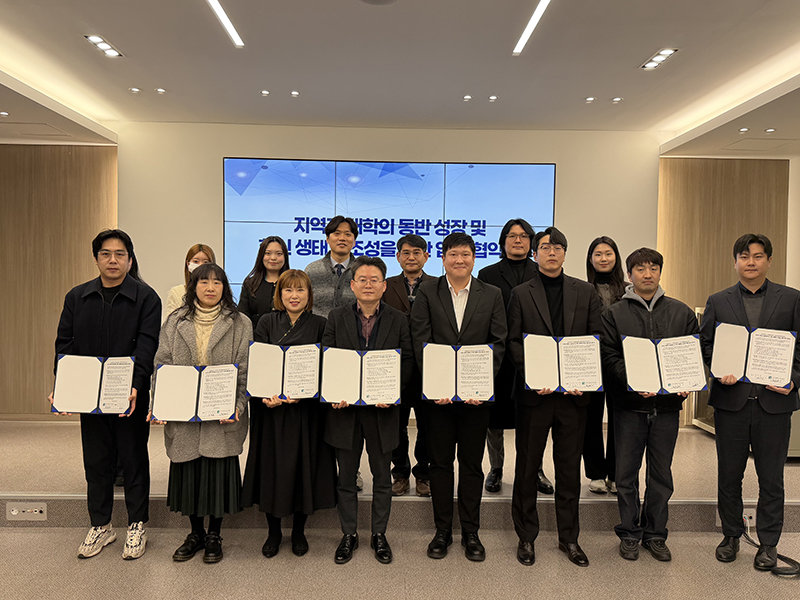
An important aspect of this project is that it did not stop at first-phase results but also included the signing of a memorandum of understanding (MOU) to ensure that collaboration can continue even after the project’s completion. Centered on Chosun College of Science & Technology, the agreement between supply-side and demand-side companies was concluded as a preliminary step toward establishing a sustainable growth structure that goes beyond short-term project performance.
The agreement was signed at the point when the project was being finalized, creating a foundation to connect the accumulated development outcomes and collaboration experience with future business expansion. In particular, it is significant in that the scope of cooperation has been clarified so that technology and content development can lead to actual on-site application, further advancement, and joint business development.
As a strategic partnership that takes into account the period after the project, rather than a one-off collaboration, this MOU is being evaluated as a mechanism that extends the achievements of the Jump-Up project to another level.
Hwang Young-guk, head of the Chosun College of Science & Technology RISE Project Group, stated, “The focus of this Jump-Up project was not simply on producing deliverables, but on designing a process through which companies can independently change and grow,” adding, “The most important outcome is how tourism companies embrace technology and content and apply them to their actual businesses.”
He continued, “The core of this first-phase outcome lies in the way supply-side companies, demand-side companies, and the university each fulfilled their respective roles while maintaining close communication,” and added, “With the first phase having been successfully completed, we expect a more expanded collaboration model in the next phase.”
ⓒ dongA.com. All rights reserved. Reproduction, redistribution, or use for AI training prohibited.
Popular News