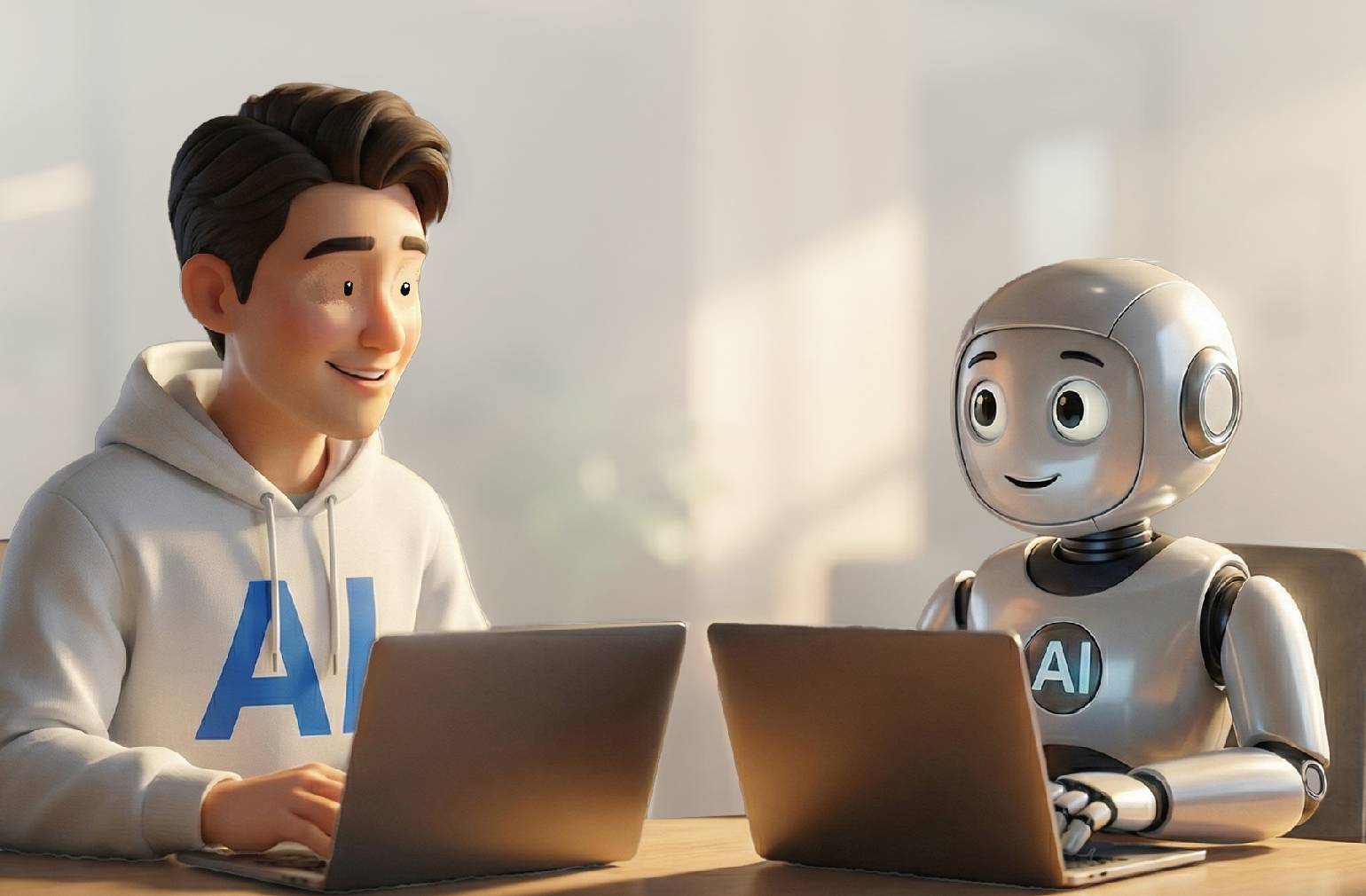
Perspectives on the Human–AI Relationship
Maeng Sung-hyun, Vice President of Taejae University and Emeritus Professor at KAIST
《“How many employees do we have? My answer is 60,000: 40,000 humans and 25,000 artificial intelligence (AI) agents.” This was a recent comment by Bob Sternfels, CEO of global consulting firm McKinsey. McKinsey has also begun using AI in its recruitment of new hires. Notably, in the hiring process, applicants are not merely evaluated by AI; they actually perform consulting tasks together with AI. The focus of assessment is not on how well candidates ‘use’ AI, but on how well they ‘collaborate’ with it. It is the ability to critically review AI outputs, then apply one’s own curiosity and judgment to contextualize them to the client’s specific requirements and derive structured conclusions.》
The dominant view of AI today is that it is a “tool for improving productivity.” Corporations envision greater efficiency in operations and production, and governments imagine administrative innovation, all gripped by the anxiety that “those who do not adopt AI will fall behind.” From this perspective, “coexistence” means accepting AI as an indispensable tool that must be used indefinitely. But what is the result of that? It is concern over job losses. On YouTube and social media, content warning that “your job will disappear” is increasing, and media reports continue to highlight shrinking employment in specific occupations. Such warnings and the social preparedness they prompt are definitely necessary.
However, if AI is viewed only through the lens of productivity, its side effects stand out more than anything else. When AI is perceived merely as a tool, the relationship between humans and AI remains a simple, superficial, one-way relationship. Coexistence does not simply mean that humans are forced to use AI and that AI replaces particular human jobs.
Genuine coexistence between humans and AI hinges on interaction—a relationship in which both sides influence each other. This is exactly what McKinsey’s AI-based interview suggests. In this interview, AI serves as a thought partner. Applicants converse with AI to expand their thinking, supplement the contexts that AI has missed, and, through their joint efforts, arrive at conclusions that would have been difficult to reach alone. What is evaluated in this process is not technical proficiency in AI utilization, but cognitive collaboration capability.
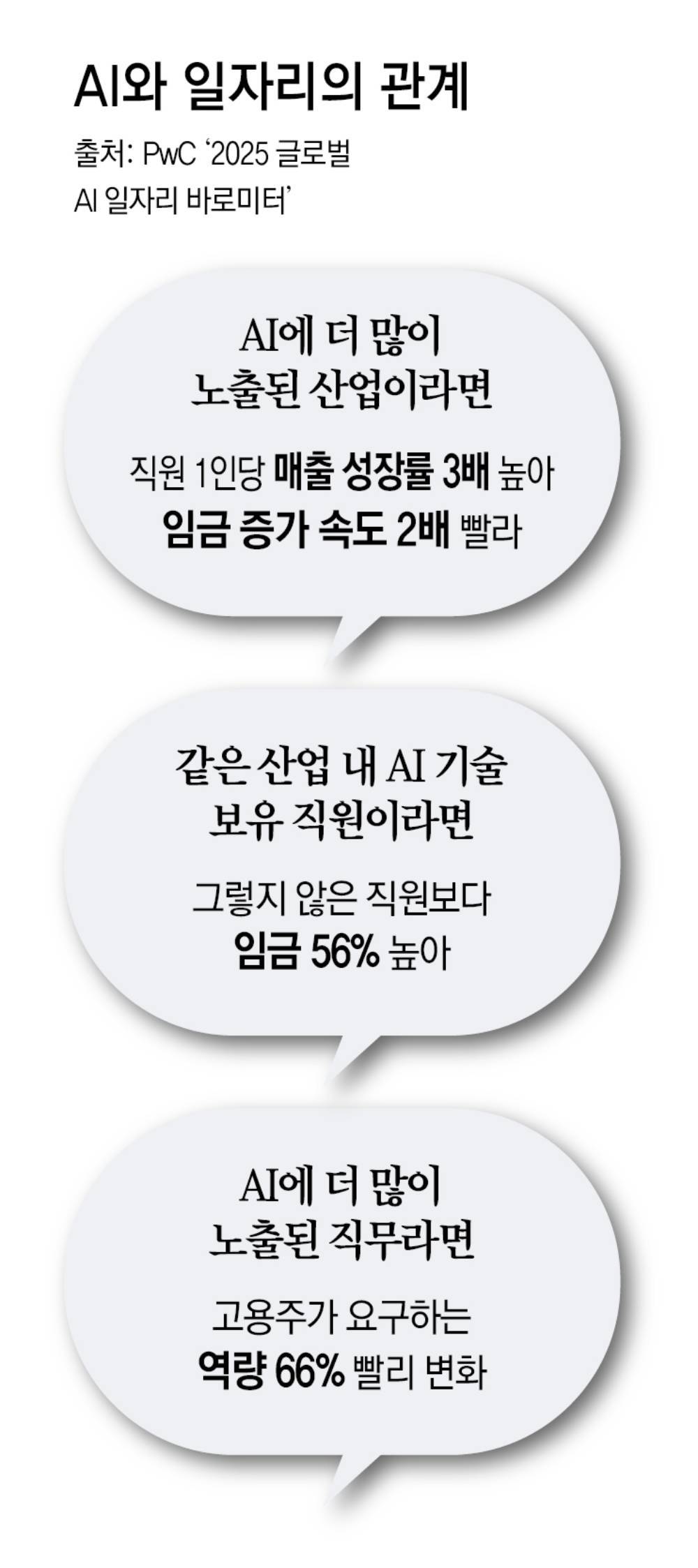
This shift in perspective can expand the human realm. For example, according to global consulting firm PricewaterhouseCoopers (PwC)’s report “Global AI Jobs Barometer 2025,” industries with higher exposure to AI recorded per-employee revenue growth about three times higher than industries with lower exposure, and wages also rose more rapidly. In addition, employees with AI-related skills were found to earn wages 56% higher than those without such skills. AI thus functions as augmentation, not simple substitution.
New occupations are also emerging one after another. The Washington Post (WP) recently introduced unfamiliar job titles such as “knowledge architect,” “orchestration engineer,” “conversation designer,” and “human–AI collaboration leader.” What these new roles have in common is that they create value at the interface between AI and humans. Developments in the medical field are also noteworthy. The Mayo Clinic in the United States, after introducing hundreds of AI models for image analysis, actually increased its radiology staff by more than 50%.
There is another dimension to coexistence. AI must be developed and used in ways that prevent it from doing “harmful things” if it is to remain a presence that can exist alongside humans. For example, the initial growth of the internet was underpinned by the philosophy of openness and permissionless innovation. That freedom transformed human life but also amplified side effects such as misinformation, hate speech, and political polarization. As the harms of a technology grow, calls for regulation gain strength.
Likewise, if the harms of AI become more prominent, regulatory and restrictive policies will inevitably follow. In this context, the author proposes “SECT AI”: Safe, Ethical, Culture-friendly, and Trustworthy AI. This is not solely the responsibility of AI developers. Everyone who uses AI has a responsibility to use it in this way.
In the government’s recent “national flagship AI” selection process, securing foundational model source technologies and demonstrating performance across various benchmarks were cited as key evaluation criteria. These elements are, of course, important for national competitiveness. However, one more criterion should be added: expansion of human capabilities. As in McKinsey’s evaluation of new hires, technology development should be oriented toward expanding human thinking, creativity, and judgment so that AI and humans can collaborate to produce better outcomes. It is also necessary to verify whether such expansion takes place in a safe, ethical, and trustworthy manner.
In this sense, coexistence is not only a technological issue but also a matter of civic choice. If AI is used solely for “convenient automation,” its side effects will return intact. Conversely, if AI is trained as a “partner in thinking,” human capabilities can broaden and social rules can become more sophisticated. Coexistence between humans and AI is not merely about adopting a tool; it is about designing the relationship between the two. This is the new paradigm demanded by the AI era.
ⓒ dongA.com. All rights reserved. Reproduction, redistribution, or use for AI training prohibited.
Popular News