JP Morgan Healthcare Conference (JPMHC)
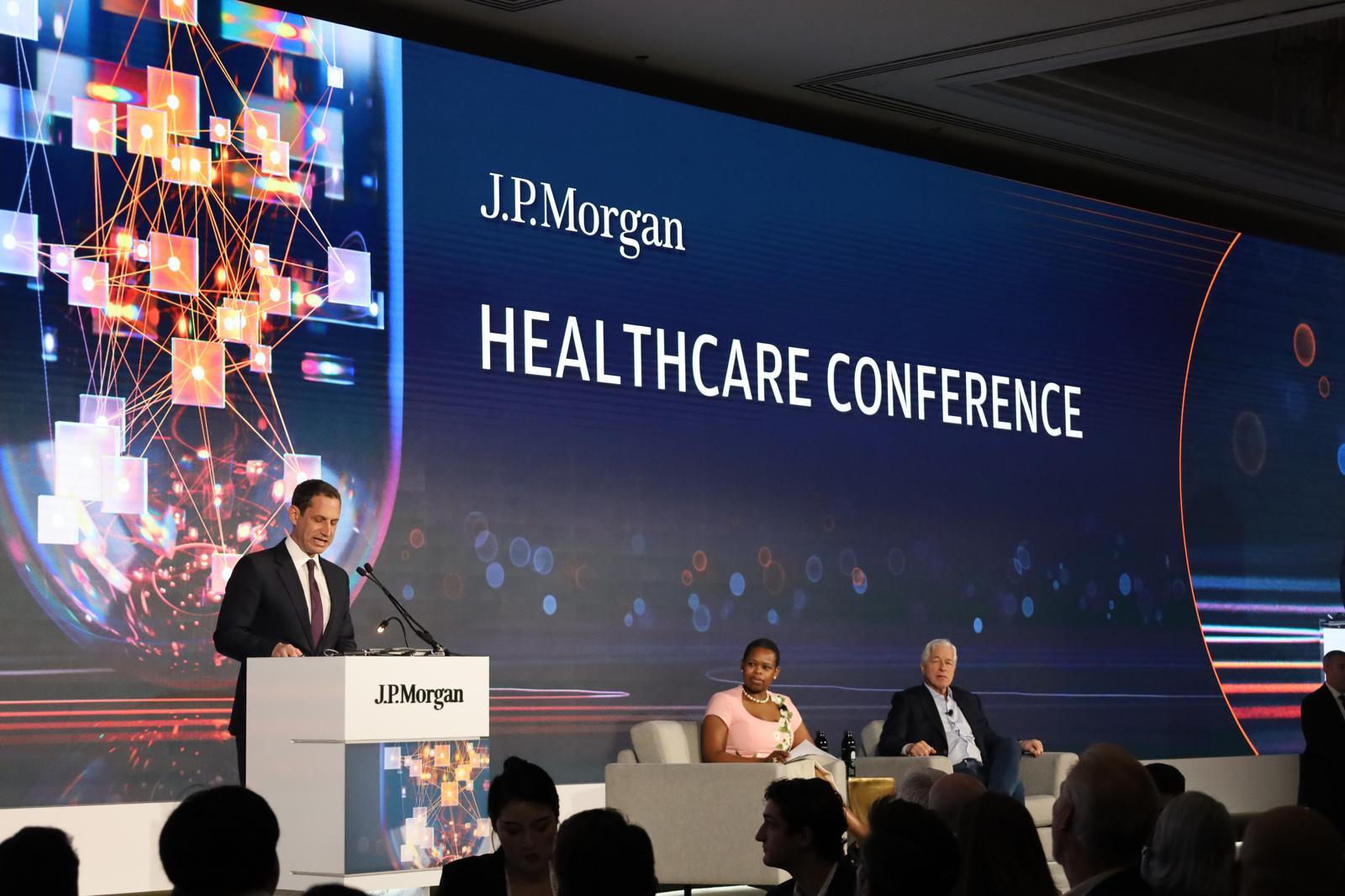
The JP Morgan Healthcare Conference (JPMHC), the world’s largest pharmaceutical and biotech investment conference with participation from more than 500 companies worldwide, concluded in San Francisco, United States, on the 15th (local time). The combined market capitalization of the companies participating in the event reached approximately USD 10 trillion (about KRW 1,470 trillion), and Korean companies demonstrated their presence across a range of sectors.
Among domestic firms, Samsung Biologics and Celltrion each made presentations on the “Main Track,” the largest stage at JPMHC. The Main Track is the core stage on which only 25 companies, invited by JPM out of more than 500 participating firms, are allowed to present, drawing the keen attention of a large number of investors.
● Samsung Biologics and Celltrion secure U.S. production facilities
At the conference, Samsung Biologics focused its presentation on the biopharmaceutical production facility in Rockville, Maryland, acquired at the end of last year from GlaxoSmithKline (GSK). As 97% of Samsung Biologics’ revenue is generated overseas, expanding its global footprint is one of the company’s key tasks. In particular, considering heightened uncertainty in the United States due to tariff policies under the Trump administration, the U.S. could become an important production base. Leveraging the U.S. facility, the company declared that it would strengthen its capabilities in contract research organization (CRO) and contract development organization (CDO), and provide an “end-to-end” service that covers the entire process from the discovery of clients’ new drug candidates to production.
Seo Jin-seok, CEO of Celltrion, who took the JPM stage alone for the first time, also expressed an ambition to transform the company from an existing biosimilar (biopharmaceutical generic) producer into a new drug development company. Seo is the eldest son of Celltrion Group founder and Chairman Seo Jung-jin. In his presentation, he stated that Celltrion plans to expand its current portfolio of 11 biosimilar products to 41 by 2038 and is developing 16 pipelines (new drug candidates) in new drug R&D.
Among them is an obesity drug, which has recently become a global phenomenon. Seo said, “We are currently developing CT-G32, a quadruple agonist obesity treatment designed to minimize muscle loss, and plan to submit an Investigational New Drug (IND) application in the second half of next year (July–December).”
The drug currently showing the greatest weight-loss effect is Eli Lilly’s “Mounjaro,” a dual agonist that acts simultaneously on glucagon-like peptide-1 (GLP-1) and gastric inhibitory polypeptide (GIP). While next-generation obesity treatments in development are triple agonists, Celltrion aims to compete in the market with an even more advanced quadruple agonist.
Celltrion also acquired a production facility in Branchburg, New Jersey, from Eli Lilly last year. The company plans to invest a total of KRW 1.4 trillion to acquire the plant and undertake facility expansion.
● Rapid advances from China
China also showed a presence at this conference comparable to that of Korea. Over the past two to three years, Chinese pharmaceutical companies have concluded major deals with global pharmaceutical firms. At this year’s JPMHC, AbbVie and Novartis each made surprise announcements on technology in-licensing from Chinese biotech companies.
On the first day of the conference, the 12th (local time), AbbVie announced that it had signed a technology transfer agreement worth up to USD 5.6 billion (about KRW 8.23 trillion) with Chinese biotech company Remegen for “RC 148,” a bispecific antibody anticancer drug candidate. Novartis stated that it would introduce, for up to USD 1.7 billion (about KRW 2.5 trillion), a technology from Chinese biotech company SciNeuro Pharmaceuticals that delivers Alzheimer’s treatments to the brain.
In December last year, U.S. President Donald Trump signed the National Defense Authorization Act (NDAA), which includes the “Biosecure Act,” effectively excluding Chinese biotech companies. Although there are projections that transactions between the United States and China could be cut off as a result, these major deals were concluded nonetheless.
Lee Seung-kyu, Vice Chairman of the Korea Biotechnology Industry Organization, said, “Politically, the United States is keeping China in check, but industrially, it is no longer possible to ignore China,” adding, “In the past, political relations were prioritized in major deals in the biotech industry, but this year will mark the first year in which industrial value overturns that hierarchy.” He continued, “Global pharmaceutical companies can no longer draw up business strategies that exclude China, so their strategic planning will be highly complex,” and noted, “The U.S.-China summit scheduled for April is a major variable.”
ⓒ dongA.com. All rights reserved. Reproduction, redistribution, or use for AI training prohibited.
Popular News