After defense, energy, and finance, semiconductor business expansion gains momentum
Positive outlook riding the semiconductor cycle
Third son Kim Dong-seon, Executive Vice President and Head of Future Vision for Hanwha Vision, Semitech, Robotics, and Momentum
Hanwha has structurally separated the business domain of third son Vice President Kim Dong-sun by setting up a distinct business pillar spanning distribution and services through to robotics and semiconductor equipment via a spin-off. Unlike the remaining company, which will focus on defense and energy, the newly established Machinery & Service Holdings will be heavily concentrated with affiliates such as Galleria, Hotel & Resort, Robotics, automation, and semiconductor equipment.
Hanwha announced on the 14th that its board of directors had resolved to conduct a simple physical (spin-off) division of the company and establish “Hanwha Machinery & Service Holdings” (tentative name). After the split, the surviving entity, Hanwha, will oversee the group’s core pillar industries including defense, shipbuilding, marine, energy, and finance, while the new company will function as a holding company managing relatively independent business groups such as distribution, hotels, robotics, machinery, and security equipment.
Hanwha is currently organized into six business divisions: Defense & Aerospace, Shipbuilding & Marine, Energy & Chemical, Finance, Tech, and Life. Among them, eldest son Vice Chairman Kim Dong-kwan has overseen the Defense, Shipbuilding, and Energy divisions; second son President Kim Dong-won has been in charge of Finance; and third son Vice President Kim Dong-sun has led the Tech and Life divisions.
With this spin-off, Tech affiliates such as Hanwha Vision, Hanwha Momentum, Hanwha Semitec, and Hanwha Robotics, along with Life affiliates such as Hanwha Galleria, Hanwha Hotel & Resort, and Ourhome, will all be placed under the newly established holding company, Hanwha Machinery & Service Holdings. The business groups with which Vice President Kim has been involved will be brought together under one roof.
Hanwha has officially explained that the split is a decision aimed at business specialization and enhancing corporate value. However, in and around business circles, there is interpretation that the post-spin-off business portfolio configuration is also aligned with the management role structure of the owner family. This is particularly because a significant number of affiliates assigned to the new holding company overlap with businesses in which Vice President Kim Dong-sun has been directly or indirectly involved.
Riding the semiconductor cycle, ‘Hanwha Semiconductor’ moves to the forefront… Hanwha Semitec derives 80% of revenue overseas
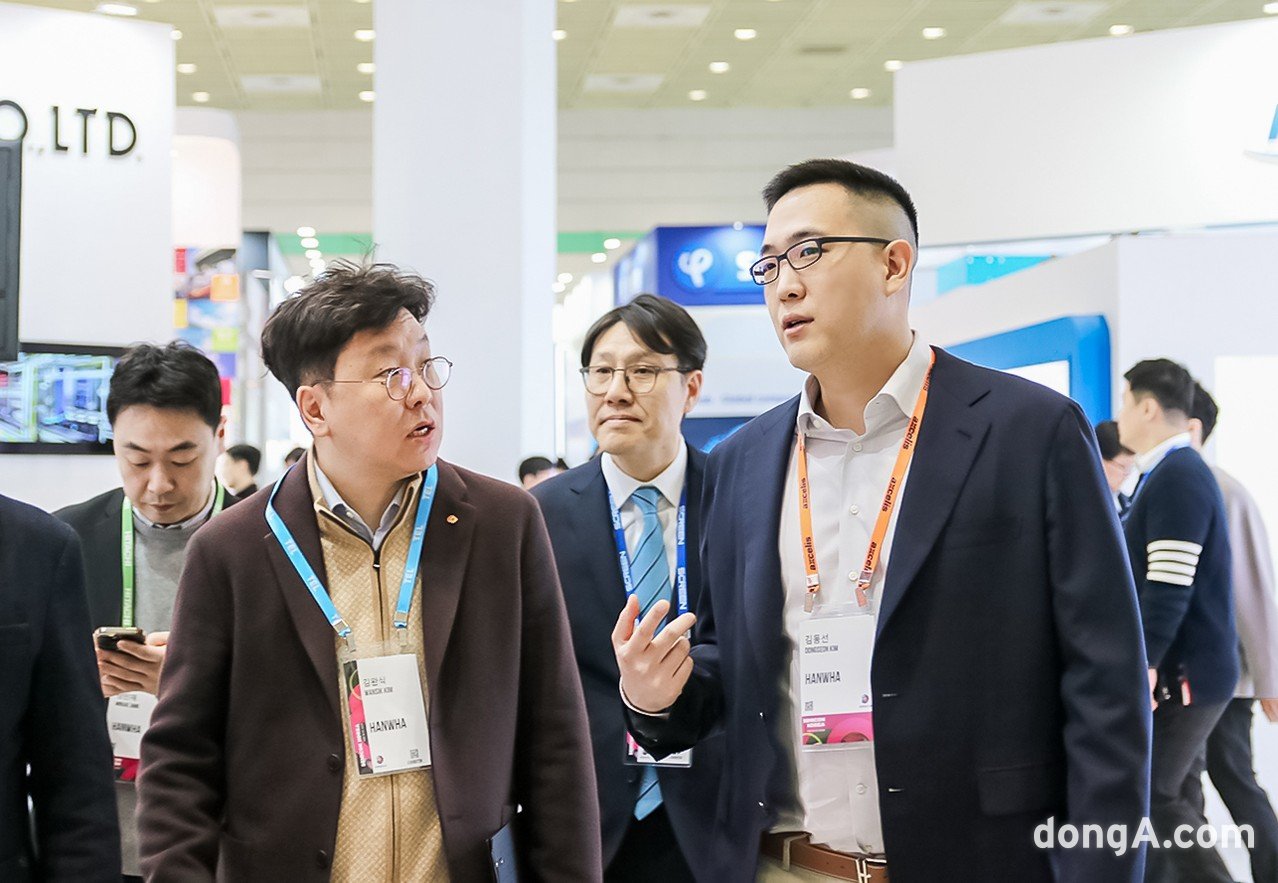
Vice President Kim Dong-sun, Head of Future Vision for Hanwha Vision, Semitec, Robotics, and Momentum (right)
In the Tech division, an equipment and automation strategy aimed at the recovery of the semiconductor cycle is coming to the forefront. In a conference call related to the spin-off, Hanwha stated that it is actively nurturing the TC bonder equipment business, which is essential for high bandwidth memory (HBM) production processes, with Hanwha Semitec at the center, and that it is accelerating the development of next-generation semiconductor packaging equipment such as hybrid bonders. The plan is to respond preemptively to memory advancement and growing demand for advanced packaging.
Hanwha Momentum and Hanwha Robotics are upgrading automation and robot solutions capable of being linked to semiconductor manufacturing processes. Their goal goes beyond supplying single pieces of equipment to providing comprehensive solutions that encompass semiconductor process automation and smart factory construction. In addition, they are combining Hanwha Vision’s AI-based imaging and sensor technologies to expand their scope of application to industrial solutions such as process monitoring, quality inspection, and logistics automation.
Under the new holding company structure, Hanwha has also presented a mid- to long-term plan to bundle robotics, automation, semiconductor equipment, and AI technologies into its “Physical AI” vision, targeting average annual growth of 30% by 2030. Business circles assess this as “a strategy to integrate equipment, robots, and AI into a single technology axis and scale them up in line with the recovery phase of the semiconductor industry.”
By contrast, the defense, shipbuilding, and energy businesses that remain in the surviving company are the group’s cash cows and have a strong character as national key industries, where stability and long-term strategy are crucial. An industry official said, “It is a structure designed to improve management efficiency by separating business areas with different characteristics,” adding, “In the long term, the respective roles of the owner family members may also become clearer.”
Some observers evaluate this as first establishing a structure that allows for separate management by each heir. Because it is a physical spin-off, the shareholder composition remains the same, but the analysis is that the range of future options has widened in that each company can have its own independent business strategy and decision-making system.
Hanwha maintains that the split is unrelated to succession or the brothers’ independence. Hanwha explained, “It is a decision to enhance corporate value and shareholder value through specialization by business segment and reinforcement of accountable management.” Through this physical spin-off, the group plans to accelerate strategy formulation and investment decisions for each business and strengthen the competitiveness of each business line.
ⓒ dongA.com. All rights reserved. Reproduction, redistribution, or use for AI training prohibited.
Popular News