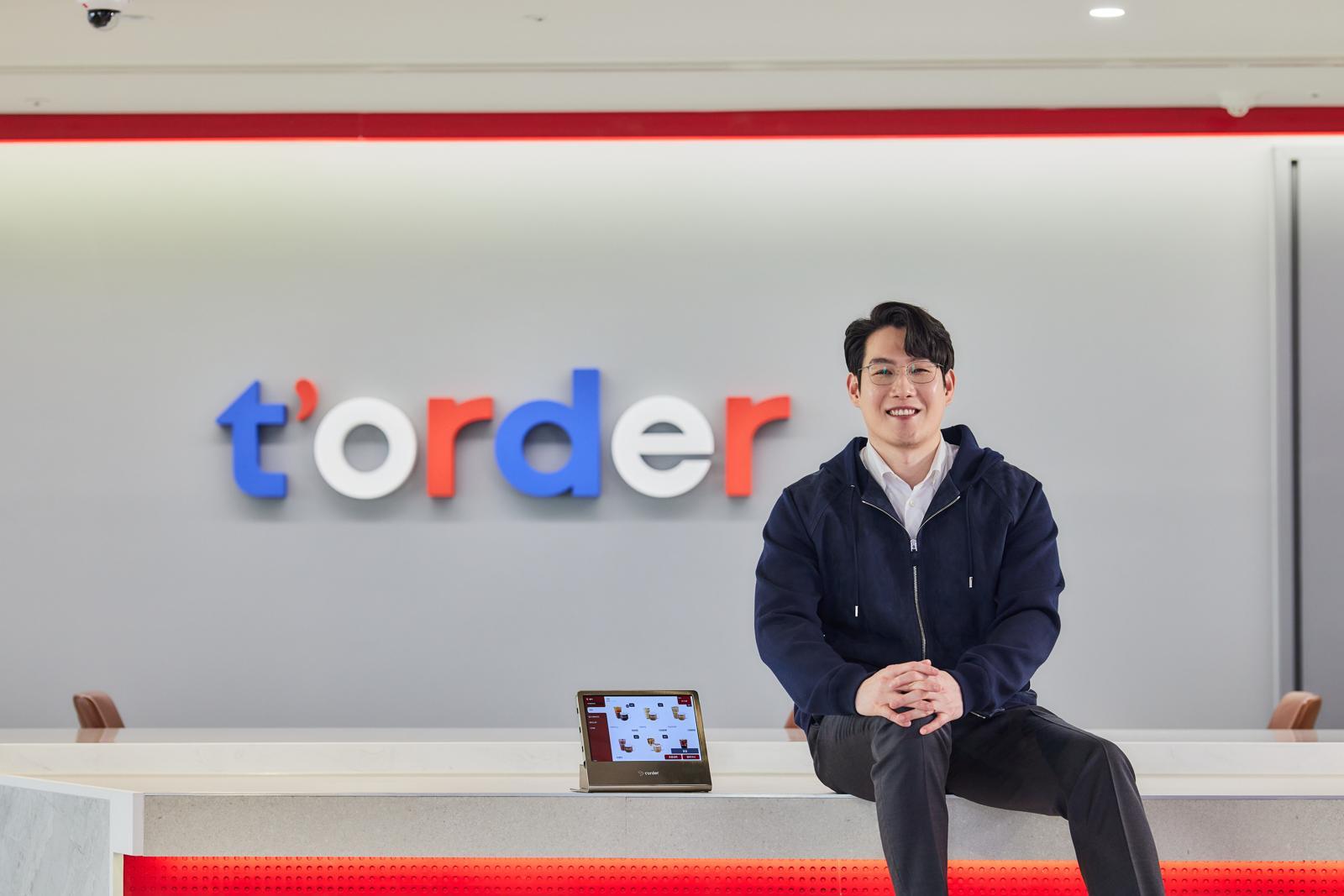
Kwon Sung-taek, CEO of Teorder, during an interview with the Dong-A Ilbo at Teorder’s headquarters in Yeongdeungpo-gu, Seoul, on 29 December last year. He said, “Seven years in online commerce and seven years in the restaurant industry have come together inside the tablet to create our current competitiveness.” Provided by Teorder.
“Teorder will become a partner that supports small business owners in increasing sales by analyzing the data accumulated by ‘Teorder’ with artificial intelligence (AI).“
Kwon Sung-taek (38), CEO of Teorder, the No. 1 player in the domestic table-order (unmanned ordering) market, met at the company’s headquarters in Yeouido, Yeongdeungpo-gu, Seoul, on 29 December last year, and stated this in explaining Teorder’s goal. He said, “Small business owners are a vulnerable group in the AI era,” adding, “We will grow into a company that goes beyond simple unmanned ordering to properly ‘serve’ small business owners by providing management reports and more.”
In 2019, Kwon focused on table ordering, which at the time was still a relatively unfamiliar concept, and founded Teorder. Having run a restaurant business, he was convinced that table ordering could resolve chronic issues in the food-service sector such as labor shortages, the burden of labor costs, and staff management.
As a result of entering the market early, Teorder’s cumulative number of orders, which stood at around 12 million in 2020, surpassed 800 million this month. The number of tablets deployed has reached 320,000, and cumulative users total 1.1 billion. Teorder’s current domestic market share is around 50%. Although large conglomerates have entered this market, startup Teorder continues to exert dominance.
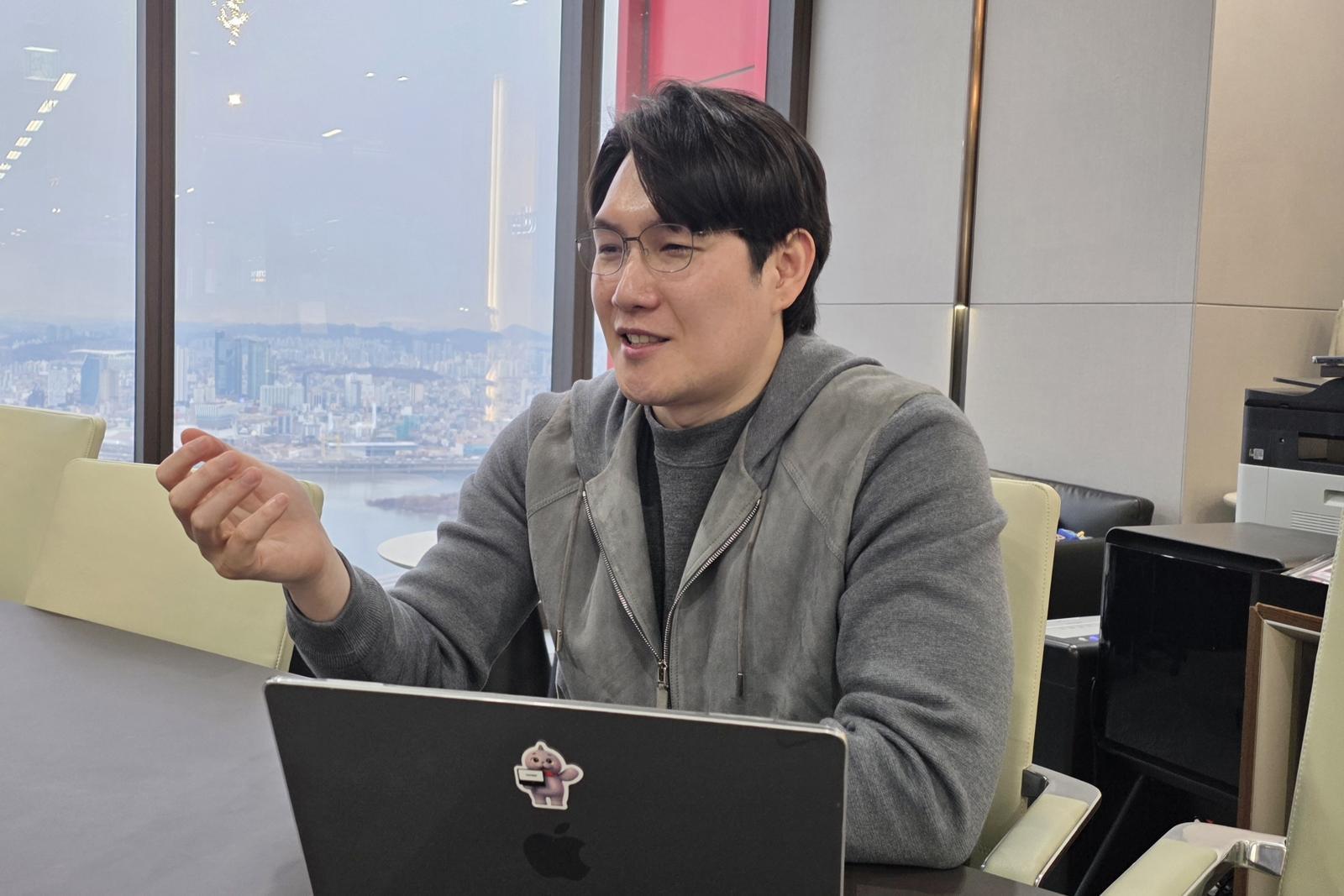
Teorder CEO Kwon Sung-taek (38), during an interview with the Dong-A Ilbo at Teorder’s headquarters in Yeongdeungpo-gu, Seoul, on 29 December last year, responds to a question about the secret to his success. Provided by Teorder.
Kwon said that over the eight years since Teorder’s establishment, the company “expanded without negative growth.” According to the Korea Rural Economic Institute, the share of domestic restaurants using table-order (unmanned ordering) devices rose from 0.9% in 2018 to 7.8% in 2023. The spread of non-face-to-face payment culture during the COVID-19 pandemic, combined with a 27.8% increase in the minimum wage over the same period from KRW 7,530 to KRW 9,620, significantly exacerbated the burden of labor costs. An analysis of small business owners who adopted Teorder last year showed that the number of in-store orders increased by an average of 2.1 times compared with before adoption, while spending on labor decreased by the equivalent of between 0.5 and up to 1.5 employees.
Kwon believes the table-order market will expand further as the AI era fully unfolds. He said, “As the spread of AI technology reduces the number of workers, and this coincides with the retirement of the so-called ‘one million newborns’ generation, small business start-ups will increase further.” He also pointed out that there is still ample room for table ordering to expand. “There is scope to broaden into other sectors such as hair salons and hospitals, and for ordering devices to evolve beyond tablets into wearable forms such as sunglasses,” he said.
However, he expressed concern that the business environment for small business owners is fragile, with the annual number of business closures approaching 1 million. To address this, Kwon stressed that AI specifically tailored to small business owners is essential. The “Teorder AI” (working title) to be launched in the first half of this year (January–June) is designed to link with KakaoTalk so that sales can be checked and menus managed purely through messenger conversations. Based on the order and sales data accumulated by Teorder, it is expected to provide instant Q&A and statistics related to operations, thereby supporting decision-making by small business owners.
Kwon said, “With Teorder AI, at the very least, I want to eliminate situations where small business owners cannot operate properly simply because they do not know how,” adding, “I want to help the small business owners who have enabled Teorder’s growth to hold out longer and continue to grow.”
ⓒ dongA.com. All rights reserved. Reproduction, redistribution, or use for AI training prohibited.
Popular News