U.S.–China, full-scale public–private push for lunar exploration Korea also taking on the space ecosystem challenge Fifth launch this year, sixth launch next year Plan to send a lunar lander by 2032
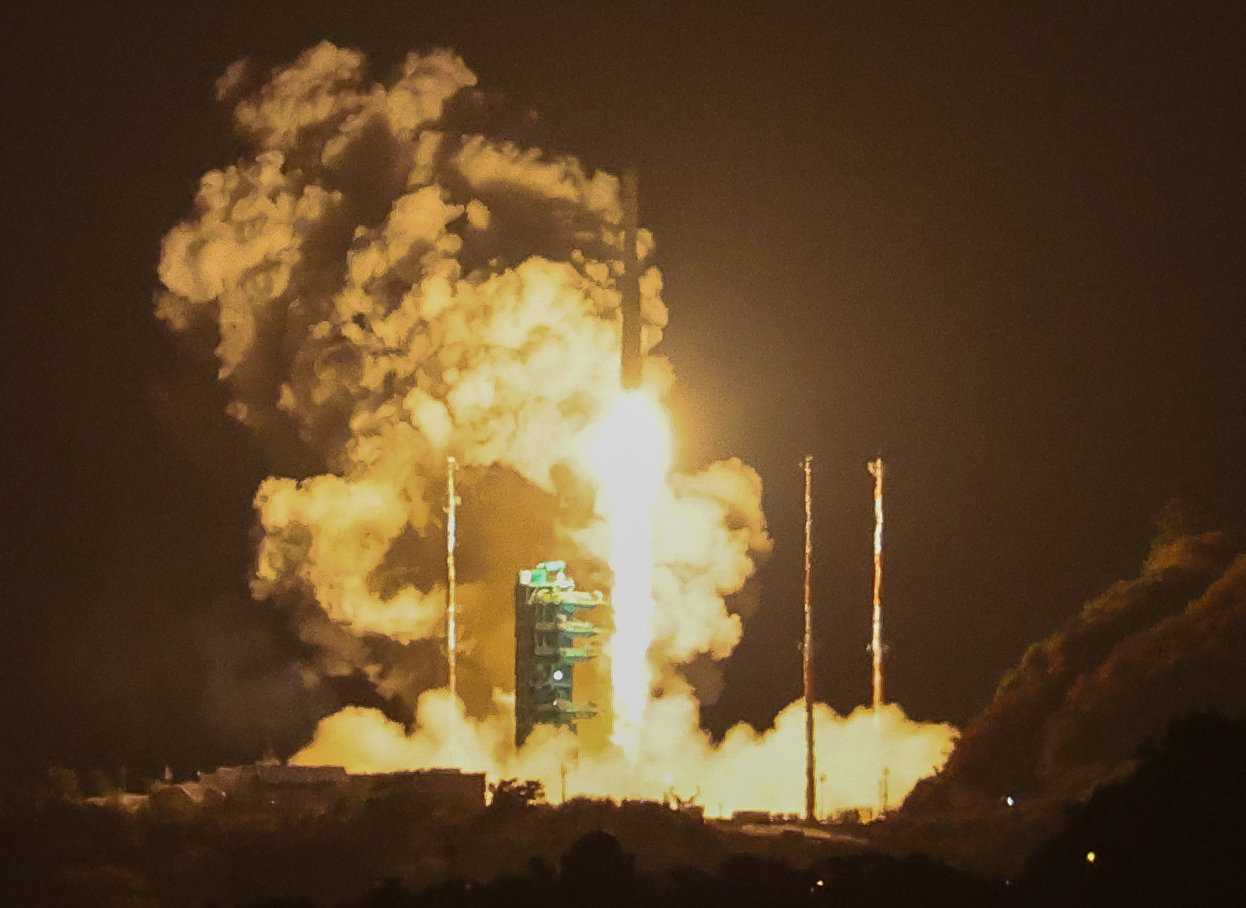
The Korean launch vehicle Nuri (KSLV-II) lifts off into space in its fourth launch from the Naro Space Center in Goheung-gun, Jeollanam-do, in the early hours of the 27th. Carrying a total of 13 satellites, including the Next-generation Medium Satellite No. 3 (single unit) and 12 CubeSats, Nuri will undertake a range of missions from observing the space environment, including auroras, to various space bio experiments such as anticancer drug research. 2025.11.27 News1
Korea opened its first private spaceflight era with the successful fourth launch of the Korean launch vehicle “Nuri” on 27 November last year. The government plans to lay the groundwork for a privately led commercial launch market through follow-up launches, including the fifth and sixth Nuri launches from this year through 2027.
The fourth Nuri launch is significant in that the launch vehicle, whose assembly was overseen by a private company, succeeded at the first attempt in both launch and communication with the onboard satellites. The main payload, the “Next-generation Medium Satellite No. 3,” succeeded in establishing communication with the ground on the day of launch. Although not included in the official success criteria, the deployment of 12 accompanying ultra-small satellites was also successful. The total weight of the 13 satellites is 960 kg, about double the payload (500 kg) of the third launch, which was the first practical launch. Observers assess that Korea has strengthened its practical launch capability by transporting a greater mass into space.
The Korea Aerospace Research Institute (KARI) and Hanwha Aerospace will carry out the fifth Nuri launch in the third quarter of this year (July–September) and the sixth in 2027. The imminent fifth launch is expected to serve as a testbed to verify Nuri’s capability for repeated launch operations. It is also seen as an opportunity to enhance Korea’s satellite technology and satellite utilization capabilities by placing multiple ultra-small satellites and technology demonstration satellites into orbit.
The Nuri launch schedule confirmed so far runs through the sixth launch next year as the final one. The seventh launch in 2028 is under discussion with the budget authorities. The Korea AeroSpace Administration explains that “to secure a success rate of more than 90% that is viable for commercialization, at least 10 launches must be carried out given the current success rate of 75%.” Securing the budget remains an unresolved challenge, but momentum appears to have been regained after President Lee Jae-myung stated in December last year, “Prepare investments on the assumption that a space launch vehicle will be launched once every year.”
Separate from Nuri, the “Next-generation Launch Vehicle Development Project” is also under way. While Nuri’s goal is to place 1.5-ton-class practical satellites into low Earth orbit, the next-generation launch vehicle aims to secure autonomous deep space exploration capabilities. Through this project, KARI plans to send a lander to the Moon in 2032. Hanwha Aerospace, a private company, is also participating in the development of the next-generation launch vehicle.
Private space launch vehicle company Innospace plans to make another attempt at a commercial launch in the first half of this year (January–June). In December last year, Innospace attempted the first commercial launch by a domestic private company by launching the small launch vehicle “Hanbit-Nano,” but the attempt failed due to damage to the vehicle. Based on the data obtained from the last launch, Innospace is investigating the cause of the failure, and the timing of the relaunch will be determined based on the investigation results and completion of follow-up measures. In addition, “Arirang 6,” an Earth observation satellite developed with domestic technology by KARI, will also be launched in the first half of this year. Equipped with a 0.5 m-class resolution Synthetic Aperture Radar (SAR), Arirang 6 is capable of observation at night and in adverse weather conditions.
Park Jong-min
AI-translated with ChatGPT. Provided as is; original Korean text prevails.
ⓒ dongA.com. All rights reserved. Reproduction, redistribution, or use for AI training prohibited.