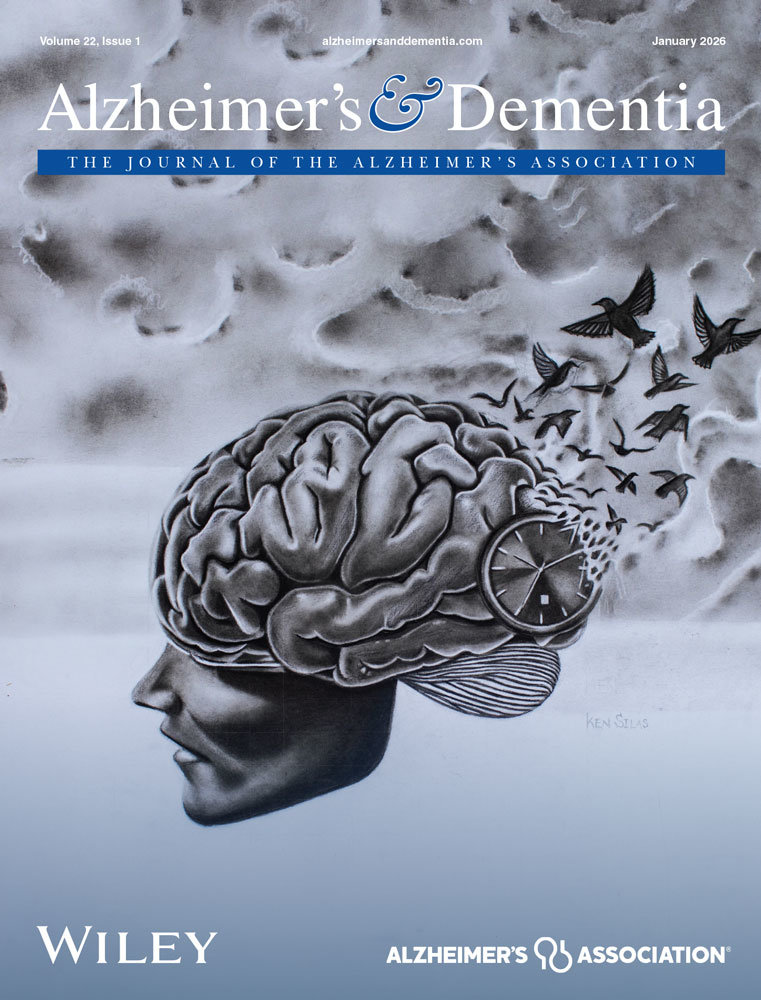
Cover of the January issue of “Alzheimer‘s & Dementia,” a leading international journal in the field of dementia and Alzheimer’s disease, which published the findings of the Gwangju Dementia Cohort Research Group. Provided by Chosun University
Research conducted by a Korean team has found that the risk of developing dementia can be predicted by a blood test up to 10 years before onset.
The Gwangju Dementia Cohort Research Group (Director Lee Geon-ho, Professor, Department of Biomedical Science, Chosun University) announced on the 15th that an integrated analysis of trace amounts of p-Tau217 (phosphorylated tau protein) present in blood and multiple biomarkers measurable through routine blood tests confirmed that dementia onset risk can be predicted far in advance. The study results were published in the January issue of Alzheimer‘s & Dementia, a leading international journal in the field of dementia and Alzheimer’s disease.
The article, titled “The Gwangju Alzheimer’s & Related Dementias (GARD) cohort: Over a decade of Asia’s largest longitudinal multimodal study,” comprehensively summarizes more than 10 years of long-term follow-up findings based on the Gwangju Alzheimer’s & Related Dementias (GARD) cohort.
Over the past 13 years, the Gwangju Dementia Cohort Research Group has conducted a study to identify high-risk dementia groups among more than 20,000 adults aged 60 and older and to track them over an extended period. Focusing particularly on individuals with brain accumulation of beta-amyloid, a known causative substance of dementia, the group performed annual precision medical examinations, including repeated cognitive function tests, brain imaging, and blood tests, to observe the entire process from the preclinical stage to actual onset of dementia.
Using precision medical big data that combined the collected blood samples with clinical, imaging, and cognitive data, the researchers analyzed biological changes that appear in the pre-onset stages of dementia. They reported that when multiple blood biomarkers—such as GFAP (a marker of astrocytes reflecting early brain response in Alzheimer’s disease), NfL (a marker indicating the extent of neural damage and degeneration), cholesterol, and blood glucose levels—are analyzed together, dementia onset risk can be predicted with relatively high accuracy.
The study further showed that applying an artificial intelligence (AI) model trained on such precision medical data can present individual dementia onset risk as quantitative values. The researchers stated that this confirms the potential to develop a risk prediction model based on a simple blood test.
However, the team stressed that these findings are based on analyses of data from a specific cohort that has been followed over a long period. They explained that, for the method to be used as a screening test for the general public in real-world clinical settings, additional studies and standardization involving diverse population groups are required.
Meanwhile, the U.S. Food and Drug Administration recently approved a blood test that detects p-Tau217 as a medical technology for diagnosing Alzheimer’s disease. While this is significant in that it opens a path to diagnosing Alzheimer’s through a relatively simple blood test, medical experts have pointed out that by the time symptoms appear, brain damage is often already substantially advanced, limiting the effectiveness of treatment in many cases.
For this reason, the importance of strategies to identify and manage dementia risk at pre-symptomatic stages has been consistently emphasized. In this context, the latest study is being evaluated as meaningful because it confirms, using long-term data, the feasibility of predicting risk before the onset of dementia.
Lee Geon-ho, director of the Gwangju Dementia Cohort Research Group at Chosun University. Dong-A Ilbo DB
Director Lee Geon-ho said, “To apply dementia prediction technology to the general public, it is important to demonstrate that clinically valid predictions are possible at stages far earlier than the appearance of symptoms,” adding, “This study is significant in that it verified that possibility using long-term cohort data.” He continued, “The precision medical data and blood biobank accumulated in the Gwangju Dementia Cohort can serve as an important foundational resource for future dementia research and technology development.”
ⓒ dongA.com. All rights reserved. Reproduction, redistribution, or use for AI training prohibited.
Popular News