Massive investments on EV boom expectations Chinese rivals’ surge and the ‘chasm’ combine into a crisis Price war in low-cost ESS battery orders Industry calls it a “temporary shock” and asks for support… Government questions “three-player system,” raises restructuring issues
Minister of Trade, Industry and Energy Kim Jung-kwan’s recent remark at a meeting with battery industry executives that he “has doubts about the three-company (Korean) battery system” is being interpreted as stemming from concerns over overinvestment in the Korean battery industry. With domestic battery manufacturers’ plant utilization rates having fallen to about half due to slowing electric vehicle (EV) demand, production capacity far exceeding demand is the core reason behind emerging discussion of restructuring.
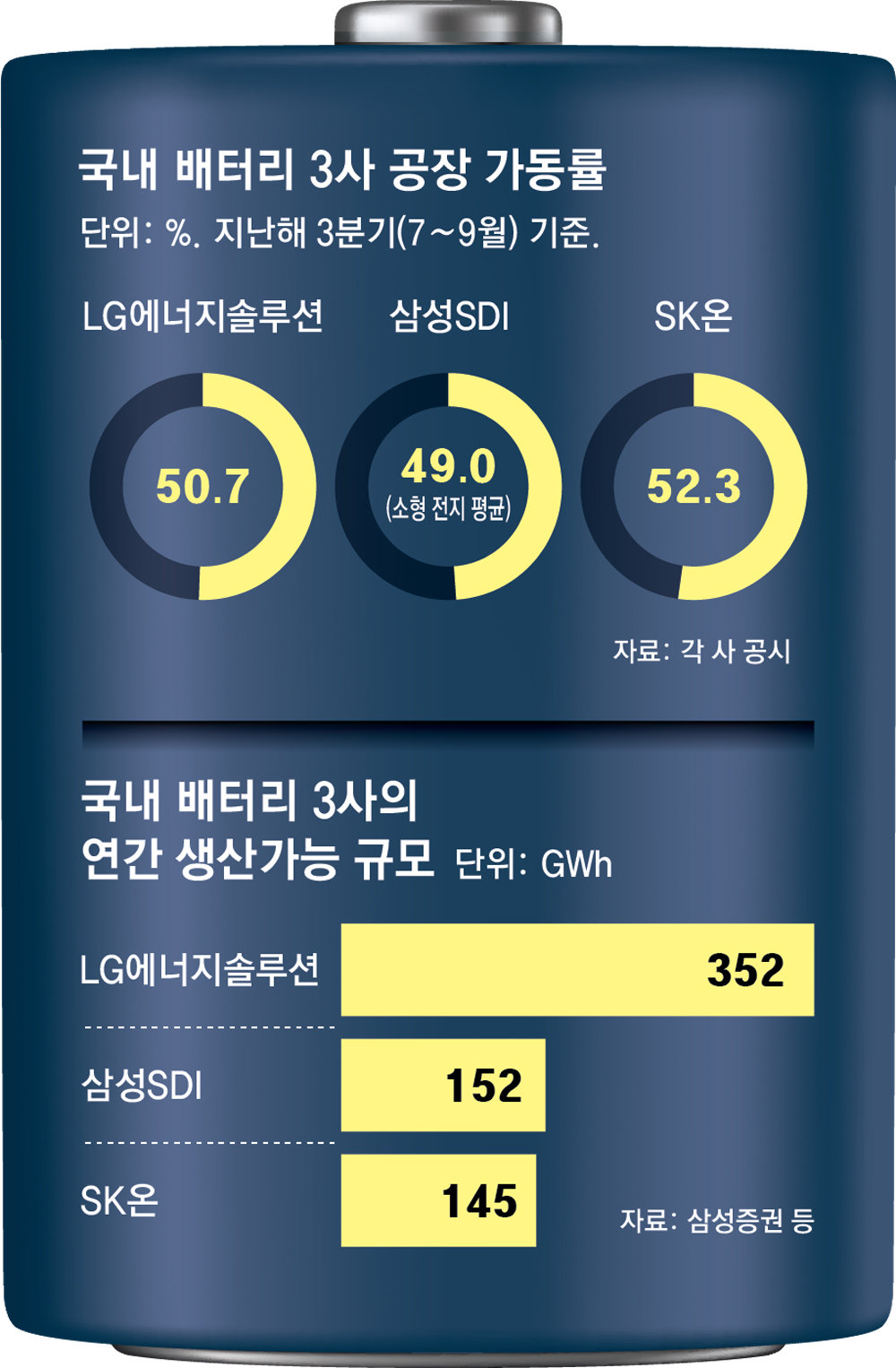
According to Samsung Securities and the battery industry on the 15th, the automotive battery production capacity of Korea’s three major battery makers (LG Energy Solution, SK On, and Samsung SDI) exceeds 500 GWh. This figure is well above the total global EV battery installation volume (excluding China) of 415 GWh in the January–November period last year. This indicates that a structure in which supply exceeds demand is becoming entrenched.
Excess supply directly leads to lower utilization rates and weaker earnings. LG Energy Solution’s plant utilization rate in the third quarter of last year (July–September) was only 50.7%. Considering that utilization of energy storage system (ESS) lines is relatively high, the industry believes the utilization rate of EV battery lines fell short of 50%. Given that LG Energy Solution had been posting operating profits through the third quarter of last year but swung to a provisional operating loss of KRW 122 billion in the fourth quarter (October–December), plant utilization is estimated to have declined further.
SK On’s plant utilization rate in the third quarter of last year also remained around half at 52.3%. Samsung SDI did not separately disclose utilization for mid- to large-sized batteries supplied for EVs, but the average utilization rate for small batteries was calculated at 49%.
Domestic battery manufacturers had carried out large-scale, preemptive capital expenditures in anticipation of rapid expansion in EV adoption. However, as Chinese companies rapidly expanded their global market share by pushing low-priced lithium iron phosphate (LFP) batteries, the position of Korean companies has narrowed. In addition, due to the EV “chasm” (sluggish demand for new industries), global automakers have been withdrawing from or scaling back their EV businesses, canceling or reducing contracts and thereby exacerbating difficulties for Korean suppliers.
The industry maintains that the recent weak performance is a “temporary shock” caused by overlapping external factors such as the scaling back of the U.S. Inflation Reduction Act (IRA) and shifts in the global eco-friendly policy stance. It argues that once EV demand recovers, utilization and earnings will rebound, and therefore policy support such as increased research and development (R&D) assistance should be expanded.
The government, by contrast, is taking a cautious stance. Although it is placing orders to expand the ESS battery market, there is an assessment that intensifying low-price bidding competition among the three battery makers is limiting the effect on profitability improvement. There is also a growing view that technology promotion policies should focus not on “across-the-board support” but on structural reforms to fundamentally enhance the competitiveness of Korea’s battery industry. Minister Kim is also said to have remarked at the battery industry meeting that “across-the-board support is of limited utility when all three battery companies are conducting next-generation battery research.”
Lee Dong-hun
AI-translated with ChatGPT. Provided as is; original Korean text prevails.
ⓒ dongA.com. All rights reserved. Reproduction, redistribution, or use for AI training prohibited.