[Now, the Innovation Finance War] 〈5〉 The UK’s Push to Grow ‘Climate Tech’
Climate tech VCs support startups from early to mature stages
Providing not only capital but also office space, education, and distribution channels
UK government offers tax benefits and partial loss coverage… Upholding a philosophy of ‘support without interference’
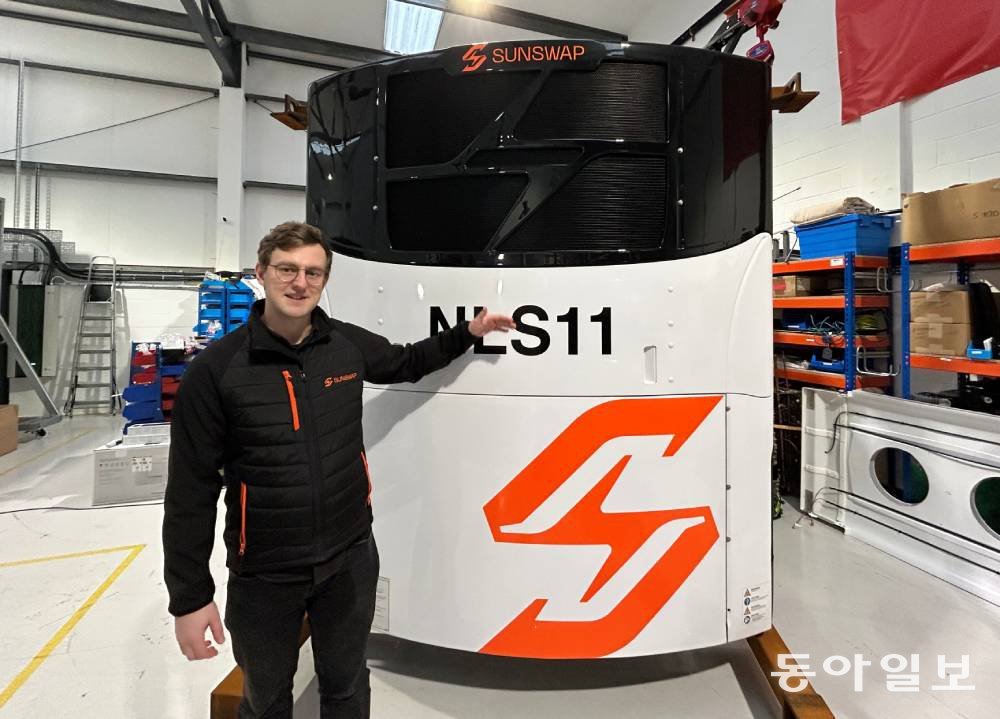
An official from Sunswap, a UK startup specializing in eco-friendly refrigerated transport systems, explains the new product development process at the company’s research and development (R&D) center in Surrey, near London, on 15 December last year. This is the first time Sunswap has opened this space to Asian media. Surrey = Correspondent Yoo Geun-hyung noel@donga.com
“If we had been based in a European country other than the UK, our idea might still exist only in our heads.”
Andrew Suses, co-founder and Chief Operating Officer (COO) of Sunswap, a UK startup specializing in eco-friendly refrigerated transport systems, made this remark on 15 December last year as he opened the company’s research and development (R&D) center in Surrey, near London, to the Dong-A Ilbo, the first media outlet in Asia to be granted access. He said the secret behind Sunswap’s rise to become a “game changer” in the refrigerated trucking sector within five years of its founding in 2020 lies in the UK’s climate tech-focused venture capital (VC) firms. “Climate tech VCs provide incubation to germinate ideas and then move on to acceleration that turns them into commercially viable businesses,” he said.
● Decarbonized refrigerated trucks cut transport costs by 81%
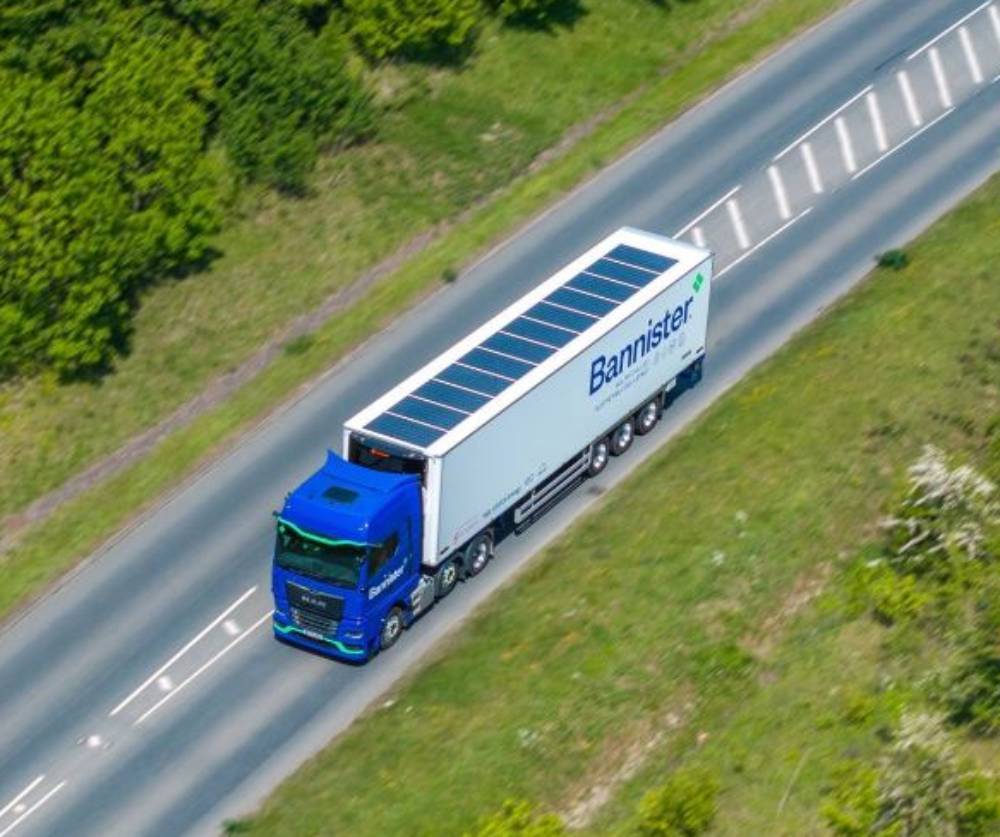
A truck equipped with Sunswap’s “decarbonized truck refrigeration system.” Solar panels attached to the upper part of the refrigerated trailer enable self-charging even while in operation. Provided by Sunswap
Sunswap is regarded as a rising star in the trailer industry, where diesel-based refrigeration systems have dominated for more than 30 years. The company is rapidly growing after developing a “decarbonized refrigerated system” that runs solely on electricity and solar power. By installing high-efficiency solar panels and batteries on the roof and sides of trailers, the system enables self-charging while on the move. This allows annual CO₂ emissions to be reduced by 12 tons per truck. Operating costs for refrigerated trailers have also fallen by up to 81% compared with diesel vehicles.
Sunswap started as a small company founded by three co-founders, including Andrew. In 2020, when the business was still at the idea stage, climate tech-focused VC firm Sustainable Ventures made a decisive investment of GBP 150,000 (about KRW 300 million), laying the foundation for research and development.
Sustainable Ventures not only provided capital but also offered office space. For a year, it supported practical operations including finance, marketing, sales, and website design, and provided a range of training programs. Leveraging its accumulated consulting expertise in climate tech, it proposed business models and helped the company build distribution networks.
● Climate tech VC expertise as the bedrock of success
Once the business gained momentum, additional investments followed. Major UK lender Barclays, the government’s climate fund Clean Growth Fund, and the British Growth Fund all decided to invest. Investment from Shell Ventures greatly helped Sunswap secure a logistics network across Europe.
The investments led to “technological innovation.” As economies of scale were achieved and the company accumulated its own test data, it developed “data-based battery management software technology.” By introducing artificial intelligence (AI) data technology, it also established a system that optimizes battery performance over time. A Sunswap official said, “In legacy diesel-based refrigerated transport systems, it was difficult to know why performance declined or breakdowns occurred, but now we can check battery status and refrigeration levels in real time.” The company that began as the dream of three founders is now growing into a mid-sized enterprise with 100 employees. Its office space has expanded sixfold.
There are also cases where VC firms have directly acquired startups, accelerating technological innovation. Onyx, a wind turbine predictive maintenance company headquartered in Nottingham, UK, has seen its technological innovation pick up speed after global financial group Macquarie acquired a 100% stake in 2024.
Onyx monitors wind power turbines in real time—assets for which failure is hard to predict in advance and where a single breakdown can incur astronomical costs. Previously, the company focused on fault detection and diagnostics for wind power facilities. After Macquarie’s acquisition, however, it evolved into an AI-driven solution that covers decisions on derated operation, repair timing, and resource allocation planning. It has developed from a simple alarm system into a solution that reduces the total operating costs of wind farms. Alexis Grenon, CEO of Onyx, explained, “Macquarie’s investment has ensured stable resource supply and attracted talent, leading to a rapid expansion of our development capabilities.”
● UK government support for VC investment losses
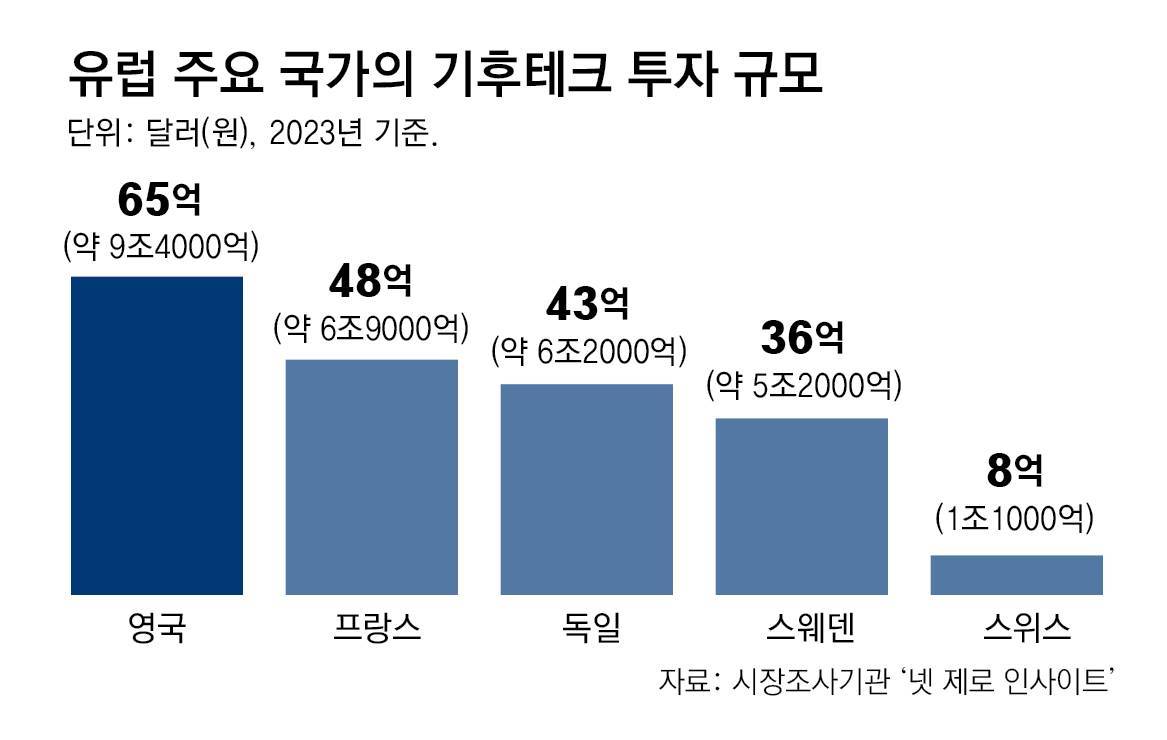
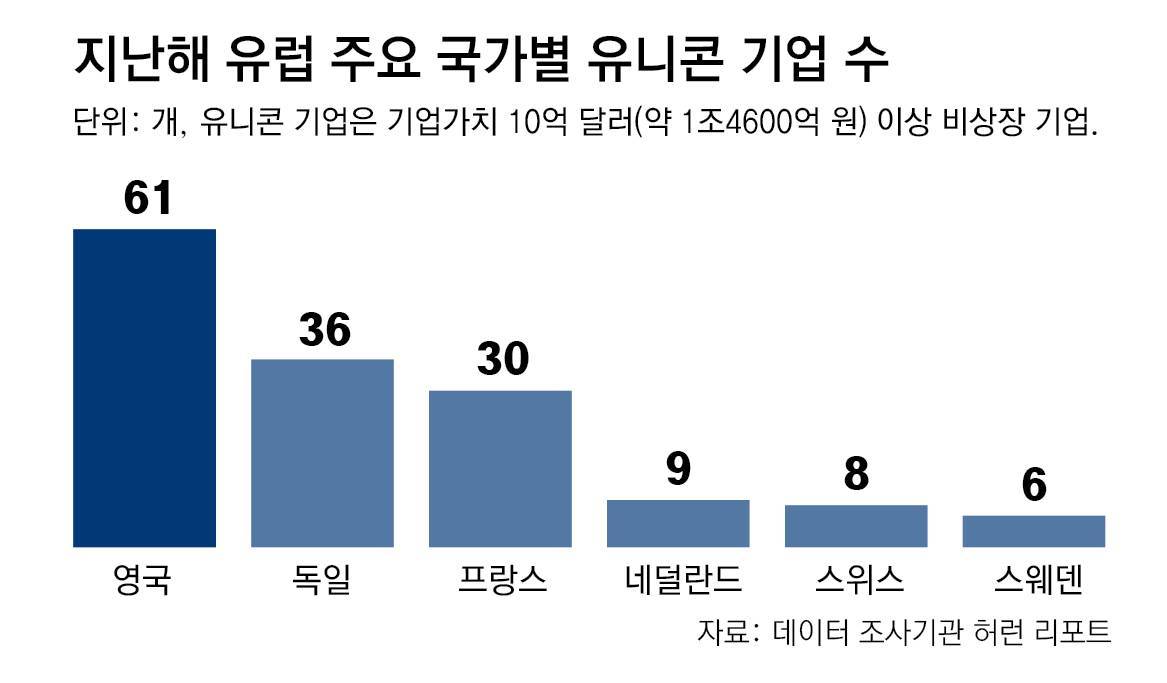
Analysts say the reason the UK startup ecosystem is viewed as relatively robust within Europe is that its innovation finance system functions in a stable manner.
The Seed Enterprise Investment Scheme (SEIS), designed to spur early-stage startup investment, is a prime example. Under SEIS, when individual investors invest in small companies, the UK government provides income tax relief of up to 50%. If the shares are held for more than three years, capital gains tax is exempted, and even if the investment fails, part of the loss is compensated, reducing investment risk. Yuliana, a director at startup consulting specialist Dohe Global, said, “Compared with other European countries, startup investment in the UK is more active because the risk is lower,” adding, “It enables private VCs to invest without hesitation even at the idea stage.”
Schemes designed to nurture startups are also cited as strengths of the UK startup ecosystem. Innovate UK, the UK government’s research and development grant program, provides funds needed at the early development stage but does not acquire equity. It effectively applies the philosophy of “support without interference” to actual investment.
The UK government’s consistency in climate policy is another factor creating a stable investment environment. An Onyx official noted, “In the United States, climate policy changes according to the administration, but in the UK, five-year carbon reduction budgets are already set out in law, which ensures policy consistency.”
UK venture capital firm houses over 160 climate startups
Some 500 founders come and go freely
Separate rooms arranged for high-net-worth investors
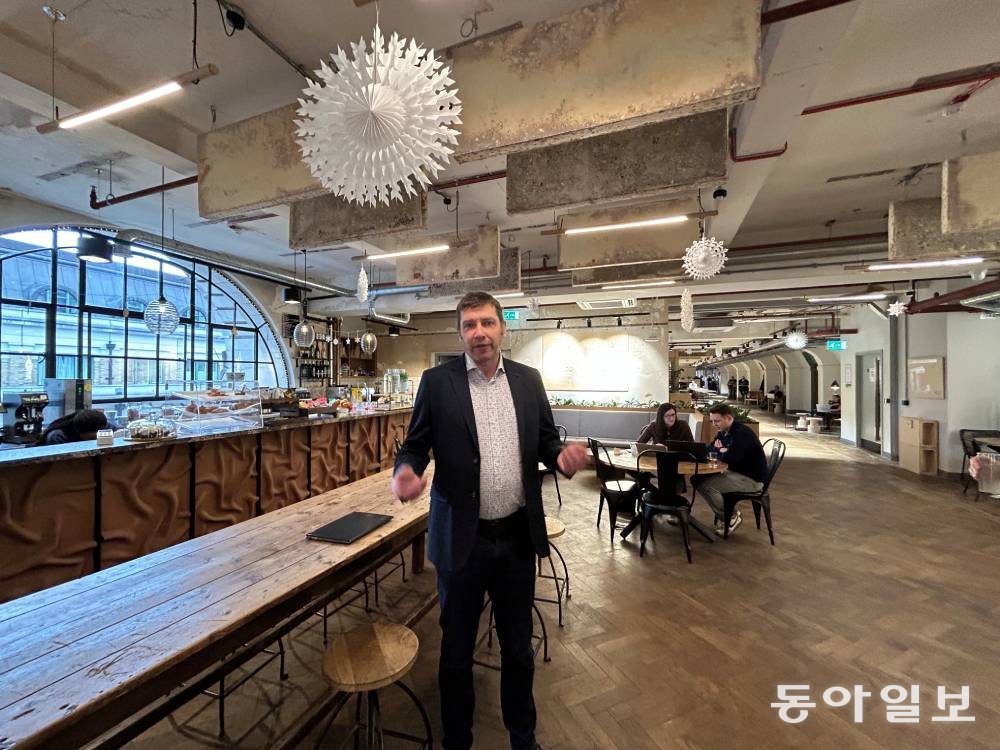
Andrew Wordsworth, CEO of Sustainable Ventures, explains the company’s London headquarters, styled like a café, on 16 December last year. This climate tech-focused venture capital firm retained the structural frame of the more-than-100-year-old building while furnishing the office with recycled materials, projecting the company’s identity into the space. London = Correspondent Yoo Geun-hyung noel@donga.com
“Is this really a company? Not a café?”
On 16 December last year (local time), near the London Eye, a landmark in the UK capital. This was the first impression of the offices of Sustainable Ventures, a climate tech-focused venture capital firm located on the fifth floor of a white brick baroque building more than 100 years old. While the exterior of the building evokes Hogwarts from the Harry Potter novels, the interior feels like stepping into a party room. Right by the entrance, employees were engaged in free-flowing discussions while enjoying a variety of drinks and desserts at a 30% discount in the café. Some people lay in one-person rooms decorated with Christmas ornaments, lost in thought. It was a scene that hardly seemed like a company office.
The building had been used as an administrative office for the City of London since the early 1900s, but for the past 37 years it had been left largely unused without a proper purpose. Three years ago, Sustainable Ventures launched a project to transform this central London building into a “hub of climate tech.”
The walls and floors of the space retain the original materials of more than 100 years, preserving a classical atmosphere. Office interiors such as furniture and partitions, however, are all made from recycled materials. Guided by the belief that “space governs thinking,” the company pursued a space that is as innovative and sustainable as possible. Andrew Wordsworth, CEO of Sustainable Ventures, explained, “We wanted to create a space where innovative and sustainable inspiration can be nurtured from the idea stage.”
The site now houses more than 160 climate tech startups preparing for the future. An average of around 500 people come and go freely each day, regardless of commuting hours. A distinctive feature is that separate rooms are set aside in this space for high-net-worth investors. Sharing the same space, these investors interact with startup founders from the early stages as they search for companies in which to invest.
Sustainable Ventures aims to go beyond the role of a typical VC that invests and generates returns, instead identifying promising companies from the idea stage and developing business models together to cultivate a “climate tech ecosystem.” CEO Wordsworth said, “We are closer to virtual co-founders than investors,” adding, “We help climate tech companies address their challenges from the early stages through tailored support.”
ⓒ dongA.com. All rights reserved. Reproduction, redistribution, or use for AI training prohibited.
Popular News