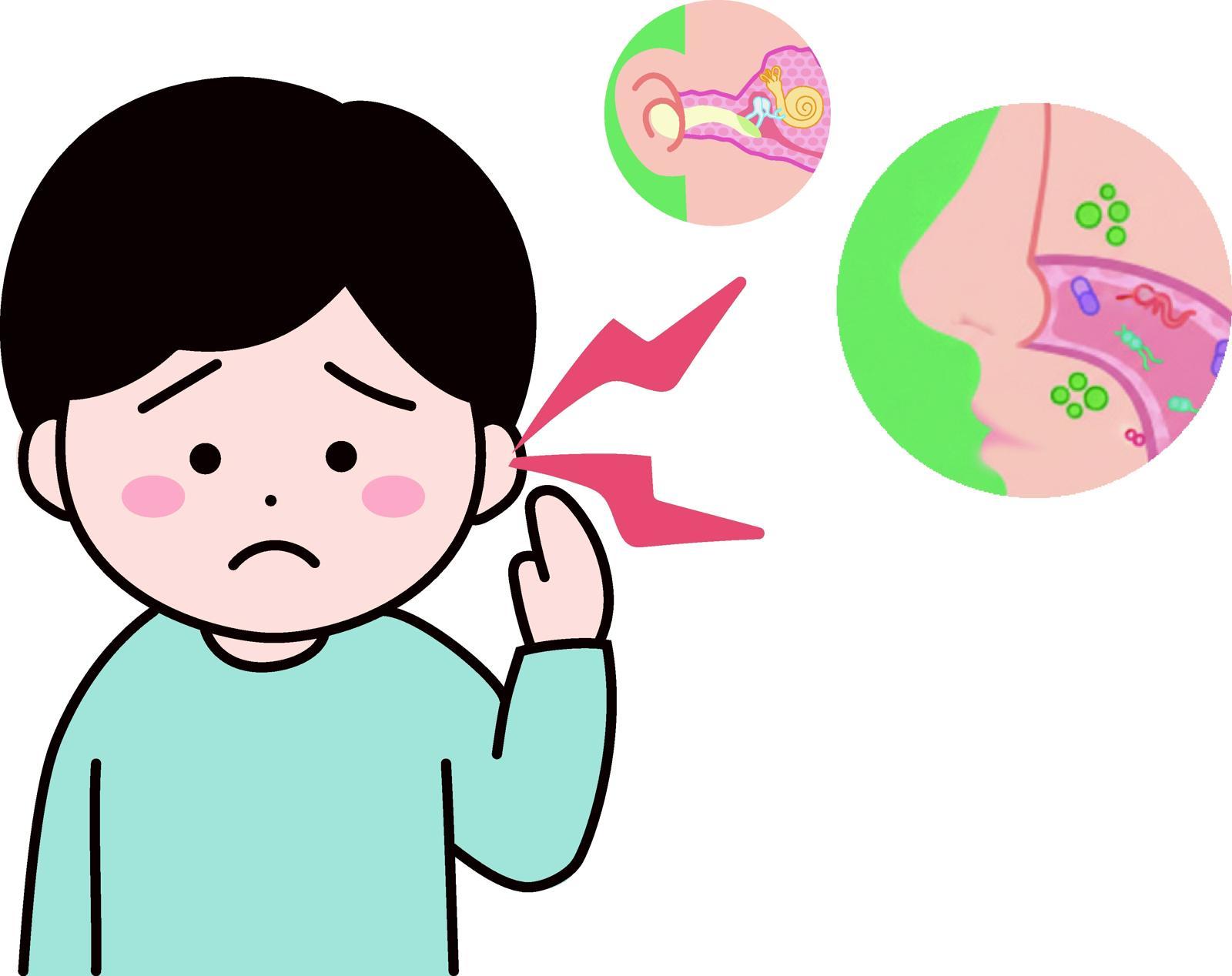
Otitis media common in infants and toddlers… Incidence falls in elementary school as the eustachian tube matures
Children aged 6–12 with chronic otitis media with effusion… Adenoids harbor many pneumococci and other pathogens
Treatment strategies must reflect age and disease type
In cases of otitis media in elementary school children aged six and older, the bacterial environment of the adenoids can have a significant impact. Getty Images Bank
When a child frequently says the ears feel clogged or keeps turning up the TV volume, parents suspect otitis media. Otitis media is one of the most common ear diseases in children and in most cases improves naturally as they grow. However, in some cases, otitis media recurs or persists even after the child reaches elementary school age. A recent study has explained this phenomenon not as “immature Eustachian tube structure,” but as a change in the bacterial environment inhabiting the adenoids. This suggests the need to change the way otitis media in elementary school children is viewed.
Why otitis media occursThe middle ear is the space from the inner side of the eardrum to just before the cochlea, where the ossicles that transmit sound are located. Otitis media refers to inflammation that occurs when viruses or bacteria invade this space. The most common causes are the anatomical structure of the Eustachian tube and upper respiratory infections. The Eustachian tube is the passage that connects the nose and the ear and is responsible for air circulation and discharge of secretions. If the Eustachian tube does not function properly, fluid easily accumulates in the middle ear and leads to inflammation. Upper respiratory infections such as the common cold cause swelling of the mucosa of the Eustachian tube, increasing the risk of otitis media.
Symptoms of otitis media vary by age. In infants and toddlers, it appears as frequent touching of the ears or irritability, while in children and adolescents it manifests as ear pain, a feeling of fullness, and hearing loss. In otitis media with effusion, pain is not severe, but a persistent sensation of fluid in the ear and hearing impairment may occur. Fever or ear discharge may also be present.
Diagnosis begins with an otolaryngology examination. An otoscopic exam is performed to directly observe the eardrum and check its color and mobility, followed, if necessary, by tympanometry, hearing tests, and tympanic impedance tests. When otitis media is recurrent or long-lasting, physicians also evaluate the characteristics of the effusion accumulated in the middle ear, the degree of hearing loss, and the presence of complications.
Treatment for otitis media varies depending on the cause and type. For acute bacterial otitis media, antibiotic therapy is the standard, along with pain control. Otitis media with effusion may be managed with a period of observation, but if it persists for more than three months or if there is marked hearing loss, myringotomy or insertion of ventilation tubes is considered. When adenoid hypertrophy is present, adenoidectomy becomes a treatment option.
Why otitis media persists in elementary school children… Changes in the adenoid bacterial environmentOtitis media is very common in children but generally improves with growth. Infants and toddlers are vulnerable to otitis media because their Eustachian tubes are short and nearly horizontal, making it difficult for secretions to drain, and because their immunity is low. As they grow, the Eustachian tubes lengthen and tilt downward, promoting drainage of middle ear secretions and typically reducing the incidence of otitis media.
However, some children still do not recover easily from otitis media even after reaching elementary school age. This has been difficult to explain using only the traditional theory of “immature Eustachian tube structure.” In response, a research team led by Professor Hong Suk-min of the Department of Otolaryngology at Kangdong Kyung Hee University Hospital and Professor Kim Bong-soo of the Department of Food and Nutrition at Ewha Womans University focused on the adenoids, which are closely related to otitis media. The adenoids are triangular lymphatic tissue located on the superior and posterior walls of the nasopharynx at the back of the nose and, together with the palatine tonsils, are responsible for the body’s primary immune function.
The research team analyzed the bacterial environment of adenoid tissue collected from the back of the nose in pediatric patients who underwent surgery for chronic otitis media with effusion lasting more than three months between May 2020 and February 2021. The control group consisted of children who underwent tonsillectomy or adenoidectomy during the same period. Subjects were divided into two age groups, 2–5 years and 6–12 years, to compare age-related differences, and the relationship between the state of effusion in the middle ear and the persistence of otitis media was also analyzed.
Results showed that in healthy children, the bacterial composition inhabiting the adenoids tends to change naturally with growth. In contrast, in patients aged 6–12 years with chronic otitis media with effusion, this age-specific pattern of change disappeared. In particular, in children with long-standing otitis media, bacteria associated with exacerbation of otitis media, such as Streptococcus pneumoniae and Haemophilus influenzae, increased, and the overall bacterial balance was disrupted. These changes were more pronounced in otitis media accompanied by sticky, mucous effusion.
Professor Hong Suk-min explained, “In pediatric otitis media, the influence of Eustachian tube structure is generally large, but in elementary school children aged six and older, the adenoid bacterial environment can have a significant impact on the persistence of otitis media,” and added, “Treatment strategies need to take both age and the type of otitis media into account.” The study is regarded as providing evidence that pediatric otitis media should be approached as a different disease entity depending on age.
The key in managing otitis media is not to leave it untreated. If otitis media recurs or persists for a long time, hearing loss can become fixed and may affect learning and language development. If a child seems not to hear well or frequently complains of ear discomfort, early medical evaluation is necessary.
Lifestyle management is also important. To prevent colds, thorough handwashing and personal hygiene are required, and exposure to secondhand smoke should be avoided. When rhinitis or adenoid hypertrophy is present, managing these conditions together helps reduce recurrence of otitis media. Above all, rather than relying solely on the belief that “it will get better with age,” if otitis media persists beyond elementary school years, re-evaluating the cause and adjusting the treatment approach is crucial to protecting the child’s hearing and quality of life.
ⓒ dongA.com. All rights reserved. Reproduction, redistribution, or use for AI training prohibited.
Popular News