■ Yonsei University College of Medicine identifies principles of immune response regulation
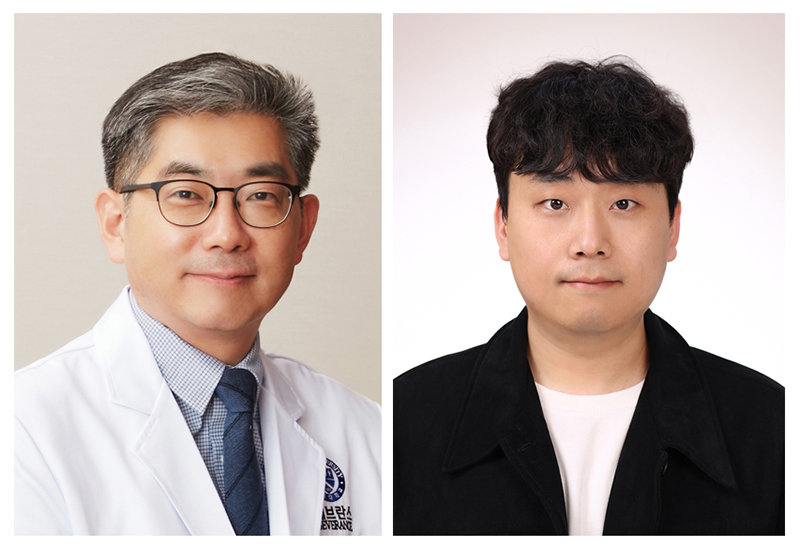
From left, Professor Hyungpyo Kim, Professor Eunchong Lee
A study has found that the three-dimensional structure of the genome directly affects the functioning of immune genes and drug responses. A research team led by Professor Hyungpyo Kim of the Department of Tropical Medicine at Yonsei University College of Medicine and Professor Eunchong Lee of the Department of Biomedical Science has identified that changes in the three-dimensional structure of the genome in immune cells regulate the intensity and speed of gene expression as well as drug responses. The findings were published in the latest issue of the international genomics journal “Nucleic Acids Research.”
DNA does not exist as a simple linear structure; it folds and connects into a three-dimensional configuration, and this structure determines when and to what extent genes are activated. The research team generated CD4+ T cells in which the function of CTCF, a key protein that orchestrates the tertiary structure of chromatin, was partially removed and compared them with normal cells. In normal cells, stable three-dimensional contacts were formed between immune genes and distant regulatory regions, but when CTCF function was reduced, these contact structures weakened and were reorganized.
When these contact structures collapsed, the speed of gene activation also slowed noticeably. During the process in which RNA polymerase reads genes, the pausing stage became prolonged, reducing the efficiency of immune gene expression. In experiments with drugs used to treat immune disorders, transcriptional responses of genes also varied depending on the three-dimensional structure of the genome. Professor Hyungpyo Kim stated, “This study experimentally demonstrates that the genome must be understood not as a plane but as a three-dimensional network,” adding, “It will serve as important foundational data for research on individual differences in drug response and precision medicine.”
■ Effectiveness of Korean medicine treatment confirmed in patients after cervical disc surgery
A study has reported that integrative Korean medicine treatment may help patients who continue to suffer from pain and functional impairment even after cervical (neck) disc surgery. Jaseng Spine and Joint Research Institute of Jaseng Hospital of Korean Medicine announced that it has published in the international journal “Journal of Pain Research” a study analyzing the effectiveness of integrative Korean medicine treatment in patients hospitalized at a Korean medicine hospital after cervical surgery.
Cervical disc herniation is a condition in which the disc between cervical vertebrae protrudes or ruptures, compressing nerves and causing not only neck pain but also symptoms such as numbness in the shoulders, arms, and hands, as well as headache and dizziness. According to statistics from the National Health Insurance Service, there are approximately 970,000 patients per year in Korea with cervical intervertebral disc disorders. Even when surgery is performed, complications such as pain, dysphagia, and paralysis may occur during the recovery process.
The research team analyzed the medical records of 142 patients with a history of cervical disc surgery who were hospitalized for neck pain at the Gangnam, Bucheon, Daejeon, and Haeundae branches of Jaseng Hospital of Korean Medicine between 2015 and 2022. On average, patients received 17 days of integrative Korean medicine treatment consisting of acupuncture, pharmacopuncture, and Chuna manual therapy.
As a result of treatment, both the Numeric Rating Scale (NRS) scores for neck pain and upper extremity radiating pain decreased by more than 2 points, and the Neck Disability Index (NDI) and quality of life measure (EQ-5D-5L) also improved significantly. No serious adverse events were observed. The research team stated that, in the recovery phase after cervical surgery, integrative Korean medicine treatment may serve as a safe adjunct therapy for pain relief and functional recovery.
■ Agreement signed to develop cancer patient prognosis management service
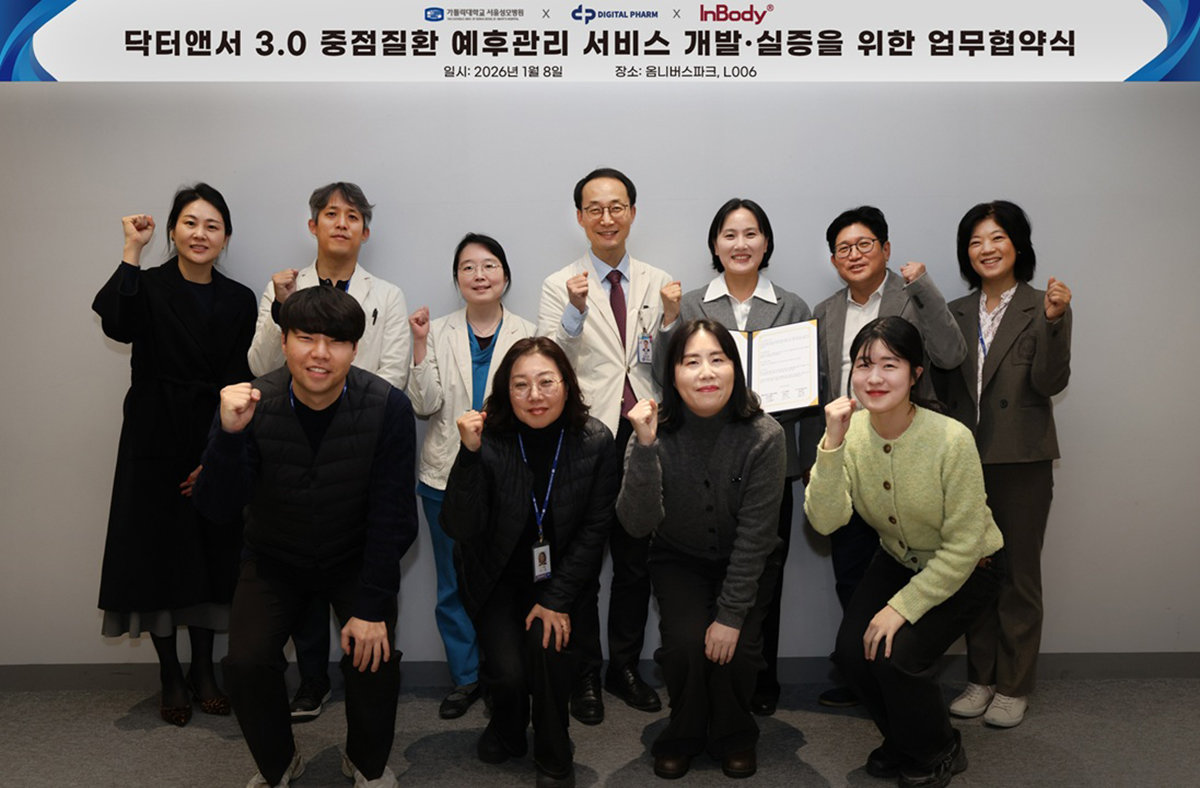
Seoul St. Mary’s Hospital announced that on the 8th it signed a tripartite memorandum of understanding with Digital Pharm Co., Ltd. and InBody Healthcare Co., Ltd. for the development and verification of prognosis management services for key diseases under “Dr. Answer 3.0.” This agreement is expected to serve as a turning point in developing and disseminating AI-based prognosis management services in the fields of breast cancer and kidney cancer, which are among the 10 key diseases of Dr. Answer 3.0 for which Seoul St. Mary’s Hospital is the lead institution.
The core of the project is to monitor changes in the condition of cancer patients in real time using body composition analyzers that can be used at home. By analyzing segmental impedance and extracellular water ratio, the system aims to detect early lymphedema in breast cancer patients and fluid imbalance in kidney cancer patients. Data measured directly by patients and self-reported symptom records are integrated and managed via the prognosis management app “Kamediate.”
Based on the information collected, the app automatically identifies high-risk groups and provides real-time tracking and management functions, improving the efficiency of clinical care. The goal is to implement a “patient-centered continuous care system” that enables early intervention by detecting warning signs before hospital visits. Once a standard model is established through real-world validation, it is expected to become a digital healthcare precedent that can be extended to various diseases and regions. The service is scheduled for official launch in September.
ⓒ dongA.com. All rights reserved. Reproduction, redistribution, or use for AI training prohibited.
Popular News