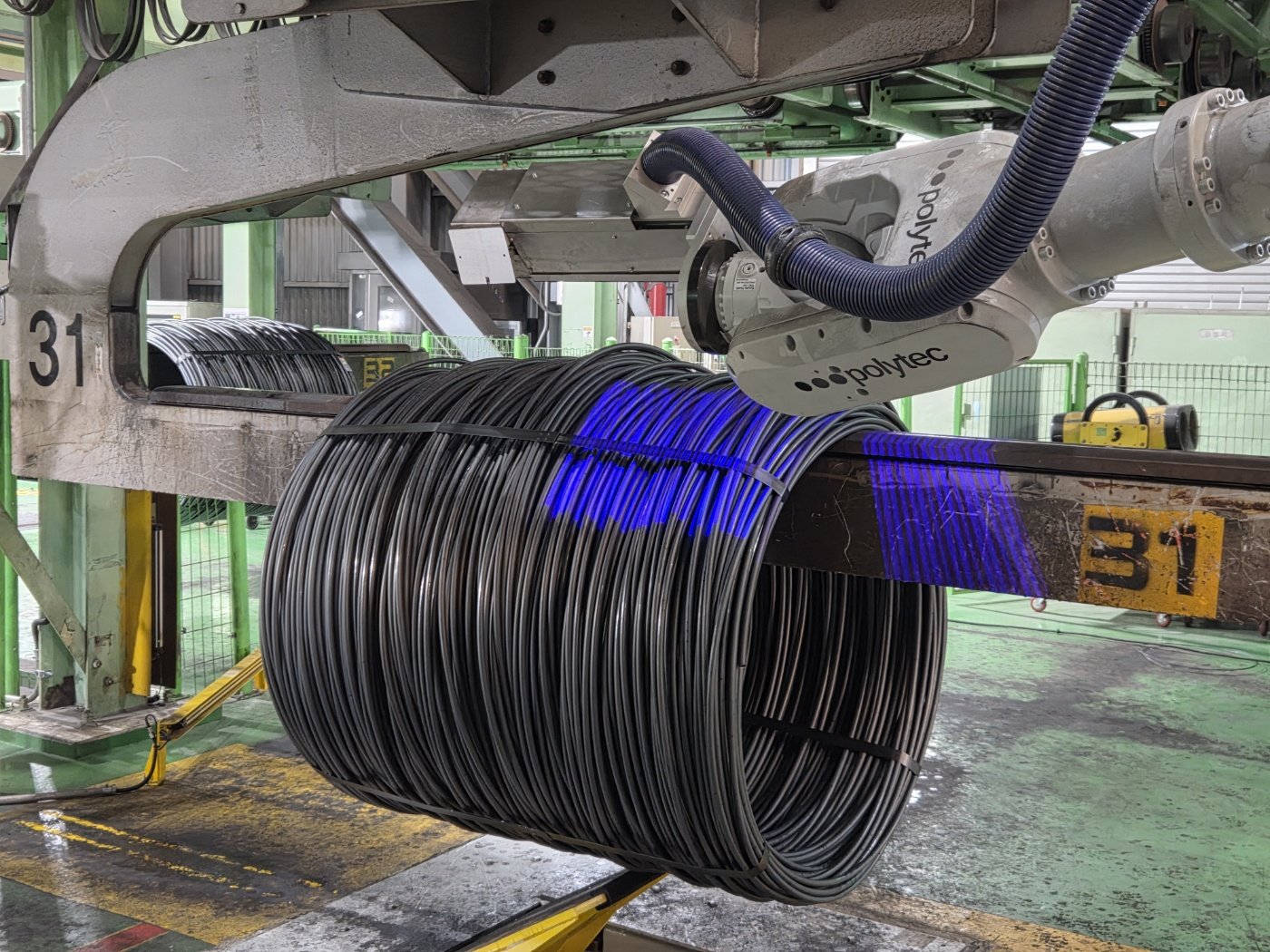
Hyundai Steel’s “wire rod tagging robot” attaching tags to products. Provided by Hyundai Steel
Hyundai Steel announced on the 30th that it is accelerating the smartification of its processes by operating robots in the inspection and packaging stages for wire rod.
In November, Hyundai Steel began operating a “wire rod tagging robot” on the wire rod coil shipment line at its small bar rolling mill for special steel in Dangjin, which automatically attaches tags containing information such as product history and specifications.
Wire rod is a product in which long, thin bar-shaped steel is processed and wound into a coil form. To minimize errors such as grade mixing caused by incorrect tag attachment and to improve safety, Hyundai Steel has been promoting unmanned and automated shipment operations, and as part of these efforts introduced robots. This is the first case in Korea of using robots for wire rod tagging.
The “wire rod tagging robot” system consists of ▲ an assembly robot ▲ an attachment robot ▲ and other components such as conveyors, coil fixing devices, and safety fences. The assembly robot attaches clips to printed product tags, and the wire rod transported along the conveyor is placed on the fixing device. The attachment robot scans the transported wire rod to locate the tag attachment position and automatically affixes the tag there.
Hyundai Steel has been promoting the introduction of the robot since last year in cooperation with BM Group Polytec, an Italian company specializing in steel industry automation. Over approximately two years, it designed the system so that the robot could be operated efficiently and safely, and recently completed on-site deployment after passing the final test (FAT2). In particular, it placed special emphasis on safety by clearly separating the area around the robot into equipment operation zones and worker access zones.
A Hyundai Steel official stated, “By having robots replace the wire rod tag attachment work that previously depended on workers’ hands, work efficiency has improved,” adding, “The company plans to continue expanding investment in robots in line with global steel industry trends.”
Hyundai Steel has been pursuing smartification across production, inspection, and shipment processes, including the introduction in July of a “beam blank shape analysis robot” at its Incheon plant to inspect the dimensions and surface temperature of high-temperature beam blanks.
ⓒ dongA.com. All rights reserved. Reproduction, redistribution, or use for AI training prohibited.
Popular News