New Treatment Developed by KAIST Professor Park Ji-ho’s Team
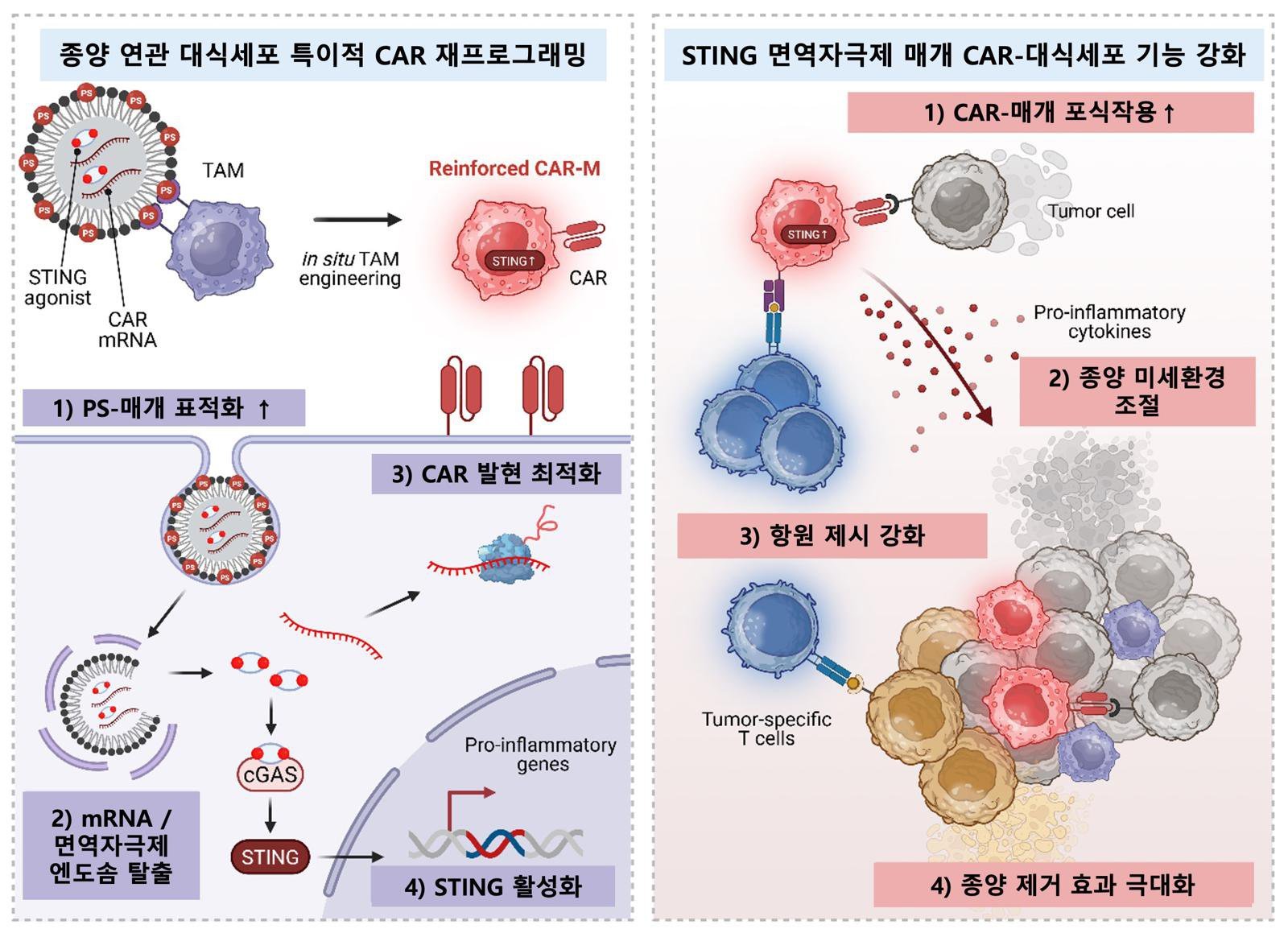
Schematic diagram of an in vivo CAR-macrophage generation and cancer cell-killing strategy via simultaneous delivery of CAR mRNA and an immune stimulant using lipid nanoparticles (provided by KAIST) / News1
A Korean research team has developed a therapy that awakens dormant immune cells inside solid tumors and induces them to attack the cancer. It is a new method that transforms immune cells within the body into anti-cancer cell therapies.
KAIST announced on the 30th that a team led by Professor Park Ji-ho of the Department of Bio and Brain Engineering has developed a method to use macrophages—a type of immune cell located near tumors—as anti-cancer cell therapies by delivering genetic information encoding the chimeric antigen receptor (CAR) protein, which recognizes cancer cells, into these macrophages. The study was published in the November 18 issue of the international journal “ACS Nano.”
The core of this therapy is the use of macrophages located “near the tumor” and, further, the delivery of CAR proteins directly into macrophages in vivo. CAR is a receptor protein engineered to enable immune cells to precisely recognize and attack cancer cells. Existing CAR protein-based therapies include chimeric antigen receptor T cell (CAR-T) products such as “Kymriah” and “Carvykti.” These have been hailed as “dream cancer drugs” for their remarkable therapeutic effects, but they have limitations in that their penetration into solid tumors—such as gastric, lung, and liver cancers that form hard masses—is low, restricting their use mainly to blood cancers.
To address this, the researchers utilized macrophages that cluster around tumors. Because these cells are already located close to the tumor, penetration is much easier. The team encapsulated mRNA carrying CAR genetic information and an immune stimulant that activates immune responses into lipid nanoparticles and injected them into the interior of tumors. Macrophages rapidly absorbed these particles and expressed CAR proteins on their cell surfaces. In effect, macrophages already present in the body were converted “within the body itself” into anti-cancer cell therapies.
Professor Park stated, “This is highly significant in that it simultaneously overcomes the two major limitations of existing CAR-macrophage therapies—delivery efficiency and the immunosuppressive tumor microenvironment.”
Choi Ji-won
AI-translated with ChatGPT. Provided as is; original Korean text prevails.
ⓒ dongA.com. All rights reserved. Reproduction, redistribution, or use for AI training prohibited.