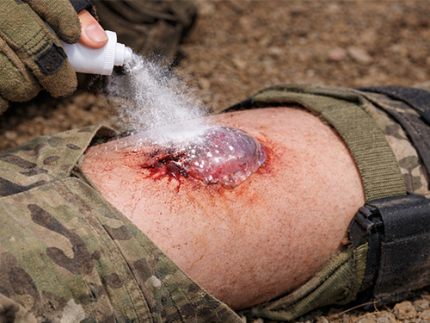
Virtual (AI-generated) image of the next-generation hemostatic agent developed by KAIST researchers. Provided by KAIST.
A next-generation hemostatic agent that, when sprayed on a wound, forms a strong hydrogel barrier within one second to stop bleeding has been developed through joint research by domestic scientists and an active-duty military officer.
On the 29th, KAIST announced that a joint research team led by Professor Steve Park of the Department of Materials Science and Engineering and Professor Sangyong Jon of the Department of Biological Sciences has developed a next-generation hemostatic agent, “AGCL Powder,” which can be freely applied even to deep and irregular wounds.
Provided by KAIST
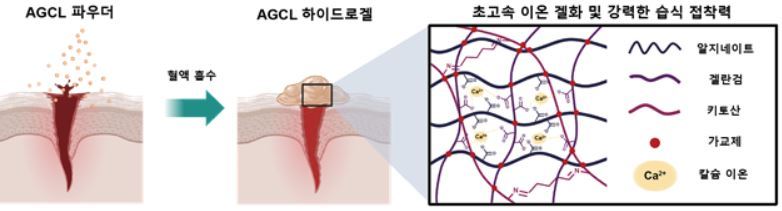
AGCL Powder combines biocompatible natural materials such as alginate and gellan gum (which react with calcium for ultra-fast gelation and physical sealing) and chitosan (which binds with blood components to enhance chemical and biological hemostasis). When it reacts with cations such as calcium in the blood, it transforms into a gel state within one second, immediately sealing the wound.
By forming a three-dimensional structure inside the powder, it can absorb blood amounting to more than seven times (725%) its own weight, rapidly blocking blood flow even in high-pressure, massive bleeding situations. It also exhibits high adhesion strength exceeding 40 kPa, a pressure level that allows it to withstand strong manual compression.
In particular, as it is made from naturally derived substances, it is safe, demonstrating a cell viability of 99% or higher and an antibacterial effect of 99.9% during use. Animal experiments also confirmed tissue regeneration effects, including the promotion of vascular and collagen regeneration.
This hemostatic agent maintains its performance for two years even at room temperature and in high-humidity environments, enabling immediate use in harsh conditions such as military operation zones or disaster areas.
In surgical experiments involving liver injury, the amount of bleeding and hemostasis time were significantly reduced compared with commercial hemostatic agents, and liver function returned to normal levels two weeks after surgery. No abnormal findings were observed in systemic toxicity assessments.
Previously used patch-type hemostatic agents in clinical settings have a planar structure, making them difficult to apply to complex wounds, and they are sensitive to temperature and humidity, which has limited their storage and operational use.
The research team explained that the newly developed hemostatic agent secures versatility by being able to respond to a wide range of wound types.
Notably, an active-duty Army major participated directly in the technology research, enhancing the completeness of the solution as a practical, combat-ready technology that takes actual battlefield conditions into account.
KAIST doctoral candidate Kyu-Soon Park (Army Major) stated, “The core of modern warfare is minimizing loss of life,” adding, “This research began with a sense of duty to save even one more soldier.” Park continued, “It is expected that this technology will be used to save lives in both defense and civilian medical settings.”
KAIST commented, “Although this is an advanced new-materials technology developed with defense purposes in mind, its potential application across emergency medicine in general—such as in disaster sites, developing countries, and medically underserved regions—is also very high,” and added, “From emergency first aid on the battlefield to hemostasis in internal surgical procedures, this is regarded as a representative ‘spin-off case’ in which defense science and technology have expanded into the civilian sector.”
ⓒ dongA.com. All rights reserved. Reproduction, redistribution, or use for AI training prohibited.
Popular News