The moment the “Hangang Ramyeon” cooker moved closer to the public
Ramen cookers first appeared more than 20 years ago, but it has only been a few years since “Hangang Ramen” began to take hold in the public consciousness. What made it more familiar to the wider public was the Hauscook ramen cooker from kitchen appliance manufacturer Beomil Industry, which has swept unmanned ramen shops across the country. Its proprietary induction coil technology was given “wings” by the COVID-19 pandemic and the rise of K-culture. The Eureka moment that took Hangang Ramen beyond the Han River started here.
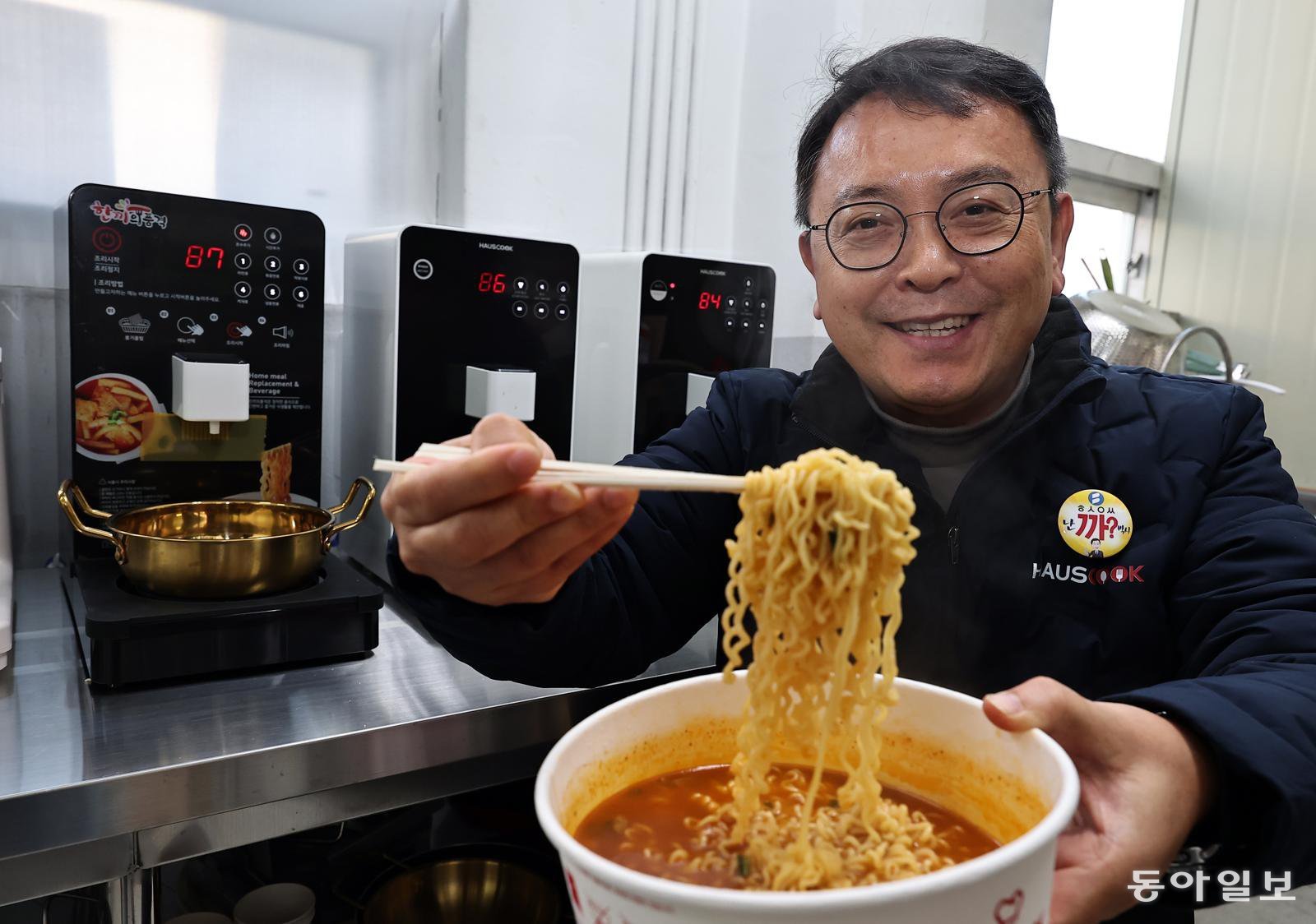
On 19 December, Beomil Industry CEO Shin Young-seok tastes ramen cooked with a ramen cooker in the company’s development lab at the Namdong National Industrial Complex in Namdong District, Incheon. Incheon=Reporter Yang Hoe-seong yohan@donga.com
It was late 2014. In the conference room of Beomil Industry at the Namdong National Industrial Complex in Namdong District, Incheon, an outside consulting adviser, several research team members, and CEO Shin Young-seok (58) put their heads together. Beomil Industry mainly supplied heater plates for electric rice cookers and electromagnetic induction heating (IH) coils to major Japanese home appliance manufacturers. Then the Japanese side proposed developing a fryer using induction coils. This was an opportunity not just to supply parts but to manufacture finished products. While discussing the pros and cons of a fryer, one team member said, “Since we have induction coil technology, how about considering a ramen cooker as well?”
That struck Shin like a flash. He thought, “This is it.” As a second-generation manager who had taken over the company built by his father, he was under pressure to further grow the business. He had been feeling the limitations of the parts industry. Until then, he had only a vague idea about entering finished product manufacturing. To do that, it could not be something completely unfamiliar. What could they make using the technology they already had? A ramen cooker looked appealing.
● “Hangang Ramen” was about atmosphere, but…Outside the home, ramen is usually cooked at snack bars over gas burners shooting up high flames. The ramen cooker was created based on the idea of what it would be like to boil ramen using an electric heater instead. The industry believes the first such machines appeared in the mid to late 1990s.
Early ramen cookers mainly used halogen-type electric heaters. In this highlight system, an electric current heats a filament, which glows red hot and produces heat. One small company first produced them, then the product passed to another company, or the original firm went out of business. Through these twists and turns, there was no proper verification of durability or other performance aspects.
These filament-type cookers were installed in a few snack stands in Seoul’s Hangang Park under the name “freshly boiled ramen.” After the mid-2000s, a few units were installed in some convenience stores that had replaced snack stands and rest areas in Hangang Park.
The industry consensus is that the quality was not at a level that could be called a proper product. They were inexpensive but often broke down, and the surface of the cooker became so hot there was a significant risk of burns. When ramen broth boiled over and stuck to the surface, it was hard to clean, giving a poor impression in terms of hygiene. As there was no dedicated container, ramen had to be eaten from an aluminum foil tray. Most critically, the ramen was only just about edible; it fell short of the level of ramen cooked at home or in restaurants.
Nevertheless, word-of-mouth began slowly to spread among visitors to the Hangang, thanks to the river’s unique atmosphere. Many people go to the river to jog or walk, or to rest by spreading mats or setting up small tents on the grass. As a result, people valued the experience and atmosphere of eating ramen while looking at the river more than the taste itself. Naturally, it did not yet have the broad popularity associated with today’s nickname “Hangang Ramen.” Still, there were signs that the cooking mechanism was shifting from halogen to induction. By 2015, several cooker manufacturers had started inquiring with Beomil Industry about induction coils.
Shin concluded that entering the ramen cooker market was worth a try. Since almost everyone in Korea enjoys ramen, the market seemed highly sustainable, and he intuitively believed it would not be too difficult technologically to surpass the existing low-quality cookers in terms of performance and functionality. Research showed that ramen cookers did not exist at all overseas. Beyond ramen itself, it seemed that if the devices could handle food more broadly, the market could be larger. Moreover, it was a market too small for large conglomerates to enter, but one that still required technology and capital burdensome enough to deter small firms with weak foundations. That, too, did not look bad. Shin had confidence in his technology.
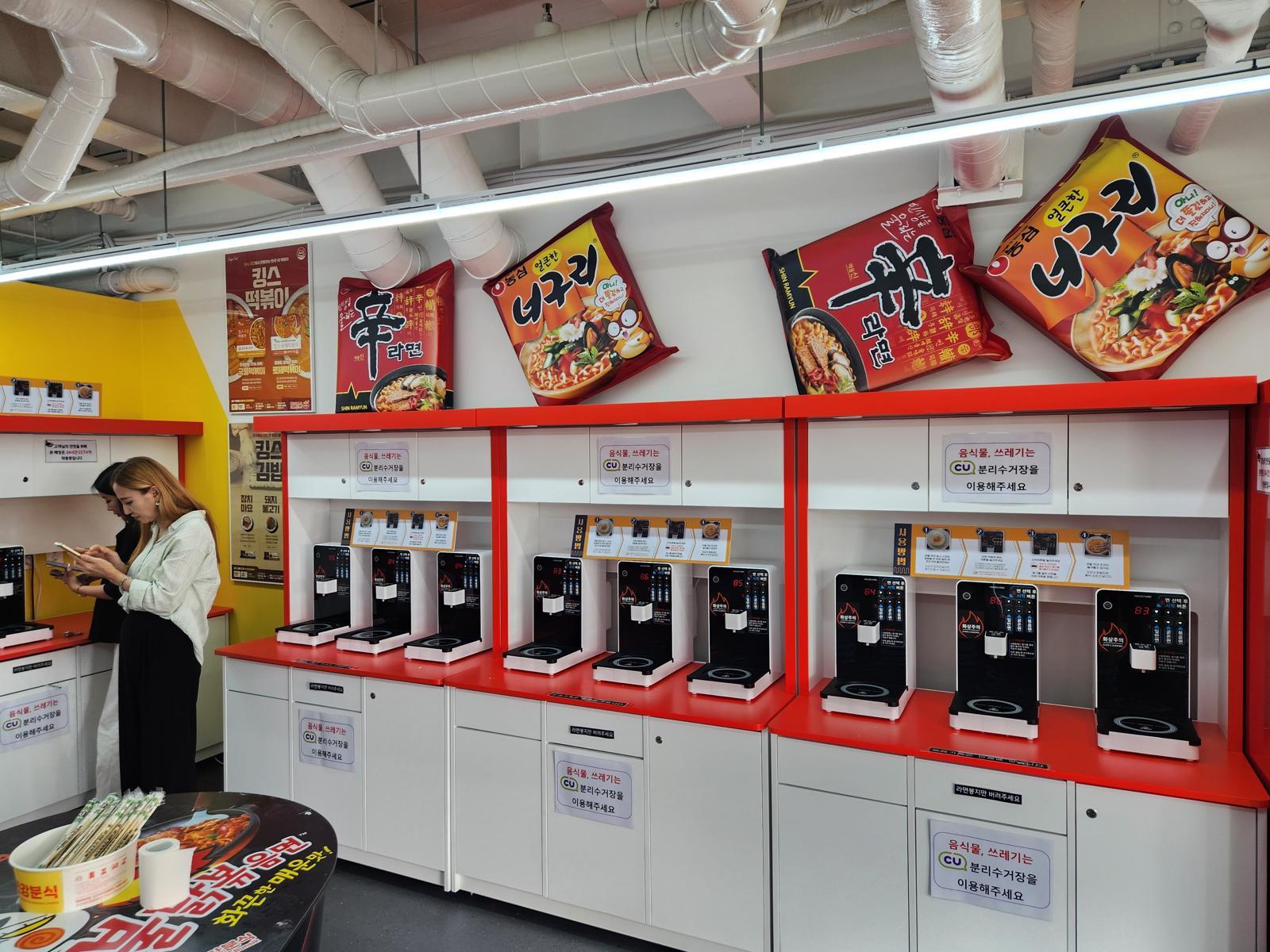
Interior of an unmanned restaurant at “Mapoint Naru” in Mangwon Hangang Park, Mapo District, Seoul. Customers stand in front of Beomil Industry’s Hauscook ramen cookers. Provided by Beomil Industry
● Boiling water quickly for continuous cookingBeomil Industry, founded in 1980 by Shin’s father, Chairman Shin Pyeong-gyun, possessed electric heating technology. Leveraging that technology, in 1998, during the Asian financial crisis triggered by the IMF bailout, the company became the first in Korea to export heater plates for rice cookers to four of Japan’s six leading home appliance manufacturers, including Mitsubishi, Sanyo, Sharp, and Tiger. It later upgraded its heating technology to develop induction coils, which it supplied to major Korean rice cooker manufacturers and exported to Japan as well. These coils are currently used in induction products produced by large conglomerates.
The core of the company’s Hauscook-brand ramen cooker, as Shin sees it, is its technology for boiling water quickly. Food does not taste better simply because it is cooked over the highest heat. Just as spicy fish stew needs to be boiled for a certain period to develop a rich flavor, the same is true for ramen. It needs to be boiled for long enough to bring out the inherent taste of the noodles. In a Hauscook cooker, water boils in about 40 seconds. Competitors’ machines typically take around two minutes.
“Most ramen cookers set the cooking time at 3 minutes 50 seconds to 4 minutes. To get the proper taste of ramen, most of that time should be devoted to cooking, but more than half is spent boiling the water, and the rest is used for actual cooking. As a result, you do not get that chewy noodle texture or the full flavor of the broth.”
The company’s induction coils have an energy efficiency of over 90%. By contrast, induction coils imported from China under OEM (original equipment manufacturing) contracts by various domestic companies are about 70–80% efficient. It is no exaggeration to say that, given the same time, which cooker boils faster is largely determined right there.
But speed alone is not enough. The cooker must be durable enough to operate quickly and continuously without errors. “To verify the durability of our cookers, I think we boiled more than 50,000 servings of ramen,” Shin said. “We once ran a single cooker at full capacity 24 hours a day without a break.” With a four-minute cooking time, one cooker can boil roughly 360 servings of ramen per day. He said that even under such continuous use, not a single error occurred. Shin, of course, took machines home and tested them constantly himself.
After more than a year of research and development, the first product came out in August 2016. Following about a year of improvements, full-scale sales began in 2017. Shin is highly confident about the cooker’s technical aspects. That does not mean there were no challenges.
Research team members sometimes said they wanted to quit because they were being asked to do work they had never done before, among other reasons. Above all, there was substantial opposition from those around him. They asked why the company should venture into finished products, where it had no experience, when its existing parts production and sales channels were already well established. Some said, “You will go bankrupt trying to develop this.” When the company opened a store called “Falling for Ramen” near the Gasan Digital Complex in Geumcheon District, Seoul, in 2018, combining ramen cookers and fryers to pioneer new distribution channels, Shin’s father even took to bed in distress, asking, “Why are you wasting money doing things you have never done before?” It took a long period of persuasion. Two external factors helped a cooker that Shin believed could compete anywhere in terms of quality and technology finally gain recognition.
● The “power” of the COVID-19 pandemic and K-cultureAccording to Shin, the head office of a gimbap franchise that ranks among the top in domestic sales recently conducted its own survey of unmanned ramen shops nationwide. Looking for easier ways to open more advanced “smart” stores, it chose the rapidly increasing unmanned ramen shops as a benchmarking target. “We visited every ramen shop we could find,” a company representative told Shin, “and 95% of the installed cookers were Hauscook.”
Right after the full-scale launch of its ramen cookers, Beomil Industry held talks with domestic and overseas buyers and received very positive feedback. It seemed that sales channels would open easily. But things did not go as expected. The sudden change came from an event that Shin could not have foreseen.
“Comparing the periods before and after the COVID-19 pandemic is like night and day.”
Before the pandemic, self-employed business owners and buyers were interested in ramen cookers but hesitated to introduce them. After the pandemic, as the economy as a whole deteriorated, they appeared to conclude that it would be difficult to generate sales using existing models, and cooker sales surged. The same was true for unmanned ramen shops.
The rise of K-food riding on the global boom in K-pop and the growing stature of K-culture also played a role. “Eating ramen by the Hangang” is a staple of foreign tourists’ bucket lists, and YouTube is full of videos showing foreigners cooking ramen at unmanned ramen shops late at night or at dawn. The animated film “K-Pop: Demon Hunters” was the finishing touch.
Of course, ramen cookers are still far from fully mainstream. Probably no more than about 5% of the Korean population knows about them. However, as the global ramen market grows, the cooker market is expanding as well. Korea’s ramen exports have broken annual records for 10 consecutive years since 2015, reaching USD 1.02 billion (about KRW 1.45 trillion) last year. In the first half of this year (January–June), exports totaled USD 731.72 million (about KRW 1.048 trillion), surpassing KRW 1 trillion early on.
Hauscook exports to 50 countries, including the United States. Shin is optimistic about the U.S. market, which is struggling with high inflation. At a restaurant in Texas that installed several Hauscook cookers, about 600 bowls of ramen are reportedly sold each day. Most of the customers are white or Hispanic Americans.
Chinese-made cookers are entering the market, but Shin believes it will be difficult for them to overtake Korean products anytime soon because their durability has not yet been verified. Still, he feels a pang of frustration that while K-food is valued, “K-cookers” seem to be neglected. When First Lady Kim Hye-kyung, wife of President Lee Jae-myung, held a Hangang Ramen tasting event in Dubai, United Arab Emirates, last month, the cooker used was reportedly made in China.
Shin believes that relying on ramen alone would inevitably limit the product’s lifespan. His vision is to continue with ramen while also enabling the cookers to be used for other K-foods and, ultimately, for local dishes in overseas markets as well.
ⓒ dongA.com. All rights reserved. Reproduction, redistribution, or use for AI training prohibited.
Popular News