Byungjin Bae, Professor of Urology, Seoul St. Mary’s Hospital
As men age, declining testosterone leads to sexual dysfunction, body shape changes, and depressive symptoms
Mild but long-lasting, requiring lifelong management… lifestyle correction and hormone supplementation are needed
Prostate cancer must be ruled out before treatment… neglect raises risks of erectile dysfunction and metabolic disease
Bae Woong-jin, a professor in the Department of Urology at Seoul St. Mary’s Hospital, said, “Male menopause is relatively less well known because the symptoms are not as distinct as in women,” adding, “There needs to be a shift in perception to regard male menopause as a ‘disease’.” Provided by Seoul St. Mary’s Hospital
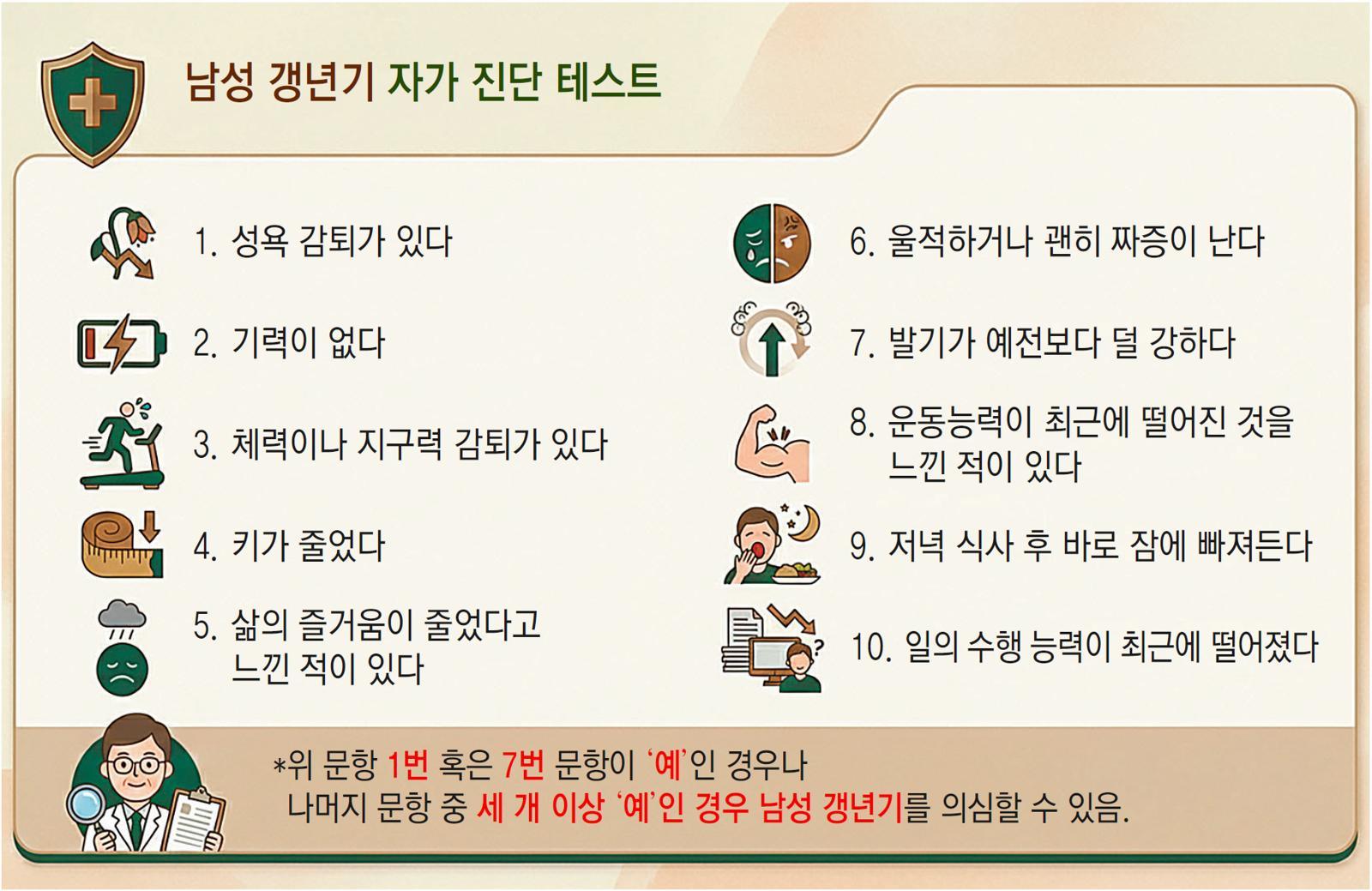
He easily feels fatigued. He frequently gets up at night to use the bathroom. His libido has disappeared. His lower abdomen protrudes even though he does not eat much. His muscles have decreased and his body silhouette has collapsed. His “tension” has fallen. His concentration and work performance are not what they used to be. He becomes irritated and tearful more often.
These are the recent changes experienced by 49-year-old Kim Hong-gi. When he shared his symptoms at a social gathering, similar concerns poured out. A variety of “word-of-mouth diagnoses” followed, including aging, depression, and hypothyroidism. One friend suggested the possibility of male menopause.
At the hospital, it turned out the friend was right. Blood tests showed his testosterone level was 1.9 ng/mL, lower than the normal range. The various discomforts he was experiencing also matched menopausal symptoms. For Kim, who had only worried about his wife’s menopause, the diagnosis felt unfamiliar.
Women, upon entering middle age, prepare for the “menopausal hurdle.” Most of them are well aware of the causes, symptoms, and treatment methods. Sharing personal experiences is also natural. Men are different. Awareness of male menopause remains insufficient. Many either do not know much about the condition or, even if they do, brush it off. They often resort to “self-treatment,” such as taking supplements based on information from the internet. Middle-aged male menopause is sometimes treated as a joke.
However, male menopause is a real medical condition. It encompasses a range of physical and psychological changes caused by declining testosterone levels. Professor Bae of Seoul St. Mary’s Hospital said, “Male menopause is relatively less well known because the symptoms are not as distinct as in women,” and added, “There needs to be a shift in perception to regard male menopause as a ‘disease’.”
● Male hormones gradually decline from the 30s
Male hormones are involved in the body as a whole. Their most important role is maintaining sexual function. They help sustain libido, erectile function, and sperm production. They also help maintain muscle and bone mass and break down fat. By acting on the brain, they affect cognitive and emotional aspects as well.
These hormones gradually decline with age. From the 30s, they decrease by about 1% per year and fall to about half after the 50s. When the support of hormones disappears, it raises red flags for overall health. Most patients are in their 40s to 60s. Professor Bae said, “Male menopause is milder than female menopause but persists over a long period. It needs to be managed throughout life.”
The most noticeable symptoms usually appear in relation to sexual activity. Libido declines and it becomes difficult to achieve an erection. This is because testosterone must dilate blood vessels so that blood can adequately flow into the penis to enable erection. Physical strength and cognitive function also deteriorate. Anxiety, restlessness, lethargy, and depression are more easily felt.
As basal metabolic rate decreases, it is easy to gain weight. Even with vigorous exercise, it is difficult to lose weight. As fat-burning capacity declines, the risk of metabolic syndrome, including hypertension and diabetes, increases. External changes may also occur. Abdominal fat increases, the skin becomes rough, and body hair decreases. Sudden facial flushing or excessive sweating may also appear.
Early detection is important for male menopause as well. This is because it often interacts with metabolic syndrome. Professor Bae said, “If menopause is left unattended, existing diseases can worsen under the influence of hormones. The reverse can also happen,” and added, “If there is even a slight suspicion, it is necessary to undergo hormone testing.”
● Diagnosis based on hormone levels and symptoms combinedMale menopause is diagnosed when blood testosterone concentration is 3.5 ng/mL or lower and is accompanied by relevant symptoms. Hormone levels fluctuate even within a day, so testing is performed between 7 a.m. and 11 a.m., when concentrations are highest. For an accurate diagnosis, patients must answer questions related to sexual function honestly.
Even if hormone levels are low, it is not considered menopause if there are no symptoms. Likewise, if symptoms are present but hormone levels are normal, it is not classified as menopause. Assumptions such as “I cry more often, so it must be menopause” or “I’m a tough guy so I can’t be going through menopause” are often incorrect. Professor Bae said, “There are many cases in which people experience symptoms similar to menopause due to aging, stress, or metabolic syndrome even though their hormone levels are normal. That is why joint consultations with psychiatry or endocrinology are frequent.”
Treatment consists of supplementing hormones. Various formulations are available, including topical ointments, intranasal sprays, and injections. The most common method is injection. Ointments must be applied daily, whereas injections are administered only once every three months, making them relatively convenient. Care must be taken to prevent topical medications from coming into contact with women or children. Exposure to male hormones can cause side effects such as infertility and precocious puberty.
If there are plans for pregnancy, it is better not to receive hormone replacement therapy. Hormone supplementation can suppress sperm production in the testes. It also increases the risk of erythrocytosis, in which red blood cells increase and blood becomes more viscous. Patients diagnosed with prostate cancer must also exercise caution. Professor Bae said, “There is no evidence that hormone supplementation is a direct cause of prostate disease, but if there is a preexisting condition, caution is necessary.”
After starting hormone supplementation, blood tests are conducted approximately every three months to monitor levels. If normal levels are stably maintained over a certain period, the interval between tests is gradually extended. If there is no change in levels, the interval is shortened to one or two months. Professor Bae stressed, “Male menopause is a condition that requires lifelong management rather than having a separate concept of complete cure,” and added, “Hormone trends must be constantly monitored while correcting lifestyle habits.”
● Obesity is a main cause of hormone declineAlthough hormonal decline is inevitable, not everyone experiences menopause. Around two to three out of ten men go through it. The key factor is the rate of hormone decline. If the decrease is gradual, the body adapts and symptoms are not prominent. Mild menopausal symptoms may pass unnoticed. However, if hormone levels drop sharply in a short period, various abnormalities can appear.
It is important to avoid risk factors that reduce hormone levels. Obesity is a major cause of decreased male hormones. As fat tissue increases, the activity of an enzyme called aromatase becomes more pronounced, converting testosterone, a male hormone, into estrogen, a female hormone. In this process, muscle mass decreases and fat accumulates more easily. Fat tissue also secretes substances that cause inflammation, which suppress the secretion of male hormones. As a result, muscle mass continues to fall while fat increases further, creating a vicious cycle.
Sleep should follow a fixed schedule for going to bed and waking up. Male hormones follow a daily rhythm. Levels are lowest in the late afternoon and highest in the early morning. Hormone levels are better maintained when a person sleeps sufficiently during periods of high secretion and is active when levels are lower. In fact, one study showed that when sleep time was restricted to five hours per day for a week, testosterone levels, which typically decrease by 1–2% per year, dropped by up to 15%.
Healthy lifestyle habits are also important. Regular exercise and avoidance of excessive drinking and smoking are essential. Strength training in particular promotes testosterone secretion. Aerobic exercise also improves blood circulation and supports overall hormonal balance. It is advisable to keep the lower body cool. When the testes are exposed to high-temperature environments such as saunas, hormone function deteriorates.
Male menopause should not be neglected. If male hormone levels continue to decline, the risk of conditions common among middle-aged and older men, such as benign prostatic hyperplasia and erectile dysfunction, increases. The likelihood of developing metabolic, cardiovascular, and cerebrovascular diseases also rises. Professor Bae emphasized, “Male menopause is a natural change caused by aging,” and added, “With active management, it is possible to enjoy a healthy old age.”
ⓒ dongA.com. All rights reserved. Reproduction, redistribution, or use for AI training prohibited.
Popular News