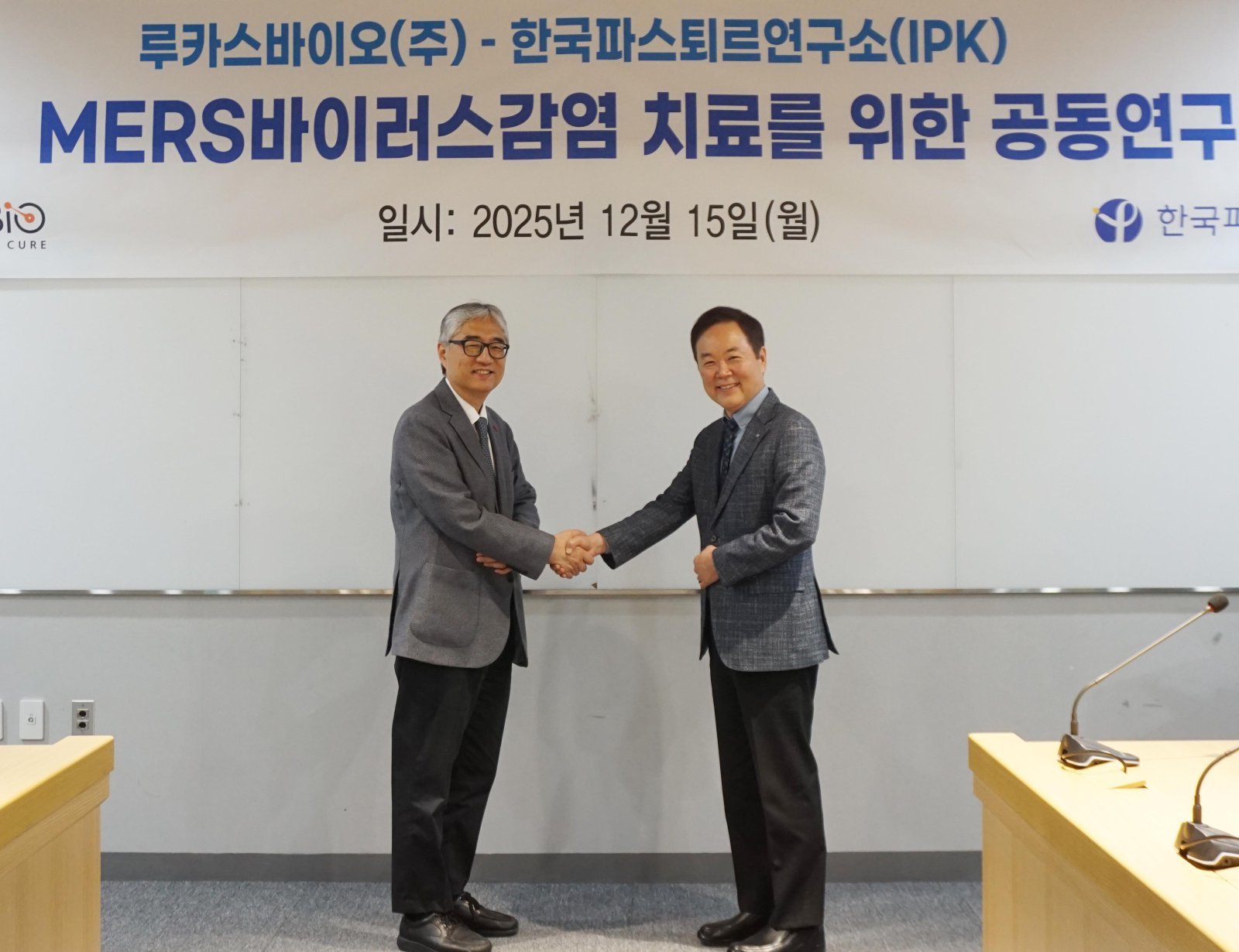
LucasBio CEO Cho Seok-gu (left) and Korea Pasteur Institute Director Jang Seung-gi sign a joint research agreement. Provided by LucasBio
LucasBio (CEO Cho Seok-gu) and the Korea Pasteur Institute (Director Jang Seung-gi) announced that they signed an agreement on 15 December to jointly develop an “antigen-specific memory T cell therapy” targeting severe fever with thrombocytopenia syndrome (SFTS) and Middle East respiratory syndrome (MERS).
This agreement is a strategic collaboration between the Korea Pasteur Institute, a leading domestic and international research institution for high-risk pathogens, and LucasBio, which has expanded a multi-virus T cell (T lymphocyte) therapy to the clinical stage for the first time in Korea. Through this partnership, the two institutions plan to accelerate the transition of high-risk virus therapies from preclinical development to clinical trials.
SFTS is a high-risk infectious disease that causes deaths every year in Korea, with a fatality rate of 16–30%, and is considered an intractable viral disease. As no vaccines or treatments have been approved worldwide to date, a successful drug development would represent the first case globally.
Under this collaboration, the Korea Pasteur Institute will be responsible for preclinical evaluation and viral analysis of the candidate treatments for SFTS and MERS. Established through scientific and technological cooperation between Korea and France, the institute is recognized for its expertise in high-risk pathogen research, antiviral efficacy assessment and infectious disease analysis.
LucasBio intends to use its core platform technology, “LB-DTK (killer cells that simultaneously target two targets),” to accelerate the therapy’s progression into clinical trials. The company has demonstrated the versatility of its platform by advancing multi-virus T cell therapies to the clinical stage, and has successfully produced antigen-specific memory T cells for SFTS and MERS, thereby securing the basis for early clinical translation.
The LB-DTK platform can manufacture T cells that respond to multiple viral antigens through a single process and is characterized by its ability to maintain long-term immune memory even in the presence of variant viruses or in immunocompromised conditions. It is evaluated as a platform that can be rapidly applied to the development of new high-risk virus therapies. Using this platform, LucasBio has achieved the milestone of bringing Korea’s first multi-virus T cell therapy targeting three high-risk viruses—CMV, BKV and EBV—to the clinical stage.
Starting with SFTS and MERS, the two institutions plan to formalize their strategies for transitioning high-risk virus-based infectious disease therapies from preclinical to clinical stages, while broadening their research scope from treatment to prevention. They will also continue to pursue global joint development and expansion of therapeutic platforms for pandemic preparedness.
Director Jang Seung-gi of the Korea Pasteur Institute stated, “This joint development of antigen-specific memory T cell therapies could become a new alternative in the research and development of treatments for high-risk infectious diseases, going beyond the limitations of existing antiviral research.” LucasBio CEO Cho Seok-gu said, “The DTK platform is a technology already validated across various viruses,” adding, “By combining it with the Korea Pasteur Institute’s internationally recognized infectious disease research capabilities, we will pursue the world’s first clinical trials of SFTS and MERS memory T cell therapies.”
ⓒ dongA.com. All rights reserved. Reproduction, redistribution, or use for AI training prohibited.
Popular News