National Gugak Center, on the verge of launch in partnership with startups
Korean traditional music is passed down orally, unlike Western music
Performers recorded some 1,000 pieces over three months… “It feels like a real professional gugak musician is playing”
Creates even ensemble pieces in under 10 seconds
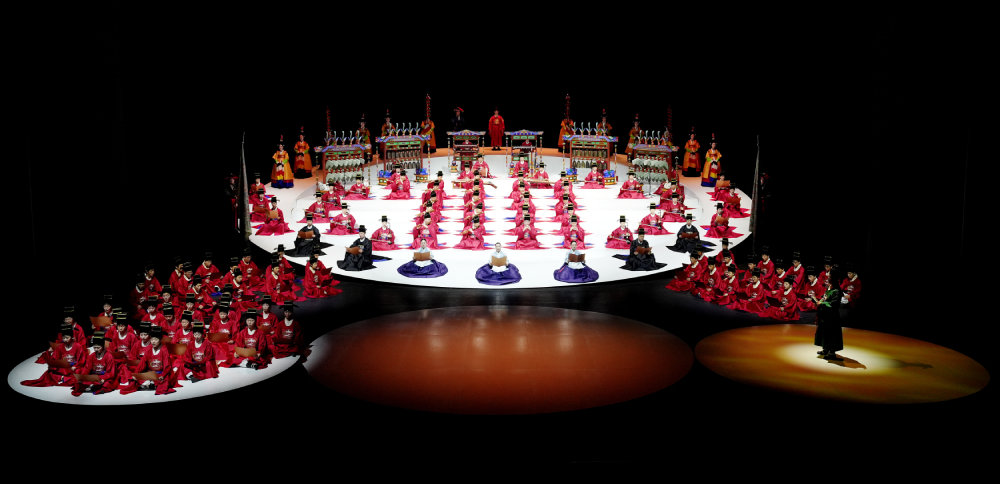
Efforts are under way to broaden the base of Korean traditional music (gugak) by using artificial intelligence (AI). The photo shows a scene from the National Gugak Center’s performance “Haengaak & Boheoja,” staged in March this year with lyrics restored by AI. After learning more than 350 classical Chinese poems, the AI generated lyrics to match the third movement of “Boheoja,” for which only the melody, without lyrics, had been transmitted. Provided by the National Gugak Center.
“Create a grand ensemble piece featuring at least five Korean traditional instruments.”
When a reporter recently entered this prompt into Google’s generative AI music creation platform “MusicFX,” the result was music that sounded more like something from the Japanese traditional theater Kabuki than gugak. The distinctive, lively percussive tones of the Japanese traditional drum “otsuzumi (大鼓)” were played in unfamiliar rhythmic patterns, and a sharp melodic line akin to that of the bamboo flute “fue (笛)” flowed over it. This occurred because the global AI does not properly recognize “gugak.”
However, when the prompt “Create an audio track in which seven Korean traditional instruments—gayageum, daegeum, haegeum, piri, ajaeng, soribuk, and geomungo—perform together” was given to the first gugak‑specialized generative AI, now in the final stages of development at the National Gugak Center, a refined gugak melody began to play in less than 10 seconds. When “add geomungo jangdan (rhythmic pattern)” was selected, geomungo performance in the jungjungmori rhythm, well matched to the existing track, was instantly added. One performer at the Center said, “It goes beyond merely mimicking a ‘gugak feel’ and is astonishing in that it sounds as if it is actually being played by a professional gugak performer.”
● Over 7,000 structured data samples by instrument built
The National Gugak Center joined hands with domestic AI music generation startup NewTune in May this year to begin developing the gugak AI. For AI to create highly complete music, it must learn detailed data on each instrument’s tone color, playing techniques, and the emotions it expresses. The problem was that, unlike Western classical music, such data did not exist for gugak.
Park Seung-soon, Chief Creative Officer (CCO) of NewTune, explained, “Google’s real-time music generation AI model Magenta has secured about 200 hours of live audio from an international piano competition, paired with performance data for each of the components that make up those recordings.” Hong Se-a, curator-researcher at the National Gugak Center, said, “Gugak has mainly been transmitted through oral teaching (gujeon-simsu: being passed on by mouth and taught by heart), and depending on the published edition or lineage of transmission, the notation can be written differently, which makes it difficult for AI to learn in a consistent way.”
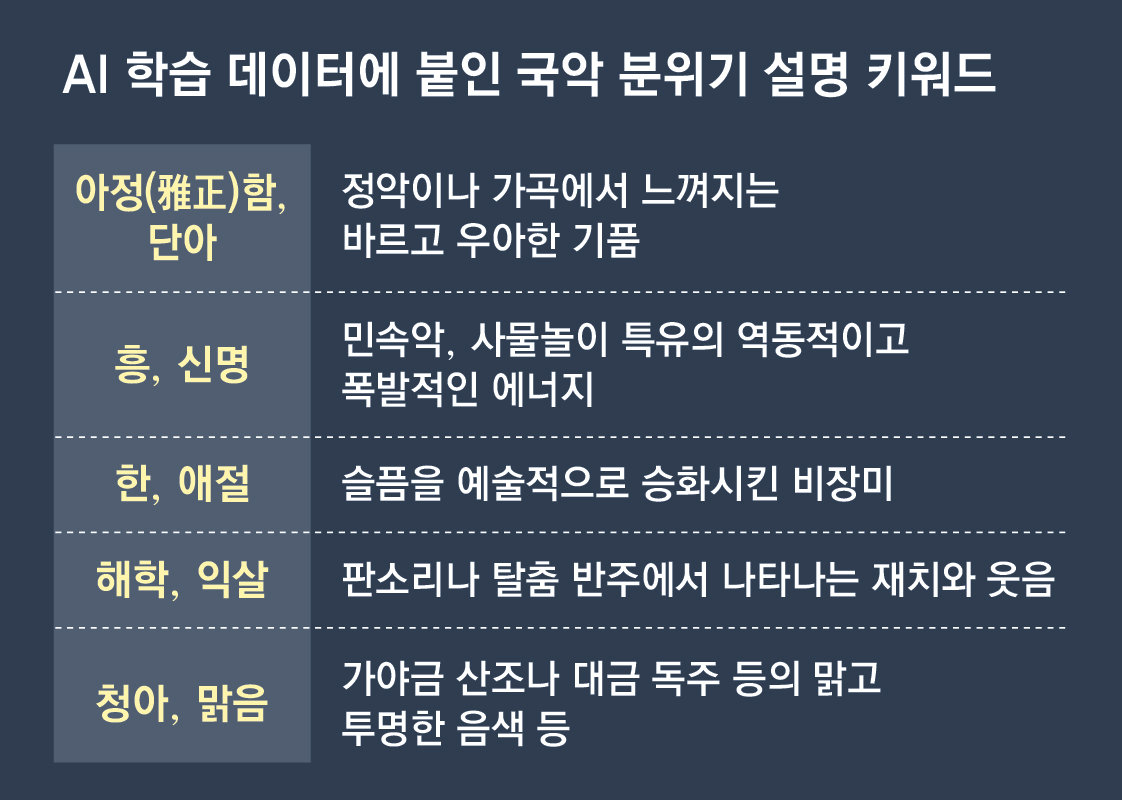
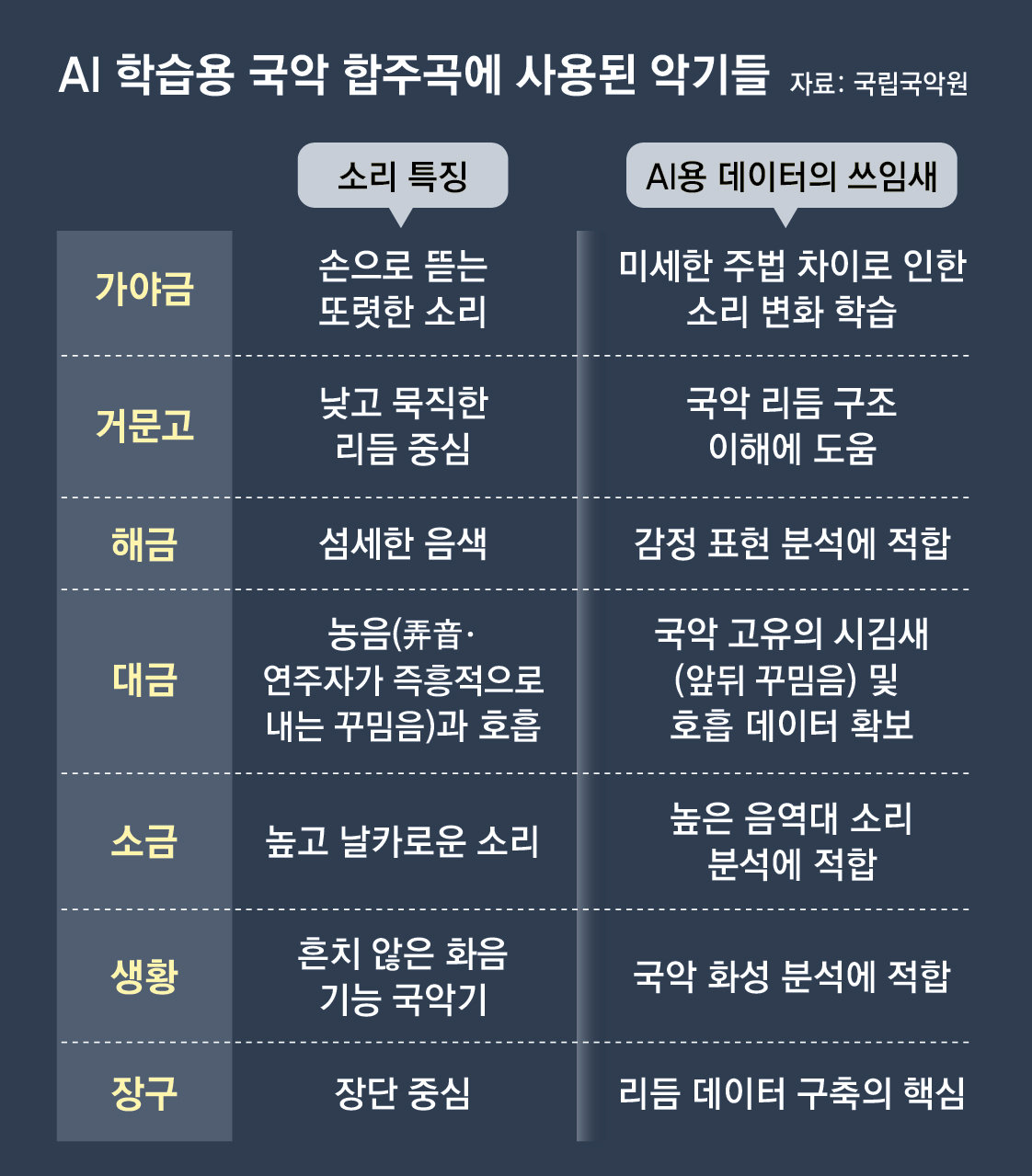
Ultimately, performers at the National Gugak Center spent three months from July this year recording more than 1,000 ensemble pieces, eight hours a day, as training data. In separate recording booths, they performed and recorded the same pieces individually, building more than 7,000 multitrack data samples for 24 different instruments, including major ones such as gayageum and daegeum as well as relatively unfamiliar special percussion instruments such as bara and unra. The recorded music spans court music such as Jongmyo Jeryeak and Yeominrak, folk genres such as the pansori “Chunhyangga” and southern folk songs, and creative gugak pieces by composers including Hwang Byung-ki, Kim Ki-su, and Park Beom-hoon for which copyright holders granted permission. Metadata on core elements—such as beat, mood, and instrument-specific characteristics—was added to the audio so that AI could learn from it. For example, the jajinmori rhythm is entered as 12/8 time, and the emotional quality of “han (恨)” as “a tragic beauty achieved by artistically sublimating sorrow.”
● “Improving problems of existing AI that distorted gugak”Once the gugak generative AI is developed and more widely adopted by users, it is expected to partially resolve the issue of gugak being lumped together as generic “East Asian-style music” on global music creation platforms. Hong said, “At present, in the case of haegeum, its nonghyeon (弄絃; improvised ornamental notes on string instruments) is recognized as noise and removed by AI, producing audio that sounds as if it is being played on the Chinese traditional string instrument erhu.”
The gugak generative AI is expected to be released online as early as the second half of next year. Although some say it “still cannot generate subtle sigimsae (ornamental notes before and after a tone) or momentary breaths that are not written in the score,” once development is completed it is expected to become possible to create crossover music that combines gugak with Western music. The National Gugak Center stated, “In cooperation with the Korea Culture Information Service, we plan to expand AI into the vocal realm in the future, including gayageum byeongchang (singing while playing the gayageum).”
ⓒ dongA.com. All rights reserved. Reproduction, redistribution, or use for AI training prohibited.
Popular News