Deep-tech startups and technology scale-ups… the Ministry of Science and ICT listens to ‘Generation Z’
Discovered 864 prospective startups through the Tech-Startup Exploration Teams
SOS Lab listed on KOSDAQ
Operating APOLLO, an AI results-diffusion platform
Supporting ‘public technologies the market wants’
Developing policy in close communication with research sites
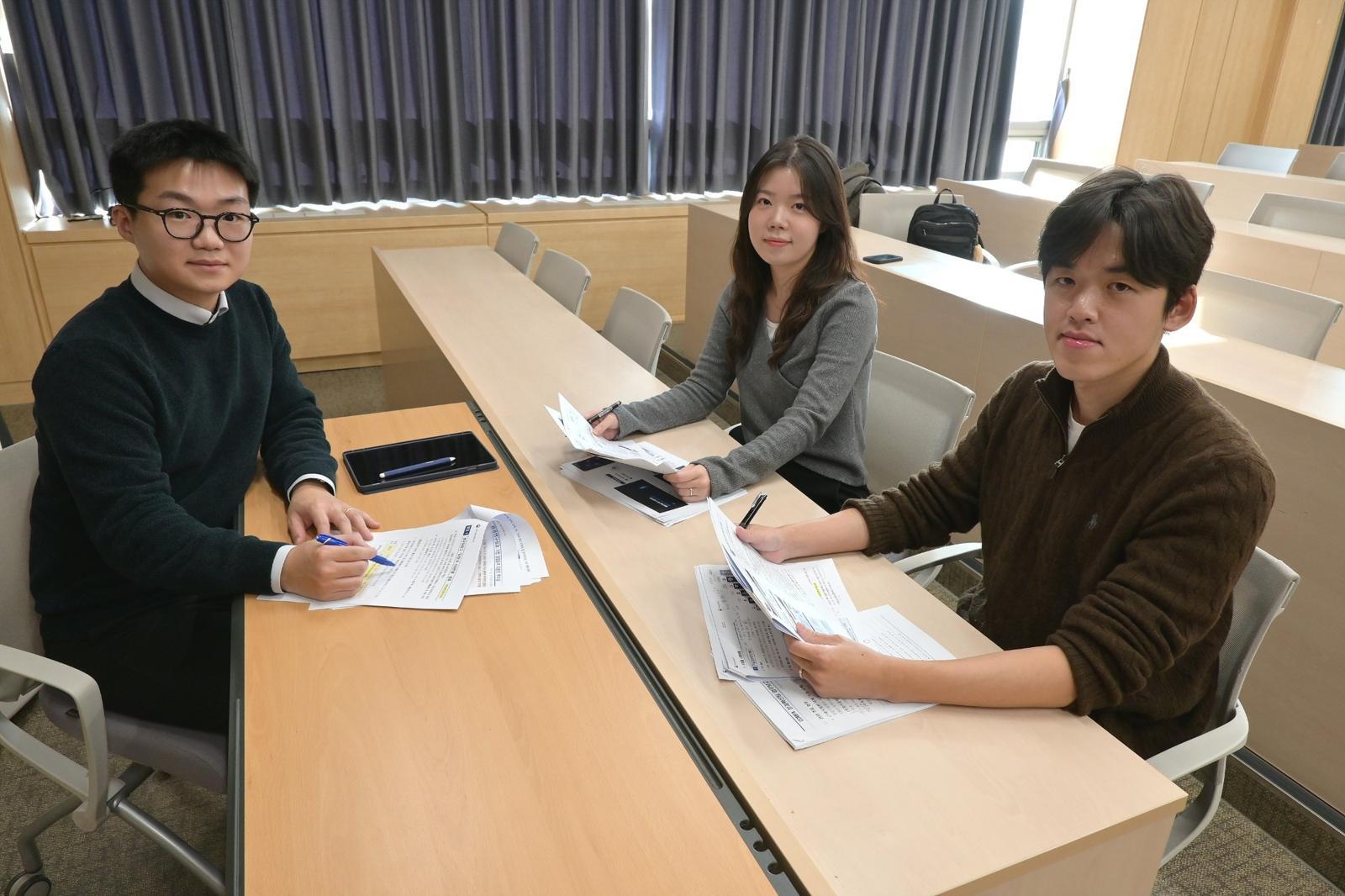
From left: Ministry of Science and ICT’s Research Performance Innovation Policy Division deputy directors Ji Young-jong, Yeom Gyu-hee, and Park Sung-hoon. Provided by IT Dong-a
Deep-tech companies in areas such as artificial intelligence (AI), digital healthcare, quantum technology, and new and renewable energy have now become core drivers of national competitiveness.
The world’s advanced economies are therefore concentrating on policies to foster young deep-tech talent and guide them toward entrepreneurship. In Korea as well, the Ministry of Science and ICT (MSIT) is deploying a range of policies to nurture young deep-tech talent and promote start-ups.
In its New Year policy briefing, MSIT presented measures to improve the research and development (R&D) system in preparation for the future and to foster talent. The key pillars are the establishment of an advanced-country-style R&D system, qualitative enhancement of basic research and innovation of government-funded research institutes (GFRIs), and support for challenges and growth by outstanding talent. The Research Performance Innovation Policy Division under the Office of R&D Policy of the 1st Vice Minister of MSIT plays a central role in this. It manages policies for technology scale-up of public research outcomes, which are the results of government R&D support, and for deep-tech start-ups.
The Dong-A Ilbo and the National Research Foundation of Korea met with deputy directors Ji Young-jong, Yeom Gyu-hee, and Park Sung-hoon of the Research Performance Innovation Policy Division at MSIT. As members of Generation Z born in the 1990s, they empathize with their peers who are at the center of deep-tech research and start-ups, and they run tailored, close-contact policies to disseminate and promote public research outcomes. They were asked about the characteristics and achievements of deep-tech start-up and technology scale-up policies, as well as future directions for implementation.
―What is the role of the Research Performance Innovation Policy Division at MSIT?Deputy Director Ji Young-jong = “The Research Performance Innovation Policy Division supports innovation-driven growth grounded in the dissemination and utilization of public research outcomes. The government’s 2026 R&D budget has been finalized at KRW 35.5 trillion, the largest in history. Our division will deliver and spread excellent public research outcomes generated by government R&D investment at universities and GFRIs to the market, thereby creating tangible economic and social value.”
―Among your tasks for disseminating public research outcomes, what are the main policies under way?Deputy Director Ji = “To disseminate public research outcomes, we support deep-tech-based start-up exploration by researchers at universities and GFRIs. We also support improving the maturity (technology scale-up) of technologies by bridging the gap between the results of basic and fundamental research and the technologies demanded by the market, and by developing them into technologies with market viability. Another major function is building an ecosystem that designates products based on excellent technologies as innovative products to support their entry into the market.”
―What kind of support policy is the start-up exploration program for researchers at universities and GFRIs?Deputy Director Yeom Gyu-hee = “It is ‘TeX-Corps (Technology Exploration Corps for Public Technology-Based Market-Linked Start-Up Exploration)’, which has been implemented since 2015. The name implies a ‘special task force exploring markets and the future through technology.’ Promising technologies do not always lead to start-ups or successful outcomes. This is an education and training project established to overcome that issue, targeting master’s and doctoral students, post-doctoral researchers (postdocs), and GFRI researchers who intend to start businesses based on public research outcomes. Laboratory Start-Up Innovation Groups identify laboratory start-up exploration teams, which then interview potential customers at home and abroad. Based on feedback from instructors who are experts in start-up exploration education, the teams verify and optimize the feasibility of commercialization. They are then supported in preparing for laboratory start-ups, including mentoring to advance business items after market exploration, provision of start-up space and equipment rental within universities, and prototype production. TeX-Corps uses the methodology of ‘I-Corps,’ a start-up support program of the US National Science Foundation (NSF), to help researchers think about the social and economic value that can be created from their research results or ongoing R&D. By placing greater emphasis on the process of exploring start-ups rather than on the outcome of founding a company, the program achieves a high success rate in leading to actual start-ups. It is also meaningful in that it conveys a desirable entrepreneurial mindset to researchers. In 2025, we supported around 100 laboratory start-up exploration teams, centered on six regional Laboratory Start-Up Innovation Groups and one women-focused group.”
―Could you introduce some outstanding companies that originated from TeX-Corps?Deputy Director Yeom = “Since 2015, TeX-Corps has identified 864 start-up exploration teams, leading to the establishment of 435 companies. As of November 2025, they have created 3,910 new jobs and attracted KRW 713.2 billion in investment. They have secured more than nine times the follow-up investment compared to the government budget invested, and their five-year survival rate is nearly double that of general start-ups, demonstrating strong performance. Based on his experience in the first TeX-Corps cohort in 2015, Dr. Jung Ji-sung of the Gwangju Institute of Science and Technology founded SOS Lab, a company developing LiDAR sensors for autonomous driving, in 2016. Recognized for its technological capabilities and growth potential, the company was listed on the KOSDAQ in 2024. The new drug development company AimedBio also recently completed its KOSDAQ listing. Aerospace company Peraige Aerospace and edtech company Luxrobo, among other innovative firms in various fields, have reached the pre-IPO stage. The fact that TeX-Corps has led technologies in many fields to start-up and growth is evidence of the program’s high level of completeness.”
―What kind of support is provided under ‘technology scale-up,’ which is the technological advancement of public research outcomes?Deputy Director Park Sung-hoon = “To transfer and disseminate public research outcomes to the market, they must satisfy both market fit and applicability. Through the Technology Management Catalyst (TMC) program, MSIT has strengthened the capabilities of innovation actors such as researchers, Technology Licensing Offices (TLOs), and technology holding companies, successfully completing technology scale-up and promoting the dissemination of public research outcomes to the market. A very diverse range of actors participates in technology commercialization. TMC enhances their capabilities and supports technology advancement with multi-stakeholder participation to improve maturity in line with market needs. There is the ‘IP Star Scientist Support Type,’ which aids researchers with high-quality intellectual property (IP) to collaborate with private TLOs for technology advancement and commercialization, and the ‘TLO Innovation Type,’ which guides public TLOs at universities and GFRIs to work with technology holding companies to produce mid- to large-scale, project-based technology commercialization outcomes. From 2026, we plan to newly introduce the ‘Company Builder Support Type,’ which will promote planning-based start-ups grounded in public research outcomes by public-sector technology holding companies and private accelerators, and the ‘Comprehensive Technology Commercialization Company Fostering Type,’ which will provide rapid, all-round support across the entire technology commercialization cycle—from discovery of outstanding technologies at diverse institutions to start-up and growth.”
―What difficulties do you encounter when promoting technology scale-up, and how are you addressing them?Deputy Director Park = “Each technology has different characteristics and evolves at a different pace. Adjusting research achievements from the lab to fit the market is extremely challenging. To do that, it is necessary to select from among excellent basic and fundamental research outcomes those technologies that are needed in the market. Connecting real market demand with research results is, in my view, a key task for our division and other institutions responsible for disseminating public research outcomes. Based on projects such as the Demand Discovery Support Group and Public Technology Discovery and Matching, we are actively working to connect corporate demand with public technologies to solve this challenge. We are also piloting Apollo, an AI-based performance dissemination platform that analyzes and forecasts promising businesses and public R&D outcomes using data. Apollo uses AI to quickly and accurately connect public technologies with market demand and to gauge corporate growth potential. Institutions engaged in disseminating public research outcomes are already piloting Apollo, and it is expected to help ensure that public technologies undergo scale-up and are disseminated to the market at the right time.”
―What policies will the Research Performance Innovation Policy Division prioritize in 2026?Deputy Director Ji = “Among the 123 national agenda items finalized by the government in September, Agenda 28, ‘Fostering Next Strategic Technologies to Lead the World,’ aims to secure at least five national strategic technologies that are world firsts and to achieve at least ten areas that rank first globally. This agenda also presents a roadmap for deep-tech-based innovation-driven growth, including ‘strengthening support for laboratory start-ups based on R&D outcomes, establishing industry-academia-research joint ventures, fostering specialized private TLO institutions, and expanding entry into the innovative public procurement market.’ We will do our utmost to establish support systems for disseminating research outcomes that can be tangibly felt by high-caliber researchers at universities and GFRIs, thereby accelerating technology-led growth based on research results created through government R&D investment.”
Deputy Director Yeom = “In November, the government announced the ‘Science and Technology Talent Securing Strategy’ for the selection and development of national scientists and the creation of an attractive ecosystem for science and engineering. To create diverse career paths for science and engineering researchers nurtured under this strategy, we plan to expand TeX-Corps and start-up exploration support. We will increase the number of Laboratory Start-Up Innovation Groups that discover and support exploration teams from universities and GFRIs from seven to around fourteen, and more than double the number of teams supported, thereby providing more opportunities for outstanding personnel based on public research outcomes to explore start-ups. These opportunities can be accessed through Laboratory Start-Up Innovation Groups within universities. Deputy Director Park = “We also plan to support technology advancement for R&D projects selected for the ‘Top 100 Excellent National R&D Achievements,’ which are chosen annually across all ministries and all R&D areas. Because R&D projects are thoroughly analyzed over nine months to select those with strong outcomes, we expect high growth potential. We will help researchers who deliver outstanding results in these projects to expand the dissemination of their achievements.” ―What has been the most meaningful moment while implementing start-up policies as public officials, and what are your future resolutions?
Deputy Director Ji = “The 1st Vice Minister of MSIT has consistently emphasized close communication with the research field. At a meeting with university professors carrying out projects under our division, we heard about universities’ perspectives on technology commercialization and the difficulties they face on the ground. I intend to be a public official who promotes policy while staying more closely in touch with researchers.”
Deputy Director Yeom = “At the ‘2025 Public Research Outcomes Dissemination Expo’ held in December, we heard candid stories from TeX-Corps participants and shared growth experiences from leaders of innovative companies originating from TeX-Corps, such as Classting and Movawheel. This allowed us to truly feel the value created by our ongoing research support programs. Going forward, we will continue to communicate with the field and consider directions that can provide practical support to industry.”
Deputy Director Park = “I felt a strong sense of meaning when we were able to elevate both the capabilities and technology levels of our beneficiaries and lead them to commercialization. It was also impressive to see cases in which laboratory achievements led to technology transfer and start-ups, and the resulting products and services contributed to industrial development while improving the quality of life for citizens. I will continue to recognize the importance of disseminating public research outcomes, listen closely to difficulties and requests for improvement from the field, and strive to provide better support.”
ⓒ dongA.com. All rights reserved. Reproduction, redistribution, or use for AI training prohibited.
Popular News