[Seoul CCEI x IT Donga] Challenge! K-Startup is the largest startup competition in Korea jointly organized by 10 government ministries. Among these, the Seoul Center for Creative Economy & Innovation operates the General League of the Innovation Startup League. IT Donga looks at promising startups that have grown together with the Seoul Center for Creative Economy & Innovation.
HOP is a Non-GPS positioning and control technology company that helps robots and drones perform autonomous navigation and unmanned inspection based on accurate location information even in indoor and underground environments where GPS signals do not reach. The company has set out the goal of supporting the automation of various industrial sites with plug-and-play sensors that enable autonomous driving simply by being attached to robots and drones. IT Donga heard a detailed explanation of the technology from HOP CEO Oh Enok.
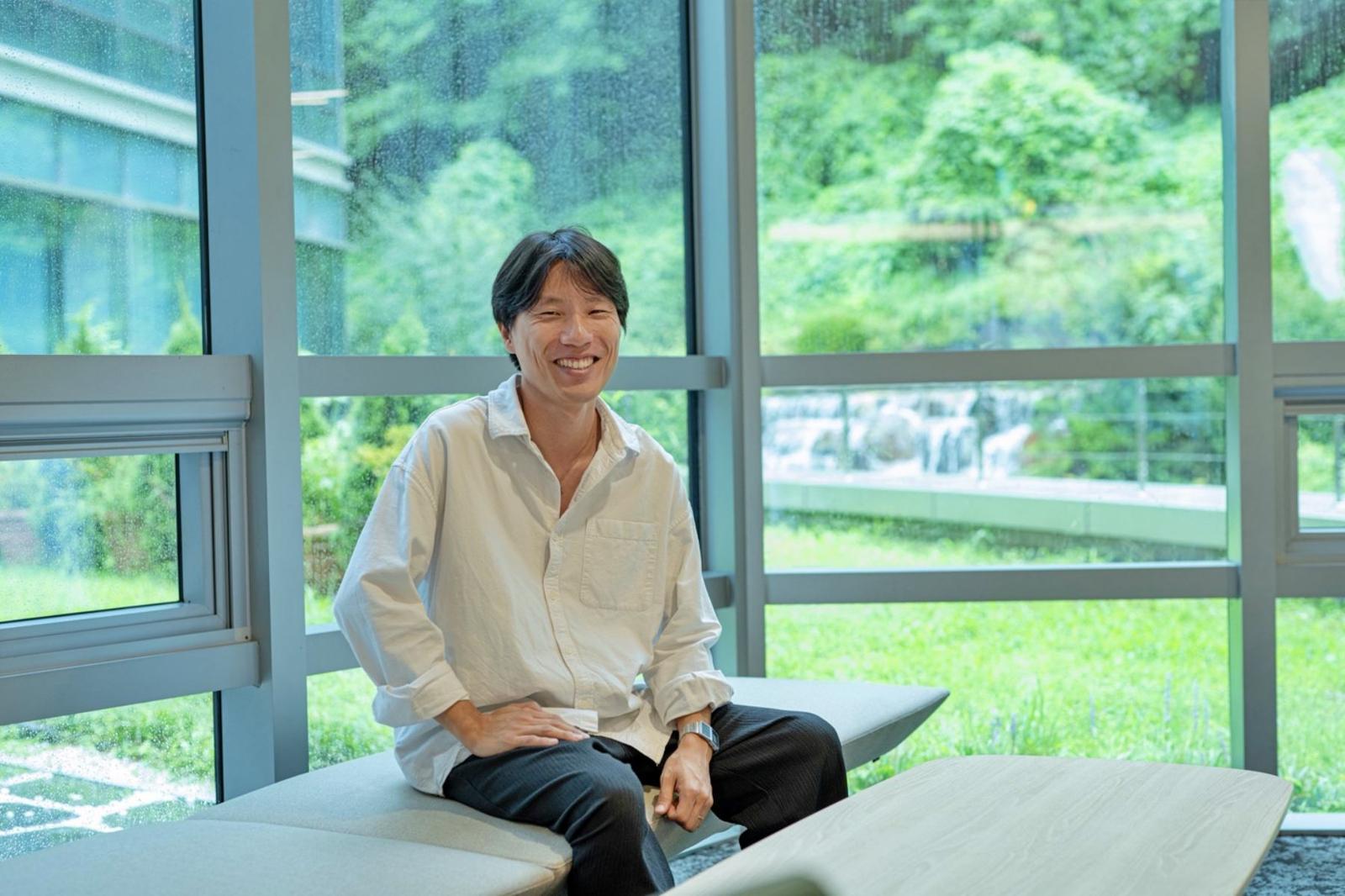
Oh Enok, CEO of HOP / Source=HOP
A firefighter’s story from extreme scenes… What led to tackling GPS blind spots indoors and undergroundA fire scene filled with smoke and darkness, where it is difficult to locate not only the person to be rescued but even fellow team members. The turning point that led CEO Oh to launch the company was a story told by a firefighter friend who worked in such extreme environments.
He said, “A friend who works as a firefighter told me that if they could quickly identify the locations of colleagues even in dark or smoke-filled spaces, they could not only prevent casualties but also search a wider area. He said this could help save more lives, even if it was just one more person,” adding, “His words made me acutely aware of the need for technology that allows securing accurate location information indoors without people having to enter dangerous spaces. So I decided to develop technology that would enable robots and drones to move autonomously based on accurate positioning and to inspect dangerous spaces in place of humans, even in indoor and underground environments where GPS does not reach. That was the beginning of HOP.”
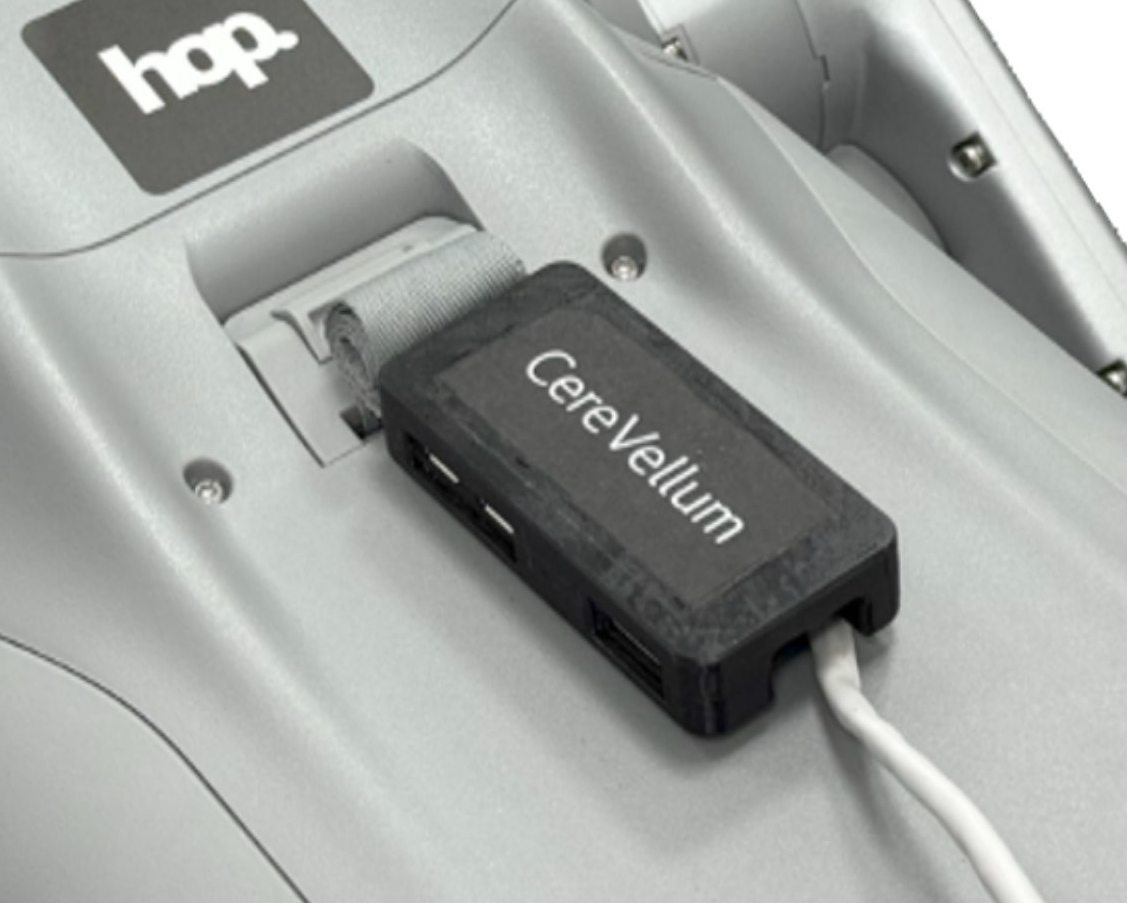
Based on the philosophy that “no matter how advanced the technology, it is meaningless if it cannot be used immediately in the field,” CEO Oh developed the indoor positioning and control system “CereVellum.” The most notable feature of this technology is that it enables immediate autonomous navigation simply by attaching the sensor to equipment, without any prior environment mapping or deep-learning training. He stressed that the company boldly removed the complex installation processes and high-cost infrastructure required by existing indoor autonomous navigation technologies.
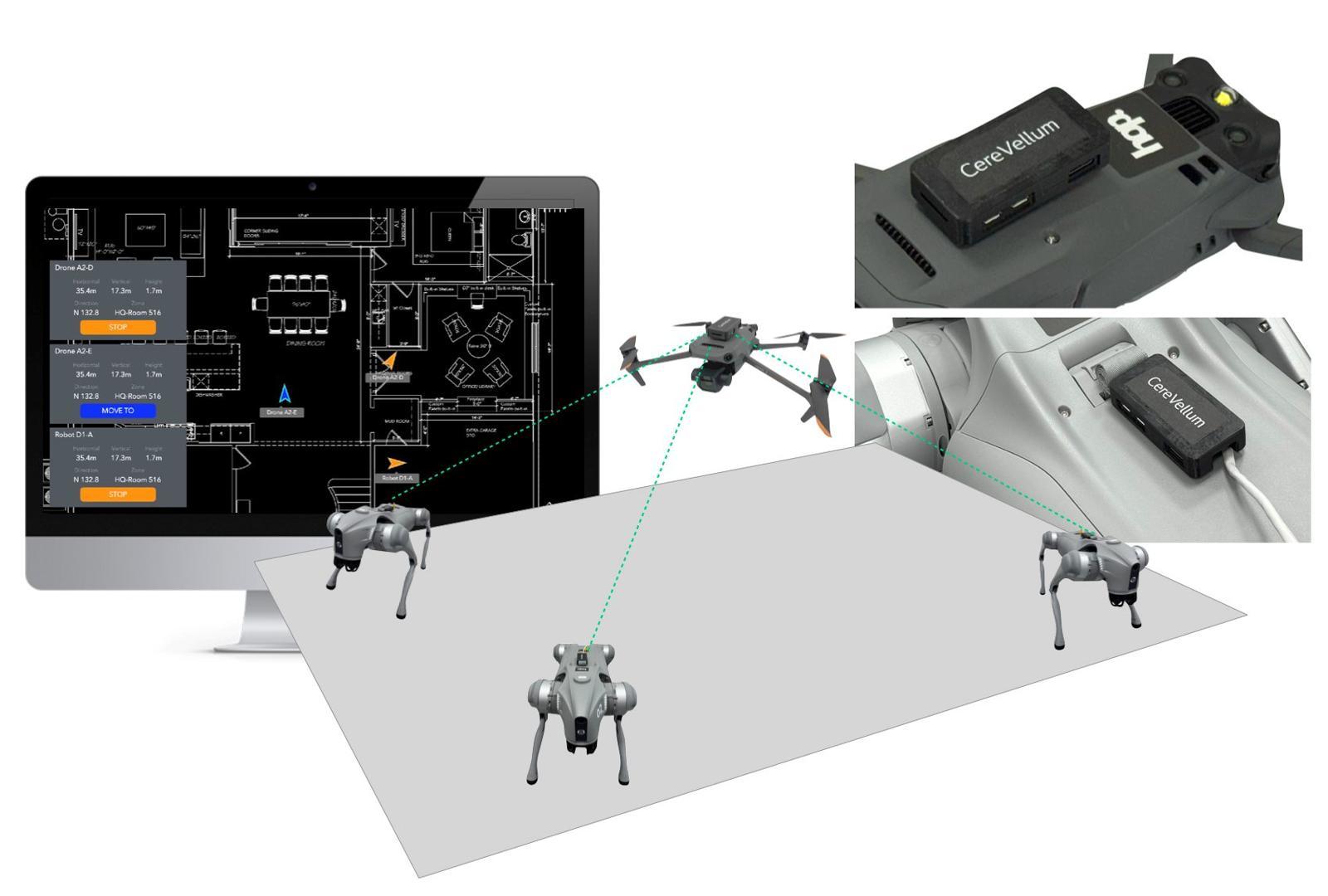
Configuration diagram of CereVellum technology / Source=HOP
CEO Oh said, “CereVellum provides real-time positioning data that replaces GPS and combines it with simultaneous localization and mapping (SLAM) and inertial measurement unit (IMU) data to enhance the reliability of robot and drone movement. As a result, it can achieve precise positioning in the 5 cm to 30 cm range even in industrial sites such as tunnels and underground construction sites, large factories, and refinery facilities where lighting is insufficient or structures change frequently,” emphasizing, “We developed the product with a focus on practicality, making plug-and-play and field-centric design our core values.”
He continued, “CereVellum’s competitiveness has already been verified across various industrial sites. It has been used for unmanned inspection of Hyundai E&C’s GTX underground construction sites, inspection of large remodeling sites for Lotte E&C, unmanned patrols at EcoPro battery plants, inspection of upper facilities in Korean Air aircraft hangars, and hazardous space inspections at S-Oil refineries. Together with the National Fire Agency and the National Fire Research Institute, we also conducted proof-of-concept testing of technology to locate rescue targets and firefighters in smoke-filled and dark indoor spaces. In actual field environments, drones and robots flew and moved stably between steel structures while collecting data, and through repeated tests we demonstrated the accuracy of autonomous movement and the performance of obstacle avoidance.”
CereVellum attached to equipment / Source=HOP
Embedding know-how gained in global field sites into the product… “Aiming to become the global standard in indoor autonomous inspection”CEO Oh is a robotics expert with extensive experience in global field operations. He emphasized that he fully leveraged the know-how accumulated over the years to develop the product.
He said, “After majoring in mechanical engineering through both undergraduate and graduate programs, I spent more than 12 years working with robotic systems and autonomous control technologies. I led drone projects for solar and wind power facility inspection, and built collaboration experience with global companies such as Siemens, GE, and Honeywell, as well as LG, Hyundai Heavy Industries, Hyundai E&C, and Samsung Heavy Industries,” adding, “HOP’s team members are also professionals with practical experience in fields such as robotics, hardware, backend, and overseas sales. A shared belief that ‘technology is completed in the field’ permeates the entire organization, and that is HOP’s strength.”
HOP identified the establishment of a stable mass production system for market expansion and the securing of global references as key tasks needed for the company’s next stage of growth.
CEO Oh said, “Going forward, we aim to secure price competitiveness through mass production of sensor modules. We will also promote rapid industrial deployment of our products through OEM partnerships with established robot manufacturers,” adding, “We will focus on overseas PoC projects in the United States, Japan, the Middle East, and Europe to build a foundation of regulatory compliance and real-world validation. At the same time, we will strengthen our lineup of field-customized solutions to meet diverse demand in construction, manufacturing, and public safety.”
He went on to say, “Support from the Seoul Center for Creative Economy & Innovation has played a major role in our growth to date. Beyond providing physical space, the Seoul CCEI has offered practical support essential to corporate growth across multiple fronts, from technology verification and PoC connections to networking and investment linkages. Thanks to this, we were able to achieve results such as completing a commercial product, participating in public proof-of-concept projects, and attracting early-stage investment in a short period of time,” adding, “We will continue to work closely with the Seoul CCEI to address key challenges and do our utmost to widely disseminate our technology both domestically and internationally.”
Oh Enok, CEO of HOP / Source=HOP
Lastly, the reporter asked what HOP’s ultimate goal is.
CEO Oh said, “HOP’s goal is clear: to create a ‘standard indoor positioning system (IPS) for environments where GPS cannot reach.’ Our ultimate objective is to build an ecosystem in which people do not need to enter dangerous spaces, and where autonomy is possible anywhere indoors or underground. We want to make CereVellum the global standard in the field of indoor autonomous inspection,” adding, “To this end, we will focus on the East Asian market through 2026, then expand into the Middle East, Southeast Asia, and North American markets in 2027, and establish overseas subsidiaries by 2029. We plan to pursue Series A and B funding rounds in 2027 and 2028, and to push for an initial public offering (IPO) in 2032. We look forward to continued interest in HOP’s journey.”
IT Donga reporter Kim Dongjin (kdj@itdonga.com)
ⓒ dongA.com. All rights reserved. Reproduction, redistribution, or use for AI training prohibited.
Popular News