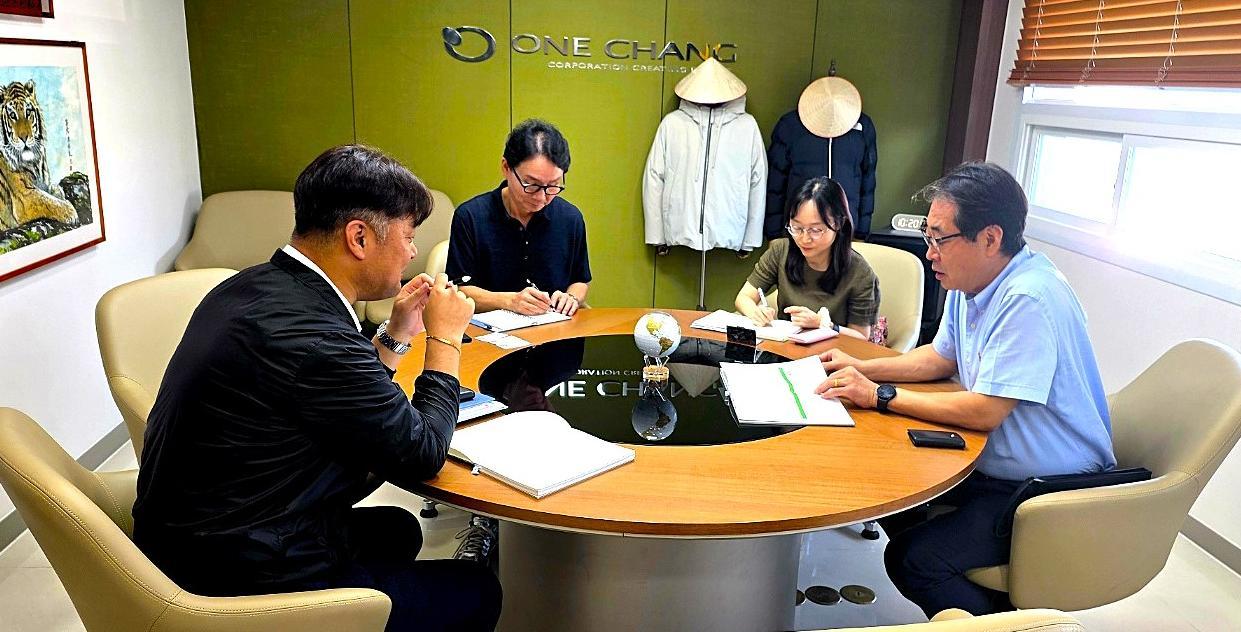
Recently at the Wonchang Material conference room in Dalseo-gu, Daegu, Choi Jae-hong, President of the Dyeing & Finishing Technology Institute (DYETEC, right), and Yoo Gu-geun, Head of the Research Center at Wonchang Material (left), discuss directions for developing recycled fiber technologies. Provided by DYETEC
The domestic textile industry is rapidly expanding beyond traditional manufacturing into a future high value-added industry.
At the center is DYETEC, located in Seo-gu, Daegu, which is drawing attention as a specialized research institute leading both demonstration and commercialization of new textile technologies. The institute provides one-stop support ranging from company-tailored research and development (R&D) and prototype production to certification and market channel linkage. It is delivering tangible results by driving structural improvement of the textile industry and entry into new markets.
A representative case is the vehicle fire-suppression smothering cover “FIRESSAK” developed by Raji Co., Ltd. The company recently developed this product through the “Disaster Safety Industry Promotion Project” in collaboration with DYETEC. It is a fire blanket that withstands temperatures above 1,400 degrees and can be used to extinguish fires more than 30 times. Raji, which had previously produced glass fiber products for automobiles, expanded its business scope into new disaster-response markets such as electric vehicle fires, using this round of technology support as a springboard.
DYETEC supported the entire pre-commercialization process, including technology for producing ultra-high-temperature refractory fabrics over 2 meters wide, heat-resistant coating technology, and safety product certification. As a result, the product is currently supplied to 141 organizations, including fire headquarters nationwide, public institutions, state-owned enterprises, and large corporations. The product, previously fully dependent on imports, has been localized, generating import-substitution effects, and is evaluated as having established a foundation for exports targeting electric-vehicle-adopting countries such as Japan, China, and those in Europe.
Collaboration outcomes with companies are also continuing in the medical and cosmetics sectors. Cosmetics specialist COSMAX and DYETEC jointly developed “BEAUTY-TEX,” a cosmetic textile containing microbiome (the collection of microorganisms in the human body), through collaborative research. This expanded the application scope of textiles into functional cosmetic ingredients.
GH Shinsojae, a nonwoven specialist for automotive interior materials, and DYETEC succeeded in localizing a laparoscopic surgery filter. This achievement came after the withdrawal of U.S.-made products from the domestic market and contributed to both business diversification into medical textile materials and stabilization of the medical industry supply chain.
Cases of support for small and mid-sized textile companies also stand out. Youngdong Textile Co., Ltd. established a system to replace solid salt used in dyeing processes with liquid salt through the Ministry of Trade, Industry and Energy’s “Green & Clean Factory Conversion Support Project.” By recycling waste resources, the company reduced annual salt usage by 1,316 tons and also achieved reduced wastewater discharge and improved working conditions.
Geunwoo Co., Ltd. transformed from a domestically focused company into an export-oriented firm based on DYETEC’s support for eco-friendly certification, R&D, and overseas market development. The company subsequently secured multiple global eco-friendly certifications and promoted joint R&D, solidifying its eco-friendly manufacturing base.
Dongjin Trading Co., Ltd. is simultaneously pursuing low-carbon process conversion and digital transformation (DX). By introducing automatic-control steam traps and wastewater heat exchangers, it reduced energy consumption and greenhouse gas emissions. At the same time, it is working to secure eco-friendly, high value-added technologies such as AI-based rolling inspection machine-vision systems, non-fluorinated water-repellent and anti-soiling agents, and recycled materials using waste fabrics.
Seojin Material Co., Ltd. enhanced its quality competitiveness through the establishment of odor-reduction facilities, eco-friendly certifications, and technology consulting. By building a customer-tailored production system using digital textile printing (DTP), it is growing into a global platform company. Wonchang Material Co., Ltd. was recognized for its recycled fiber technologies utilizing process-generated waste and its capabilities in developing high-functional materials, and last year became the first company in the domestic textile sector to be selected as a “Top Materials, Parts, and Equipment Company” by the Ministry of Trade, Industry and Energy.
Choi Jae-hong, President of DYETEC, said, “The full-cycle corporate support model that extends beyond R&D to demonstration, certification, market channels, and exports is producing results,” adding, “As a research institute that acts as a catalyst by turning textile companies’ technological limits into industrial opportunities, DYETEC will ensure that the power of collaboration connecting technology and markets becomes the source of competitiveness for the future textile industry.”
ⓒ dongA.com. All rights reserved. Reproduction, redistribution, or use for AI training prohibited.
Popular News