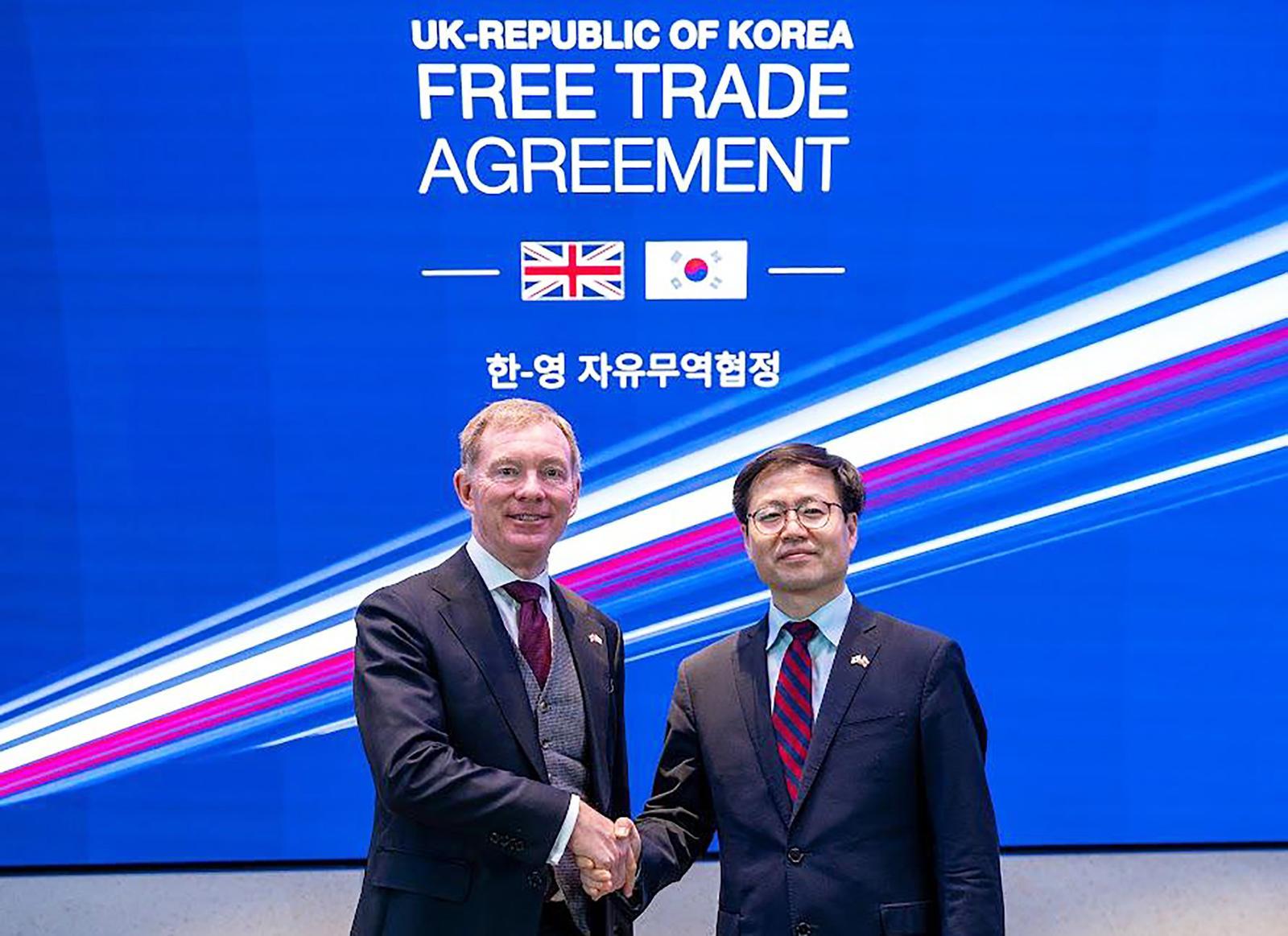
Yeo Han‑koo, Chief Negotiator for Trade at the Ministry of Trade, Industry and Energy, poses for a commemorative photo on the 15th (local time) in London, United Kingdom, after announcing the conclusion of the Korea–UK FTA improvement negotiations with Chris Bryant, UK Minister for Trade at the Department for Business and Trade. 2025.12.16. Provided by the Ministry of Trade, Industry and Energy
The Republic of Korea and the United Kingdom have finally concluded negotiations to improve their Free Trade Agreement (FTA) after more than two years of talks. The scope of duty‑free benefits will be expanded for Korea’s key export items such as automobiles and K‑food, and the opening of the UK high‑speed rail market is expected to boost exports.
The Ministry of Trade, Industry and Energy announced on the 16th that on the 15th (local time) in London, United Kingdom, Chief Trade Negotiator Yeo Han‑koo and Chris Bryant, UK Minister for Trade at the Department for Business and Trade, concluded the Korea–UK FTA improvement negotiations and signed a joint declaration confirming the outcome. Previously, the two countries had agreed to pursue follow‑up negotiations within two years of the Korea–UK FTA’s entry into force in 2021. Following multiple rounds of improvement talks and bilateral meetings since early last year, the negotiations were finally concluded on this day.
According to the joint declaration, the originating value‑added threshold in either party required for automobiles (10% tariff) to qualify for duty‑free treatment has been lowered from the current 55% or more to 25% or more. Automobiles accounted for 36% of Korea’s exports to the UK last year. In particular, the government expects electric vehicle companies, whose value added fluctuates significantly depending on the prices of imported battery raw materials such as lithium and graphite, to benefit from this change.
The rules of origin have also been relaxed for promising export items in the K‑culture sector. For chemical products such as cosmetics (tariffs up to 8%), duty‑free treatment will be granted if processes such as chemical reactions, refining, mixing, and blending are carried out domestically. For processed foods including dumplings, tteokbokki, gimbap, and kimchi (tariffs up to 30%), duty‑free benefits will be available even when key raw materials such as flour and vegetables are imported from third countries and the products are manufactured domestically.
In the government procurement market, the UK high‑speed rail market will be additionally opened, correcting the previous imbalance under which only Korea had unilaterally opened its market. The online gaming sector will also be opened, which is expected to broaden the platform for Korean‑developed games to enter the European market.
ⓒ dongA.com. All rights reserved. Reproduction, redistribution, or use for AI training prohibited.
Popular News