TV personality Park Mi-sun, who recently revealed she is undergoing chemotherapy after being diagnosed with breast cancer. Photo courtesy of tvN
《Among the main characters in the American TV series ‘Sex and the City,’ Samantha is someone who always lives her life with confidence.
One day, Samantha is diagnosed with breast cancer.
She is initially gripped by fear, but with her characteristic confidence she finds a highly capable breast cancer specialist, and, fortunately, as it is an early-stage cancer, she undergoes successful surgery. However, during chemotherapy she experiences various side effects, including hair loss.》
Lee Jinhyung, Professor of Bioengineering, Stanford University, USA
Samantha gives a speech at a support group for breast cancer patients, and the heat from the stage lights causes her to sweat profusely under her wig. Unable to tolerate the heat, she rips off her wig and, instead of reading the polished script she had prepared, openly shares how difficult chemotherapy truly is. In response, patients in the audience also remove their wigs and rise to their feet in applause and cheers. It is a very striking scene.
Cancer is a disease that everyone fears. Even if it is caught early by good fortune, the treatment process is far from easy because it involves many side effects. The fundamental goal of chemotherapy is to eradicate cancer cells, but there is still no treatment that destroys cancer cells without affecting other cells at all.
Hair loss is the most visible and representative side effect. Another important side effect, less visible to the eye, is brain-related disorders. A typical brain disorder that can arise from chemotherapy is cognitive impairment, commonly referred to as “chemo brain.” Memory deteriorates, concentration declines, and the speed of information processing slows. Fatigue, another major side effect of chemotherapy, can aggravate lethargy and cognitive decline. Chemotherapy drugs can also stimulate the vomiting center in the medulla of the brain, causing nausea and vomiting. Chemotherapy can lead to peripheral neuropathy, that is, numbness, tingling, stabbing pain like being pricked by needles, burning sensations, and reduced sensation in the hands and feet. It can also cause motor problems such as impaired balance, difficulty grasping objects, and a sensation as if the soles of the feet are floating while walking.
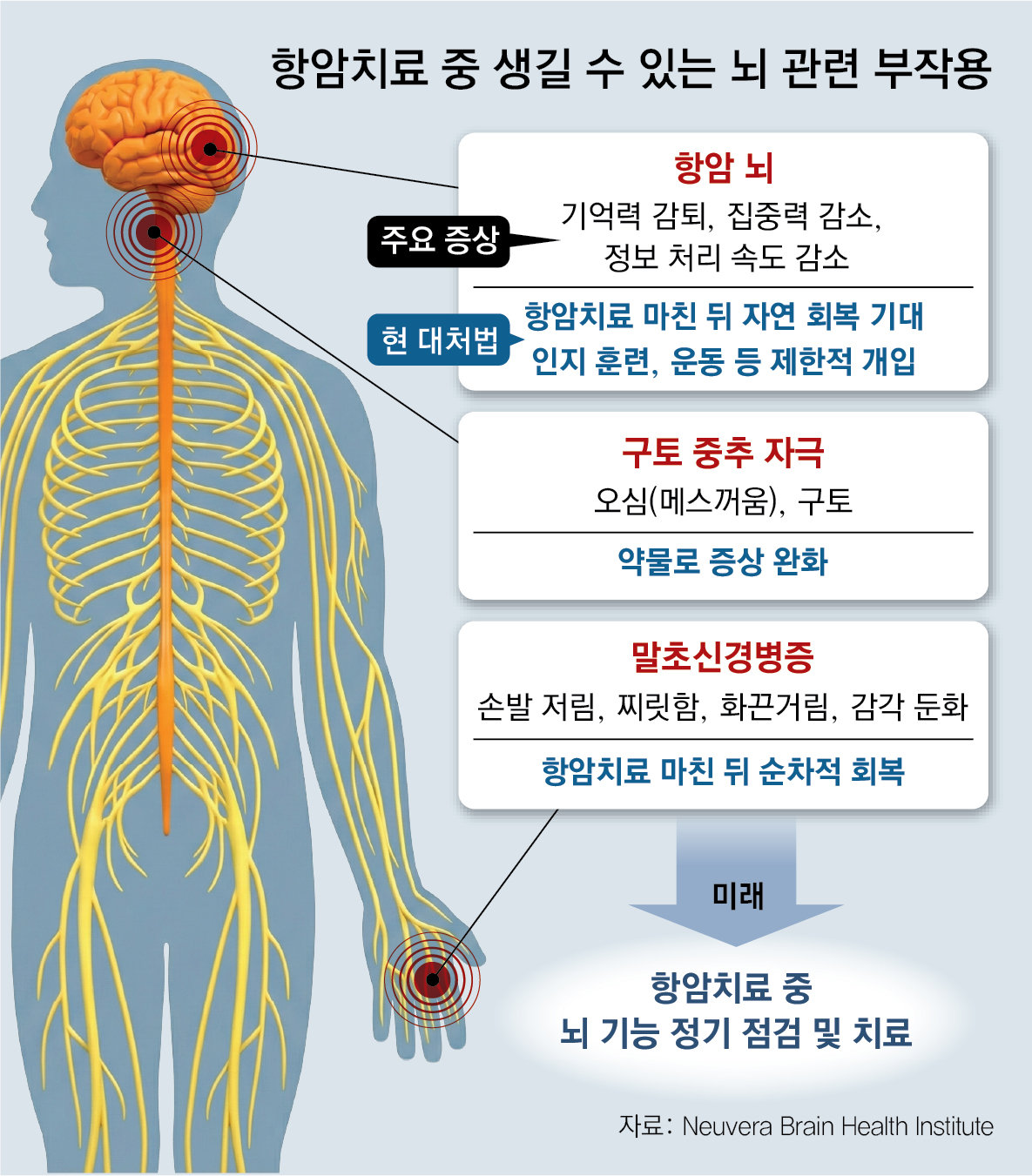
There are currently three main reasons cited for why chemotherapy affects the brain. First, chemotherapy drugs can directly act on neurons or the central nervous system and impair cognitive function. Second, some view that changes in the balance of gut microbiota caused by chemotherapy affect the brain through the gut-brain axis, triggering cognitive and behavioral changes. Finally, inflammatory responses in the brain that occur after chemotherapy or radiation therapy are also identified as causes of cognitive decline.
Chemo brain is usually temporary, but in some cases it takes several months or even years to recover, and cognitive training or exercise is attempted to aid recovery. Nausea, vomiting, and fatigue can be alleviated with medications administered alongside chemotherapy. However, when brain-related symptoms are severe or persistent, it is difficult to find effective countermeasures. This is because there is still insufficient understanding of accurate diagnostic methods for the underlying causes and of how to treat them.
Moreover, many abnormal brain-related symptoms that appear during chemotherapy are easily regarded as problems that must simply be endured as part of the treatment journey. In other words, given the ultimate goal of overcoming a formidable disease such as cancer, other issues tend to be treated as secondary and are often overlooked. When a lion is attacking and one is running for life, it is hardly an option to stop running just because memory feels a bit off, the limbs are numb, or there is vomiting or dizziness.
In ‘Sex and the City,’ Samantha, who experiences hair loss during breast cancer chemotherapy, rips off her sweat-soaked wig in the middle of a speech. Photo courtesy of HBO
Yet ignoring such symptoms, particularly for patients undergoing long-term chemotherapy who remain exposed to anticancer agents for extended periods, can lead to confronting another major obstacle—brain disorders—after cancer has been overcome. Above all, even if a metaphorical lion is in pursuit during treatment, there are still cases where the pain becomes so overwhelming that it is no longer bearable.
Another reason why it has been particularly difficult to pay special attention to brain-related abnormal symptoms during chemotherapy is that, in practical terms, brain disorders themselves have long been technically challenging to diagnose and treat. If simple tests could easily pinpoint the problem and treatment were straightforward, medical teams could have responded more proactively for all patients undergoing chemotherapy.
However, a new era is now emerging. Technology is advancing rapidly, and a time is approaching in which detecting and treating brain problems can be done quickly and easily. This is opening the way to monitor and manage brain function throughout the challenging course of chemotherapy. Through this, it may be possible to look forward to a future in which patients can survive chemotherapy without abnormalities in brain function and with reduced suffering during the treatment process.
In the future, the process of overcoming cancer may no longer have to be a lonely journey of unconditionally enduring distressing symptoms such as memory loss and pain. Instead, it can become a journey of safeguarding brain health through active diagnosis and management. Just as Samantha found a kind of freedom by ripping off her sweat-soaked wig, it is to be hoped that patients will be able to cast off the problems within the brain and overcome cancer as well!
ⓒ dongA.com. All rights reserved. Reproduction, redistribution, or use for AI training prohibited.
Popular News