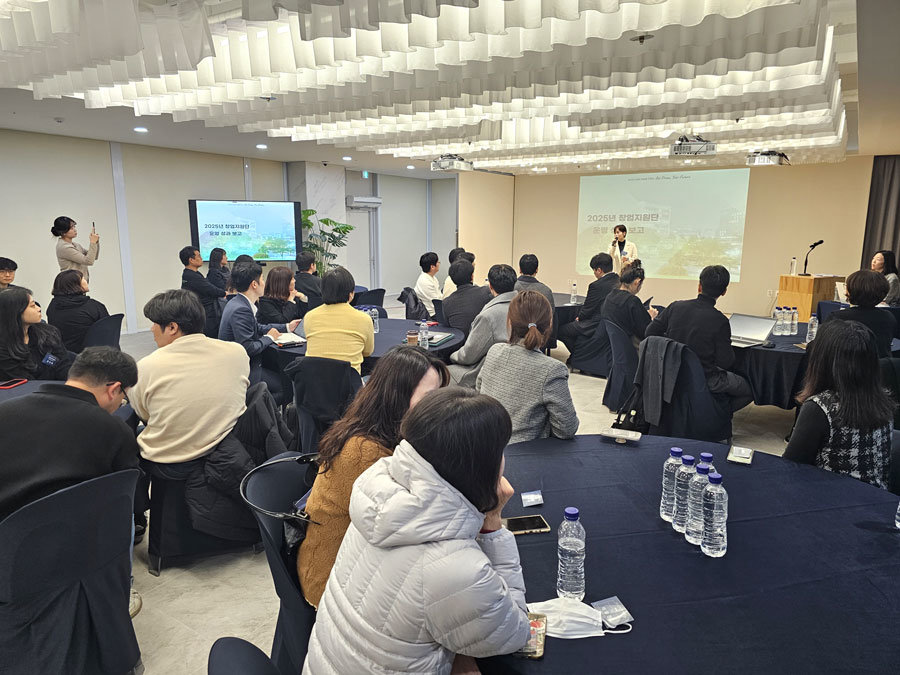
The “2025 Regional Specialized Startup Alliance IR (Investment Attraction) 2nd” event, organized by the Startup Support Group of Seoul National University of Science and Technology, was successfully held on December 12 at the SangSang Hall of Seoul National University of Science and Technology in Gongneung-dong, Seoul. The event was prepared to strengthen the investment capabilities of companies benefiting from the Preliminary Startup Package and Early Startup Package and to provide them with practical opportunities for investment attraction.
SangSang Hall at Seoul National University of Science and Technology, where the 2025 Regional Specialized Startup Alliance IR 2nd event was held / Source = ITDongA
The event was attended by Jeong Kyung-hee, Deputy Head of the Startup Support Group at Seoul National University of Science and Technology, Lee Woo-jin, Team Leader at Seoul Technopark, and Lee Sung-kyung, Team Leader at Seoul National University of Science and Technology Technology Holdings, as well as numerous investment experts from venture capital (VC) and accelerators (AC), and various stakeholders from the startup ecosystem.
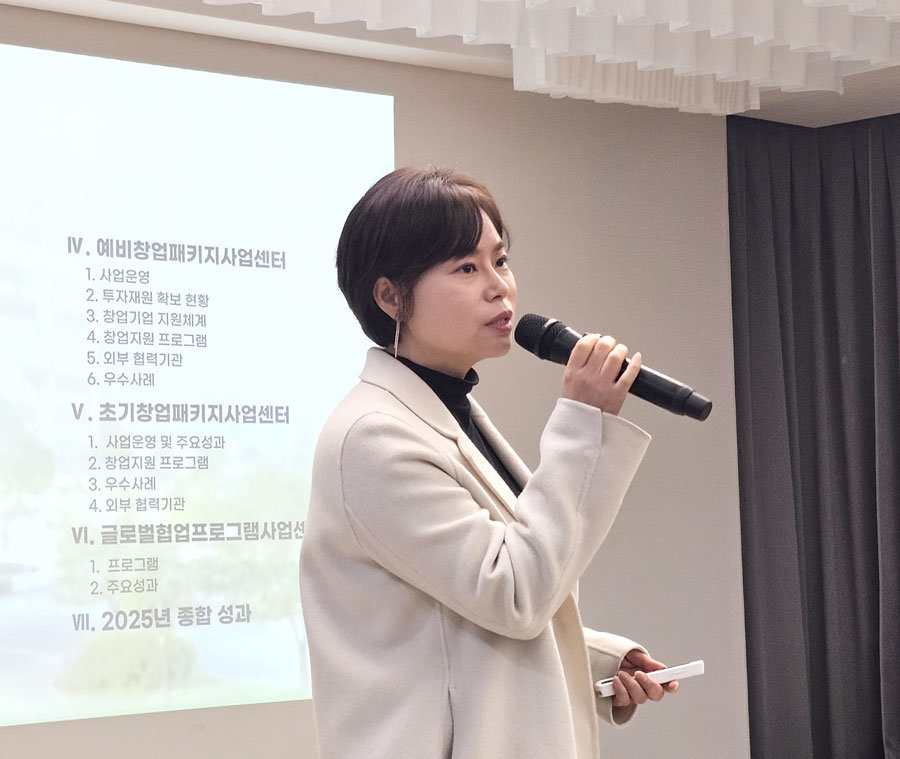
Deputy Head Jeong Kyung-hee of the Startup Support Group at Seoul National University of Science and Technology presenting this year’s achievements / Source = ITDongA
The event began with each institution sharing its achievements toward revitalizing the startup ecosystem. Jeong Kyung-hee, Deputy Head of the Startup Support Group at Seoul National University of Science and Technology, pledged intensive support through a phased assistance system so that companies can achieve substantial results. Lee Woo-jin, Team Leader at Seoul Technopark, introduced specific support measures for manufacturing companies, such as assistance with building smart factories. In addition, Lee Sung-kyung, Team Leader at Seoul National University of Science and Technology Technology Holdings, drew attention by emphasizing a partnership that covers the entire process from investment to exit and sharing successful investment exit cases.
“K-Nano” – Using aerosol technology to improve semiconductor yieldIn the main IR session, 11 promising startups in various fields, including semiconductors, robotics, quantum computers, and eco-friendly materials, took the stage to present their technologies and business models. Among them, the performance of deep-tech-based companies such as “K-Nano,” “OptiQ Labs,” and “Harmony Gate” stood out.
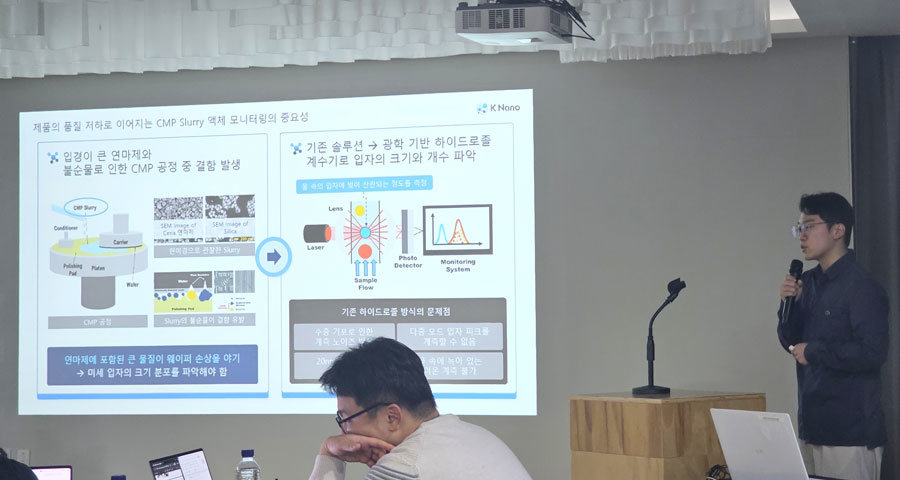
“K-Nano” presenting a semiconductor defect-causing particle detection system using AI particle engineering technology / Source = ITDongA
The first company to take the stage, “K-Nano” (CEO Kwak Dong-bin), introduced a system that monitors in real time the particles that cause defects in semiconductor processes. As semiconductor fine processes become more advanced, quality control of ultrapure water and process liquids has emerged as a key factor in yield.
Manager Ji Hyun-woo of K-Nano stated, “The conventional liquid particle counter (LPC) method has clear limitations due to noise from bubbles in the liquid and in measuring particles smaller than 20 nanometers (nm),” adding, “K-Nano analyzes liquid by converting it into an aerosol (gas) state, fundamentally eliminating bubble noise and enabling monitoring of ultrafine particles at the 1 nm level.”
In particular, K-Nano possesses a unique technology that separates actual particle signals from non-volatile residue (NVR) signals through AI algorithms. The company has already conducted four technology verifications (PoC) with Samsung Electronics, gaining recognition for its technological capabilities, and announced that it aims to enter the global market by mass-producing semiconductor process liquid monitoring equipment in the future.
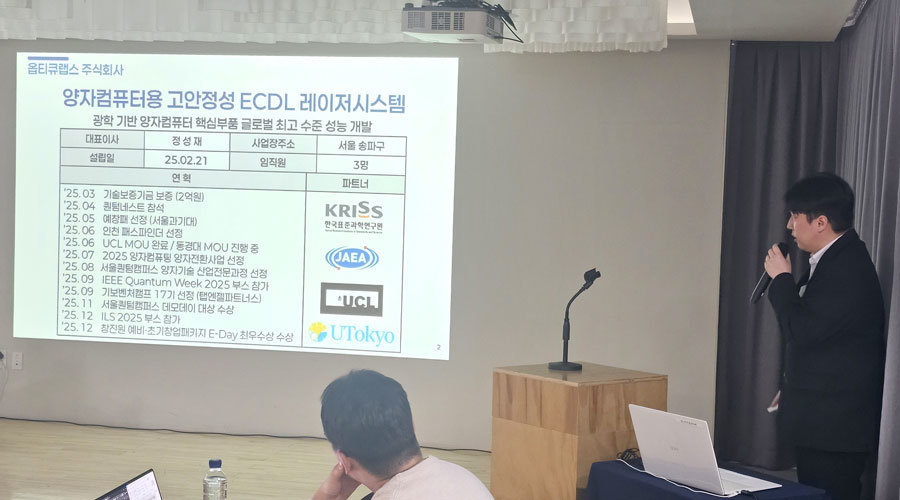
“OptiQ Labs” – Localizing dedicated laser systems, key components of quantum computers“OptiQ Labs” (CEO Jung Sung-jae) presented an “optics-based high-stability laser system,” a core component of quantum computers, which are regarded as next-generation “game changers.” Currently, developers of ion-trap-based quantum computers face difficulties because they lack dedicated laser systems and must instead intricately modify general commercial lasers.
“OptiQ Labs” presenting key optical components for high-stability ion-trap-type quantum computers / Source = ITDongA
CEO Jung Sung-jae of OptiQ Labs said, “As the number of qubits in a quantum computer increases, the number of required lasers grows exponentially,” emphasizing, “We provide a high-precision, high-stability laser system optimized for quantum computing environments as an all-in-one solution, dramatically reducing research and development costs and time.”
OptiQ Labs has already achieved a superior narrow line width performance of 50 kHz compared with competitors and stressed that its first goal is to be adopted as a vendor by global leading quantum computing companies such as Quantinuum.
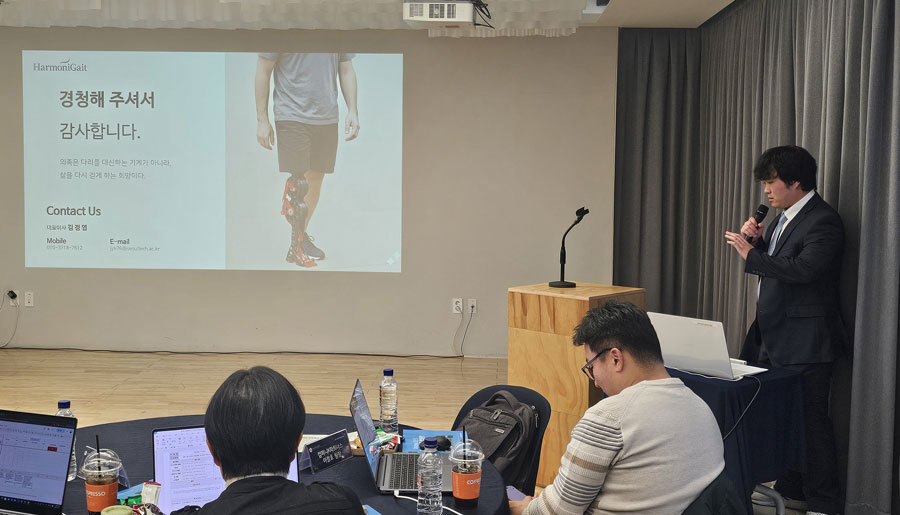
“Harmony Gate” – AI learns how to walk: active robotic prosthetic leg“Harmony Gate” (CEO Kim Jung-yeop) showcased an AI-based smart robotic prosthetic leg for people with limb loss. Most existing prosthetic legs are passive, without motors, causing significant inconvenience and risk of falls when climbing stairs or walking on slopes.
“Harmony Gate” presenting a user-adaptive smart robotic prosthetic leg equipped with human-mimicking AI technology / Source = ITDongA
Director Kim Dong-jun of Harmony Gate explained, “Active actuators (motors) are built into the knee and ankle, and AI learns the user’s gait pattern and surrounding environment to assist a natural walking motion.”
In particular, the company’s plan to offer the product in the KRW 3 million price range through modular design and 3D printing technology, compared with imported robotic prosthetic legs that cost from tens of millions of KRW up to KRW 100 million, drew strong interest from the judges. Harmony Gate is preparing for commercialization next year in cooperation with domestic distributor “Seoul Orthopedics” and motor specialist “SPG.”
Diverse innovative ideas from promising startups attract investors’ attentionOther promising companies from various fields also participated in the IR. “POBU” (CEO Ko Hyung-seon) introduced a mobile robot system capable of producing multiple beverages in parallel at the same time to resolve order surges during peak times. The system’s strength is that mobile robots moving along rails collaborate to handle 20 beverages within 2 minutes.
“TTX” (CEO Choi Dong-jae) presented an automated payment system with an explosion-proof touch display that can be safely used at locations with explosion risks, such as gas stations and hydrogen charging stations. The system features the use of vision AI to recognize vehicles and drivers and simplify the payment process, cutting through the complex web of interests in the oil refining industry.
In the eco-friendly sector, “Right People” (CEO Park Se-jin) introduced wet wipes and packaging materials made from 100% natural pulp and biodegradable raw materials, presenting a clear solution to increasingly stringent global plastic regulations. “Isaac Concepts” (CEO Kim Tae-young) drew attention with a hybrid liquid cooling system for thermal management of high-performance semiconductors and data centers.
Presentations also continued in the content and platform sectors. “Hypercent” (CEO Kim Ju-wan) presented the performance and scalability of a horror multiplayer game based on the “Backrooms” IP, which has recorded more than 100 million views worldwide. “Peoples” (CEO Kim Beom-jun) proposed a vision for narrowing educational gaps with its AI creation solution “Dream AI Studio,” which allows anyone to easily create picture books.
In addition, “Museive” (CEO Jung Hae-min) received encouragement by candidly sharing its pivot story from an AI composition tool, which had not succeeded, to “Trigger,” a service that helps people who find it difficult to keep a diary by making calls and assisting with recording. Lastly, “MediSensing” (CEO Kim Sung-eun) showcased advanced sound AI technology that analyzes infants’ health conditions and blind spots in home cameras through sound.
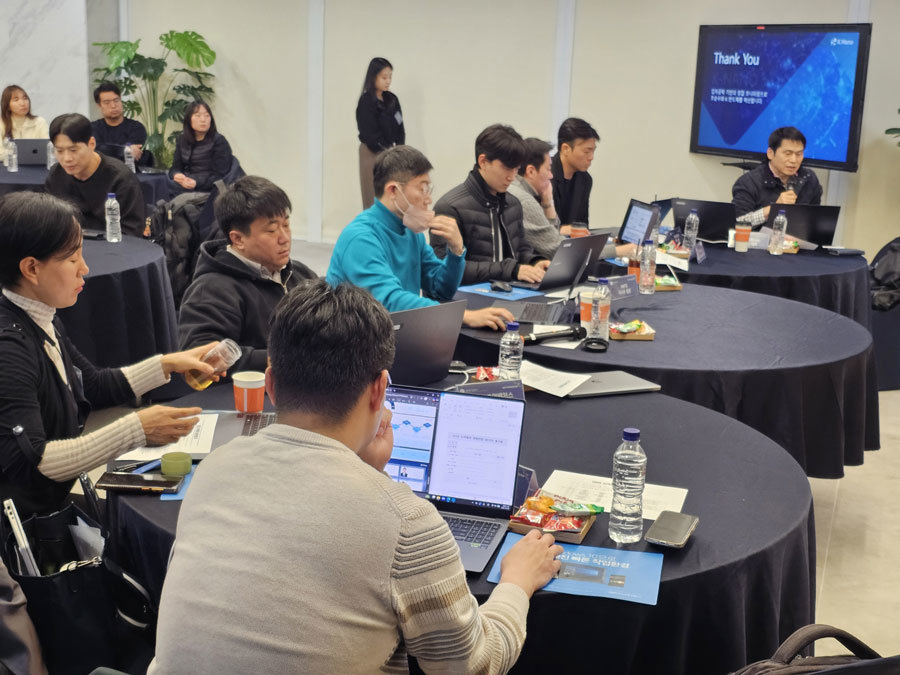
Startup investment and incubation experts closely observing the entrepreneurs’ presentations / Source = ITDongA
In his overall assessment, Koo Won-hoe, CEO of Ensl Partners, stated, “Technology is important, but ultimately the essence of business lies in defining and solving customers’ problems,” and encouraged the participants by saying, “I hope that the companies presenting today will focus more on customers’ needs and grow into entrepreneurs who dream big and are not afraid of failure, like Elon Musk.”
Through this 2025 Regional Specialized Startup Alliance IR 2nd event, universities, local communities, and the investment ecosystem were able to come together to confirm the growth potential of early-stage startups and promote practical scale-up. Seoul National University of Science and Technology plans to continue this approach going forward.
ITDongA reporter Kim Young-woo (pengo@itdonga.com)
ⓒ dongA.com. All rights reserved. Reproduction, redistribution, or use for AI training prohibited.
Popular News