Launching a unified national university system in every province from March next year… establishing decentralized campuses in four regions
On-site AI engineering training in collaboration with Google Cloud Korea
1,400 professors, 30,000 students, KRW 217.1 billion in support… a key national university ‘kingpin’ to prevent regional decline
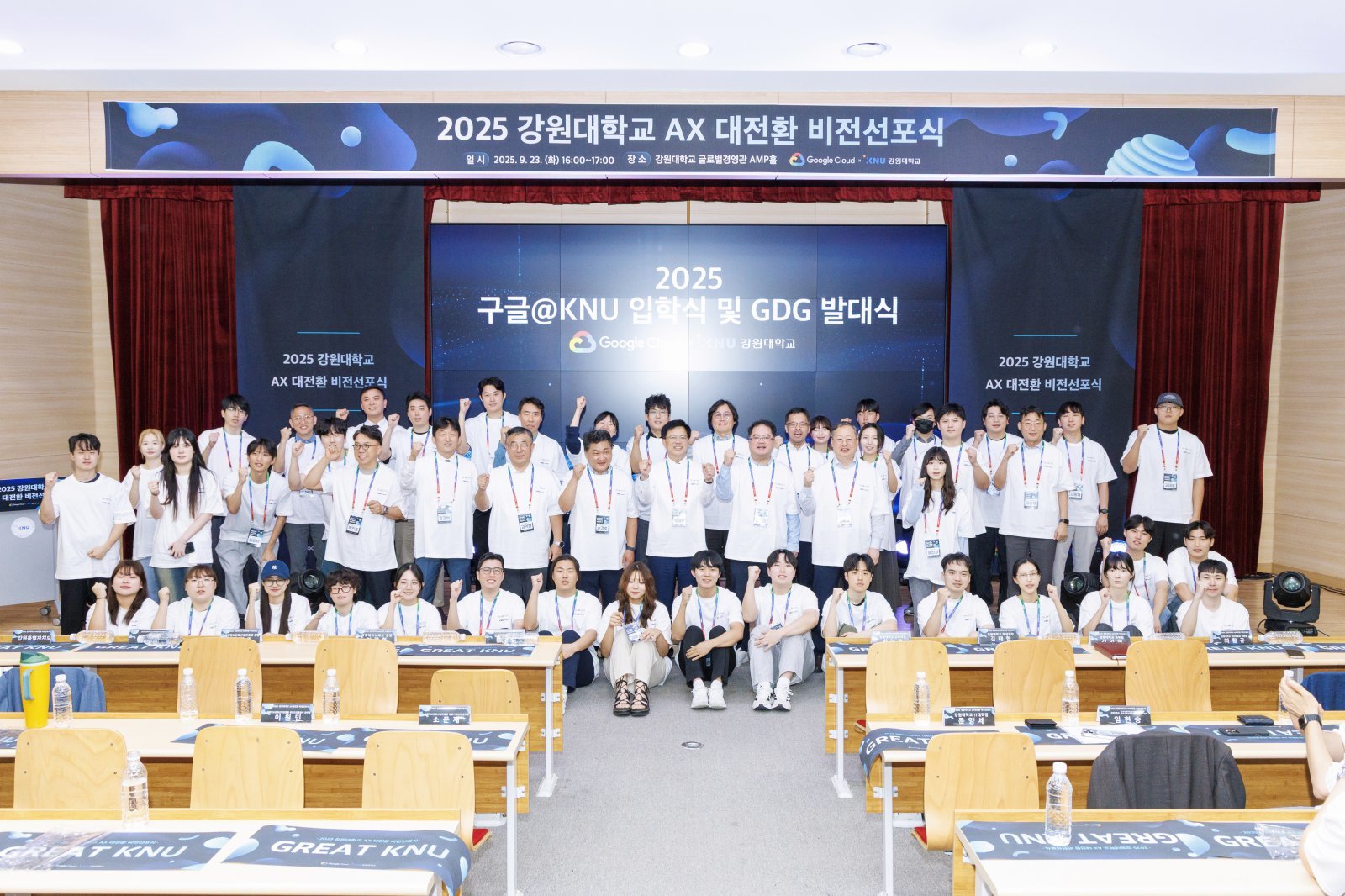
Kangwon National University (KNU) has decided to lead regional innovation by strengthening AI-based education, research, administration, and industry-academia infrastructure. To this end, it has signed an agreement with Google Cloud Korea. It supports courses, extracurricular and club activities linked with Google, as well as employment at Google. Entrance ceremony for the Google-linked education program (Google@KNU). Provided by Kangwon National University
Kangwon National University (President Jung Jae-yeon) and Gangneung-Wonju National University (President Park Deok-young) will be integrated and relaunched as the new integrated Kangwon National University in March 2026. Ahead of the launch, they have joined hands with Google, a leading global big tech company, to accelerate education in advanced industrial technologies, including artificial intelligence (AI). Observers note that the “one province, one national university” model, which Gangwon Special Self-Governing Province is implementing for the first time in the country, signals a major shift in the national higher education system as well as in the co-growth ecosystem of regions and universities.
The integrated Kangwon National University will have campuses in Chuncheon, Samcheok, Gangneung, and Wonju, and will be established as a mega-sized national university with 30,000 students and 1,400 professors. It will be the largest among national and public universities in Korea, covering the entirety of Gangwon Special Self-Governing Province. It has already secured KRW 217.1 billion (KRW 173.7 billion in national funding and KRW 43.4 billion in local funding) through its selection for the Ministry of Education’s “Glocal University 30” initiative. Sufficient momentum has been secured for innovation after integration as well.
● Google engineers design curriculum as ‘Google@KNU’ launches
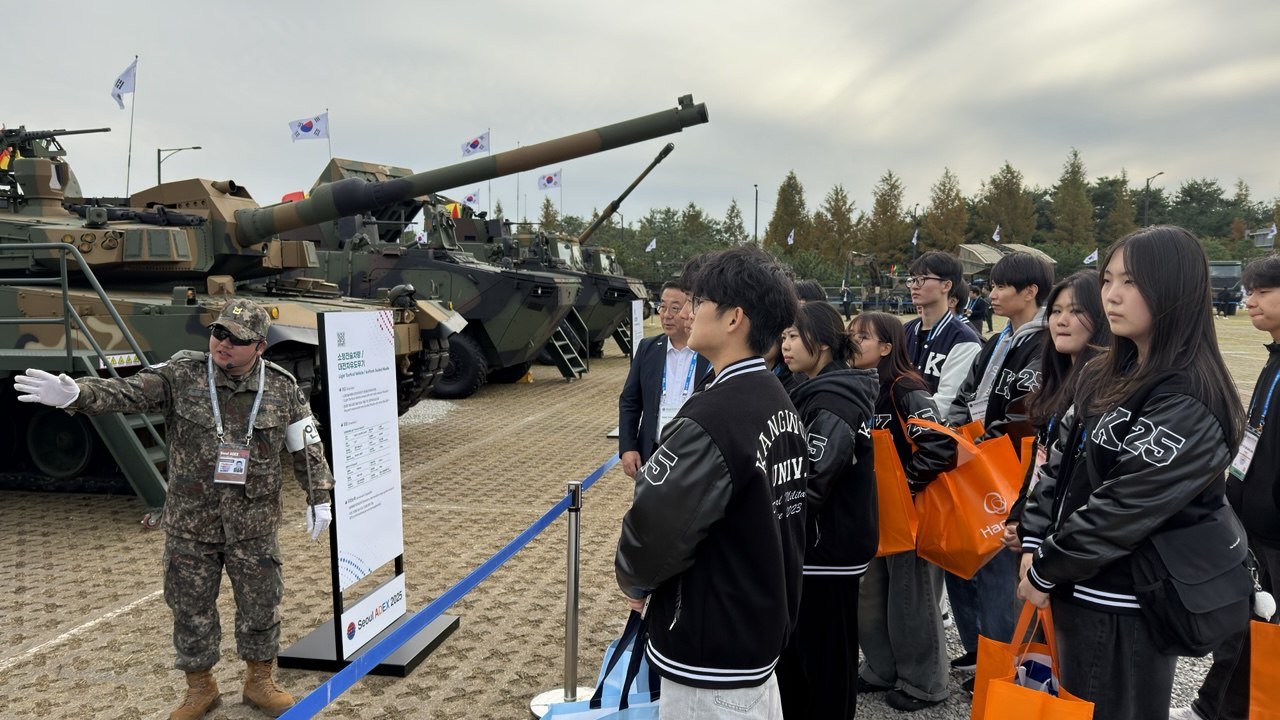
Students of Kangwon National University experience state-of-the-art defense technologies at the “2025 Seoul International Aerospace & Defense Exhibition.” Provided by Kangwon National University
The launch of the integrated Kangwon National University is aligned with the government’s “creating 10 Seoul National Universities” policy, which aims to develop regional flagship national universities into research-focused institutions on par with Seoul National University. As the platform and engine for innovation in the Gangwon region, the integrated Kangwon National University is regarded as the “kingpin” that will overcome the crisis of regional extinction. To support this, the government has increased the budget for flagship national universities within next year’s Ministry of Education budget from KRW 424.2 billion this year to KRW 885.5 billion. These funds will be invested in undergraduate education innovation and the expansion of advanced experimental and practical training equipment. The budget for fostering AI and science and engineering talent is KRW 334.8 billion.
The integrated Kangwon National University is already making preemptive investments in future industries, in particular establishing an educational ecosystem in the AI-software field in cooperation with Google, a global corporation. This is embodied in the “Google-linked education program (Google@KNU),” operated together with Google Cloud Korea. Google engineers design the curriculum and teach AI technologies that can be applied directly in industrial settings. Kangwon National University has also been reselected for the “Software (SW) Oriented University Program” led by the Ministry of Science and ICT and will receive KRW 17.8 billion in support over the next five years. This will enable the creation of an environment where all students, regardless of major, can study AI.
In addition, it has been selected for the “2025 Advanced Industrial AI Talent Training Bootcamp Program” run by the Ministry of Education and the Korea Institute for Advancement of Technology. Only three universities were selected nationwide out of 32 applicants. In cooperation with AI startup Upstage, Kangwon National University Hospital and others, the university plans to operate training courses for AI practitioners, including tracks such as cloud-based AI services and medical AI.
● Integrated semiconductor education-research system built with Seoul National University In the semiconductor field, Kangwon National University has secured approximately KRW 78.0 billion through its selection for the “Semiconductor Specialized University Support Program” and the hosting of a Semiconductor Joint Research Institute. Together with the Semiconductor Joint Research Institute at Seoul National University, it has established an integrated education and research system that covers the entire semiconductor production process from design and processing to packaging. The Wonju campus will serve as the hub for industry-academia cooperation in semiconductors. By 2028, the university will also establish a double-major program in Semiconductor Convergence Studies.
The university also plans to further advance the training of defense industry specialists, which has been progressing rapidly, including the establishment of the Department of Digital Military Studies in 2023. The Advanced Military Science and Technology Research Institute (Director Kim Ik-hyun), which houses four centers for defense AI, defense robotics and semiconductors, and defense information security, has been selected for the Ministry of Education’s Glocal Lab initiative and secured KRW 21.6 billion in research funding. It will be the first university in Korea to carry out a national research project on a Korean-style defense cyber risk management framework (K-RMF). It will also pursue the development of core defense security technologies to respond to cyber threats.
The Institute of Mathematical Sciences, which was simultaneously selected for the Glocal Lab initiative, plans to contribute to revitalizing Gangwon’s specialized industries—such as precision medicine, bio, and agricultural life sciences—through AI convergence research.
● Differentiated functions at each multi-campus to promote co-prosperity One of the innovations that local communities are closely watching in the integrated Kangwon National University is the multi-campus system. The university plans to operate campuses in four regions of the province, each with differentiated functions tailored to local industrial structures and needs.
The Chuncheon campus will become an education and research hub focused on precision medicine, biohealth, and data industries. The Samcheok campus will be developed into a cooperation hub among region, industry, and university in the fields of liquefied hydrogen and energy. The Gangneung campus will be specialized as a cooperation hub linking earth sciences, academia, and research in the areas of new materials, marine and natural product bio, while the Wonju campus will be specialized as an industry-academia cooperation hub focusing on semiconductors and e-mobility.
To this end, the university has newly established a University Innovation Strategy Office and built a decentralized governance system centered on a campus president system. Reporting directly to the university president, the University Innovation Strategy Office serves as a control tower, responsible for formulating development strategies for the integrated Kangwon National University, planning financial projects, and managing performance. Each campus president holds practical authority over all aspects of academic administration.
The “Top-Class Integrated Departments” model, in which large departments with more than 100 students are jointly operated by multiple campuses, is also cited as an example of innovation. For instance, the Department of Computer Engineering at the Chuncheon and Wonju campuses is operated as a single department. Through an AI-based education system and a remote joint lecture framework, students can share the curricula of diverse faculty members without physically moving between campuses.
The “P3L model,” which further reinforces the university’s identity as a regionally embedded institution, is also attracting attention. This is a program that identifies and solves local problems in the field, with the Samcheok campus living lab project being a representative case.
● ‘Campus start-up base’ as foundation for nurturing Gangwon-style unicorns The university is also accelerating efforts to transform its four campuses into a large-scale start-up ecosystem. It is operating the “Startup Minerva School,” which fosters hands-on entrepreneurial talent in connection with regional strategic industries at each campus. With more than 9,400 students completing 286 courses, success stories have emerged, including student start-up company “Gamja Island” and faculty start-up company “AprilBio.”
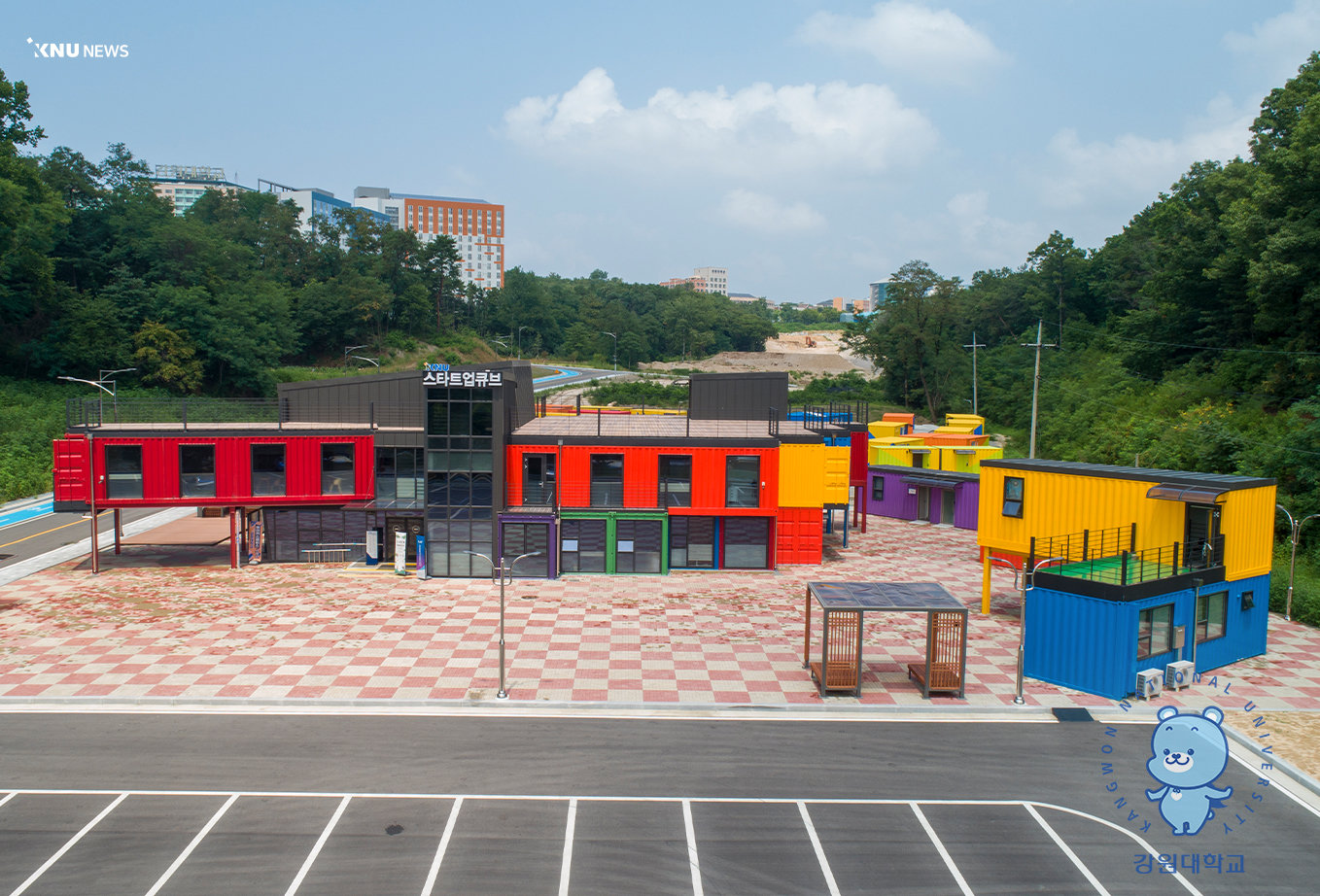
The “KNU Startup Cube,” a container-type start-up space that serves as an outpost for student and faculty entrepreneurship, is also drawing attention. By providing one-stop support from idea generation and prototype development to commercialization, it has produced 35 student start-ups and 17 faculty start-ups. Recently, the start-up club “Go With” from the KNU Startup Cube developed a fertilizer using the invasive species prickly lettuce to prepare for drought and won the “2025 Enactus Korea National Competition,” the largest university student business project contest in the country.
Construction of the “Campus Innovation Park,” an urban high-tech industrial complex that will house companies, research facilities, as well as residential and cultural facilities within the university, is also progressing smoothly. The construction progress rate stands at 70%. A “Industry-Academia-Research Innovation Hub” will be established here, and 117 companies in advanced industrial fields such as bio, semiconductors, and digital healthcare have expressed their intention to move in.
● Settlement support, including one-stop support center for international students
Through the “KNU Startup Cube (top photo),” Kangwon National University provides one-stop support from idea generation and prototype production to commercialization, and the number of international students has recently increased significantly. Provided by Kangwon National University
The university is also continuously expanding its external reach. The number of international students currently stands at 2,697, more than tripling over the past five years. The integrated Kangwon National University is promoting the university overseas by establishing KNU Cultural Centers abroad. It also operates the KNU Preparatory College program before admission and a one-stop support center after admission to help international students settle in. Kangwon National University is working toward integration not only with Gangneung-Wonju National University but also with Chuncheon National University of Education and Gangwon State University.
President Jung Jae-yeon said, “The integrated Kangwon National University will become a milestone in the innovation of higher education in the Republic of Korea,” adding, “We will focus our capabilities so that local talent can receive top-level education without having to leave for the Seoul metropolitan area.”
Kangwon National University will accept applications for the 2026 academic year regular admission from the 29th to the 31st. The Chuncheon campus and Samcheok (Dogye) campus will admit 799 students, while the Gangneung and Wonju campuses will admit 102 students. Further details are available on the Kangwon National University admissions website and the Gangneung-Wonju National University admissions website.
ⓒ dongA.com. All rights reserved. Reproduction, redistribution, or use for AI training prohibited.
Popular News