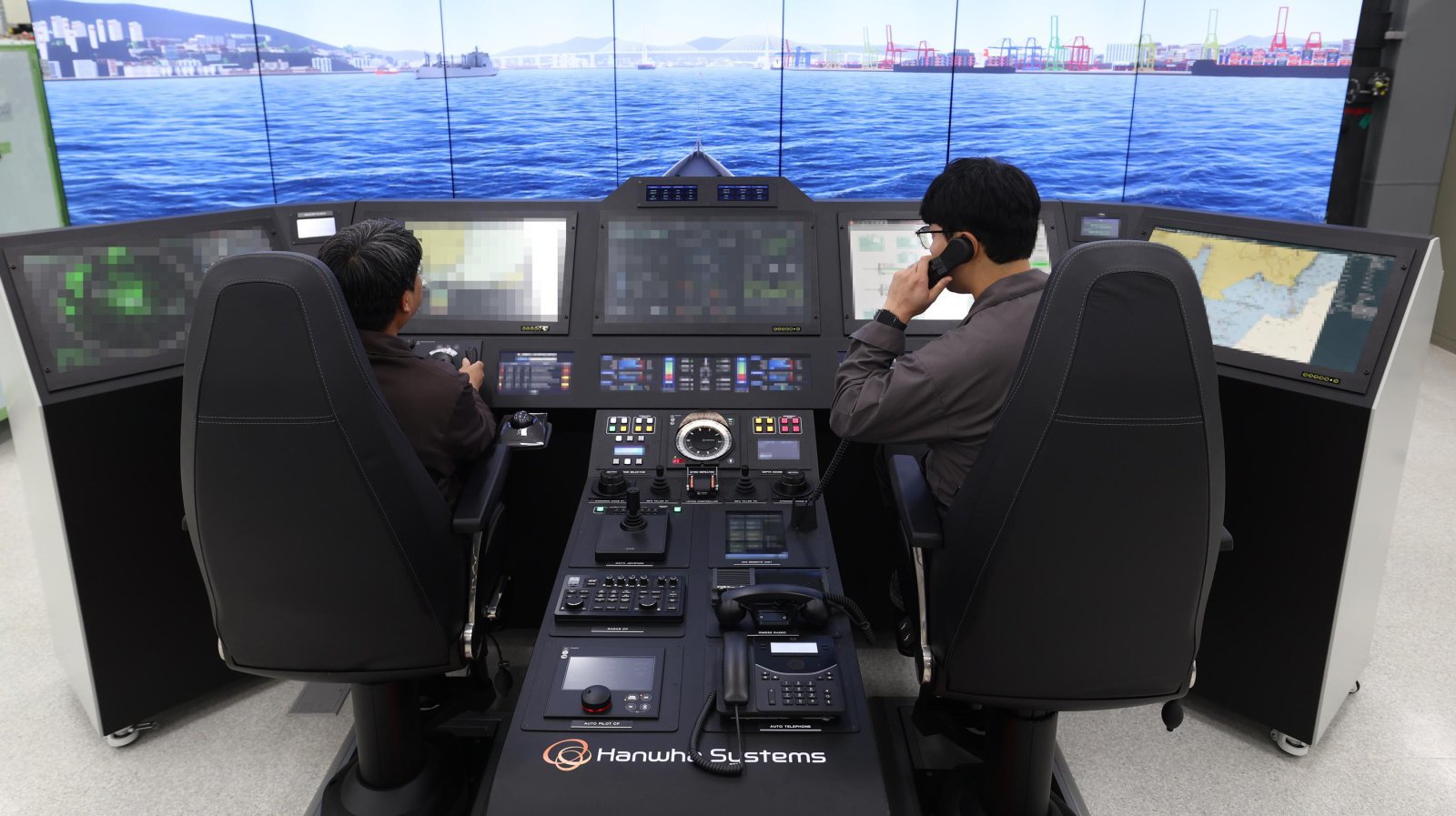
Hanwha Systems employees demonstrate cockpit-type Integrated Bridge System (IBS) equipment. Using this equipment, bridge operations that previously had to be shared among 6–8 crew members for steering, communications, and other tasks can be controlled by just two operators who manage the vessel. The lower screen has been blurred for security reasons. Provided by Hanwha Systems
On 12 December, during a visit to Hanwha Systems’ new business site in Gumi, North Gyeongsang Province, simulation equipment resembling an aircraft cockpit came into view upon entering the third floor of the largest manufacturing building among the five buildings including the main office. It is the aircraft cockpit-type Integrated Bridge System (IBS) that Hanwha Systems is developing for the first time in Korea. This is a ship control device that consolidates all functions and screens within arm’s reach so that, like an aircraft, just two operators can perform bridge operations—such as steering, communications, and navigation—that previously had to be divided among 6–8 crew members.
Sitting in the simulator and slightly moving the steering device shaped like a control yoke, information such as the vessel’s position, tilt, and azimuth appeared as a head-up display (HUD) on the front screen depicting the forward view.
At Hanwha Systems’ Gumi plant, which sits on a site of 89,000㎡ (about 27,000 pyeong) and houses five buildings—the exhibition hall (main building), research building, development and testing building, manufacturing building, and MRO building—the “eyes, ears, and brain” of K-defense systems were being produced. Kim Yong-jin, Head of Hanwha Systems’ Gumi Plant (Senior Executive Vice President), said, “Radar systems, integrated combat systems, and optical surveillance equipment for aircraft, naval vessels, and missiles produced here are installed not only in Hanwha products but also in various weapons of K-defense companies such as Hyundai Rotem and LIG Nex1,” adding, “About 30% of Gumi plant sales come from overseas exports.”
Throughout the manufacturing building, “vibration-free clean rooms” reminiscent of semiconductor fabs were installed. The total combined area of these clean rooms alone is about 1,500 pyeong. They are used to produce semiconductor modules for radar and optical equipment such as range finders for K2 tanks. The company added that the clean rooms’ vibration level is about one-hundredth that of ordinary buildings, and the dust level is about one-fifth that of large hospital operating rooms.
Optical equipment produced in this way undergoes precision testing at a laboratory on the fourth floor. When the zoom of a range finder was adjusted and the measurement button pressed toward a building on a mountainside beyond a highway—so distant that it appeared not merely blurry but almost foggy to the naked eye—the screen immediately displayed a reading of 4,620 m. This range finder, mounted on the next-generation main battle tank K2 developed and produced by Hyundai Rotem, can precisely measure the distance to targets five times farther than the K2’s effective firing range. In fact, according to the Ministry of National Defense and others, the K2 tank surprised UAE officials by achieving a 100% hit rate on targets more than 4.5 km away during a combined joint exercise held in the United Arab Emirates in September this year.
On the first floor, in the Cheongung system radar assembly and test facility, anechoic chambers (spaces whose walls and ceiling are lined with pointed structures to prevent the reflection of electromagnetic or sound waves) were installed in several locations. Personnel were gathered under a radar rotating rapidly at one revolution every 1.5 seconds, inspecting the equipment. They were upgrading the operational radar for “Cheongung I,” a surface-to-air missile capable of shooting down aircraft, to the “Cheongung II” radar, which can intercept ballistic missiles. Park Hyuk, Head of the Radar Business Center (Executive Vice President), said, “Because ballistic missiles travel at speeds of Mach 4–5 or higher, far exceeding those of aircraft, radar precision and processing speed must be significantly enhanced,” adding, “This facility also carries out upgrades from passive electronically scanned array (PESA) radars, which can detect only one target at a time, to active electronically scanned array (AESA) radars capable of detecting multiple targets simultaneously.”
Hanwha Systems expects that full-scale operation of this newly completed site, which was finished at the end of last month, will increase its production capacity by more than 30%. The company stated, “As the defense market is expected to grow for more than the next 10 years, additional production facilities will be introduced on the site and automation equipment will be installed to ensure that K-defense’s strengths—on-time delivery and high-quality production—are maintained.”
ⓒ dongA.com. All rights reserved. Reproduction, redistribution, or use for AI training prohibited.
Popular News