[SeoulTech x ITDongA Joint Project] The Preliminary Startup Package Support Program (hereinafter, the “Preliminary Startup Package”) is a major startup support initiative of the Ministry of SMEs and Startups and the Korea Institute of Startup & Entrepreneurship Development (KISED), designed to help promising ideas grow into businesses. As a 2025 host institution for the Preliminary Startup Package, the Startup Support Group at Seoul National University of Science and Technology (SeoulTech) supports the growth and development of early-stage companies. ITDongA, together with the SeoulTech Startup Support Group, is highlighting promising startups that are currently on a growth trajectory.
“Excluding cases where domestic medical device companies apply for FDA approval directly, most either apply through government programs or outsource the process to consulting firms. Meanwhile, from this year, the FDA has begun accepting online submissions not only for 510(k), but also for approval procedures such as PMA and De Novo, and is developing tools in cooperation with OpenAI to assess pharmaceuticals and other products. Anticipating that FDA’s digitalization would create a need for digital management, Medirule was founded.”
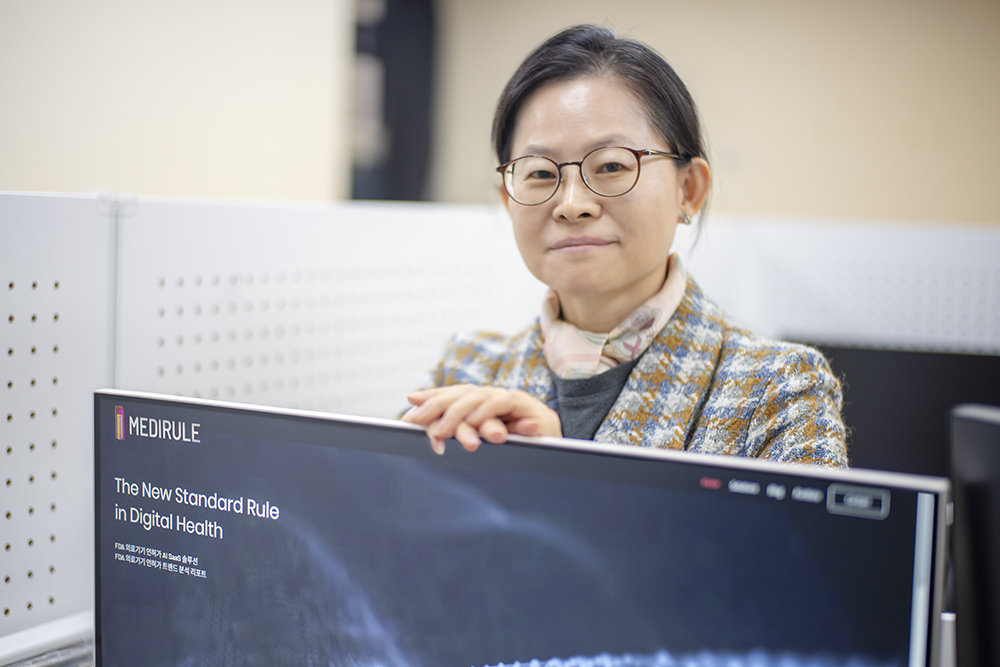
Ahn Mi-kyung, CEO of Medirule / Source = ITDongA
CEO Ahn Mi-kyung began her career at Samsung SDS in 1998, later working for companies related to big data solutions. Since 2014, she has moved into the development of hospital and medical services, accumulating relevant know-how. Until last year, she served as head of the planning team at a company that provides Korea’s integrated medical information systems. In line with the digital transformation and changes in the medical device market, she founded Medirule and began carving out her own path.
Observing how AI medical devices will reshape the market… leading to FDA approval business
There are three main reasons behind CEO Ahn’s decision to establish Medirule. The first is the inefficiency of the FDA certification process in actual work environments. The second is that the expansion of AI medical devices will likely increase the probability of recalls, making systematic management essential. Most importantly, FDA approvals themselves are undergoing digital transformation.
Ahn explained, “I have been responsible for planning related to integrated medical information systems and medical devices, and I also hold the ISO 13485 certification (the international standard for quality management systems in the medical device industry). While working on a medical device planning team, I always prioritized safety. FDA approval is the most definitive way to demonstrate this externally, so I have focused on this area as well.”
CEO Ahn is an industry expert with over 20 years of experience in AI big data and medical device planning / Source = ITDongA
She continued, “Working on the front line, I constantly experienced a gap between the development and planning teams. Development would be completed and then the approval process would begin, but afterward, we would have to add functions, standardize them, and do additional documentation. Also, even for items that have received approval, annual reporting is required, and if data is not properly managed, it becomes problematic. I always felt the need for a tool to manage all of this comprehensively.”
She also anticipated that as medical devices incorporating AI began to obtain FDA approval, safety issues related to AI medical devices would surface. Ahn said, “I thought that medical devices with AI applied to them would inevitably have a higher likelihood of errors or problems than general medical devices. That is why, in 2021, I published a paper titled ‘A Study on Medical Errors and Design Types through Text Mining Analysis of FDA Medical Device Recall Data’.” After the paper was published, institutions such as Korea University, the National Rehabilitation Center, and domestic medical institutions and companies seeking FDA certification for new products approached Ahn to hear her views.
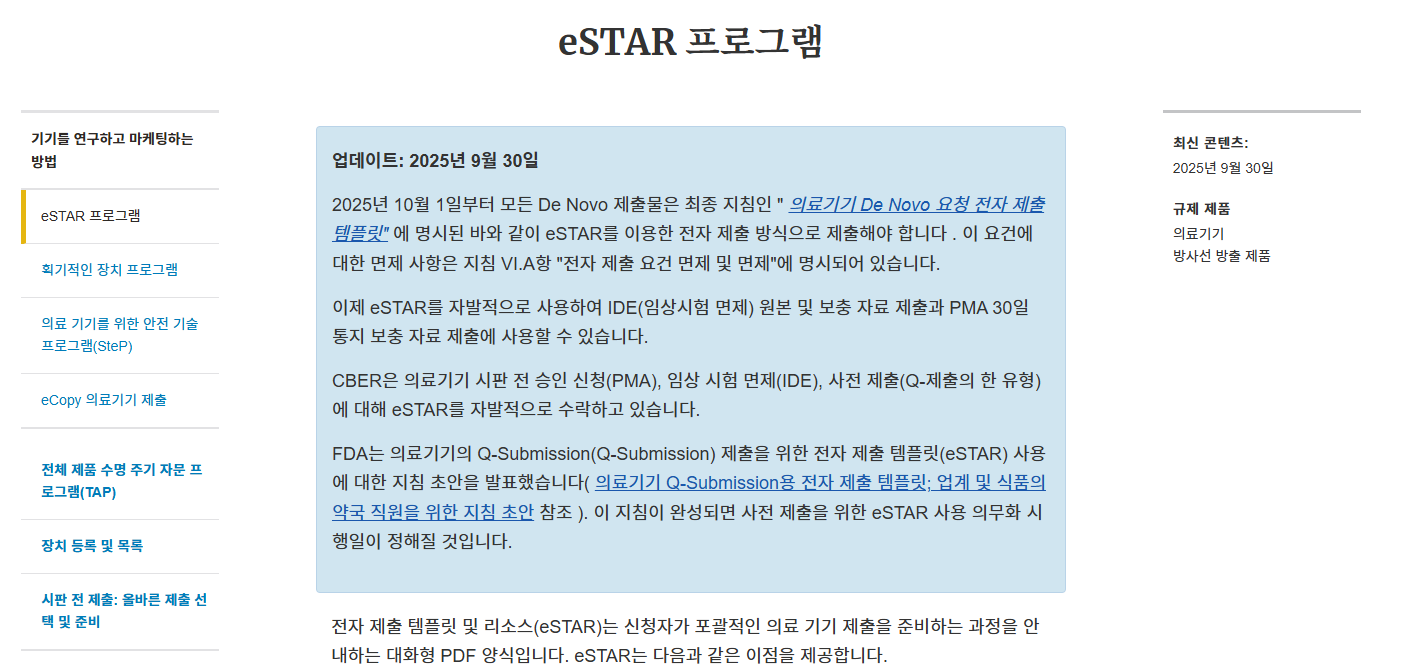
Since October, the FDA has moved the submission process for De Novo and optional PMA, following 510(k), to online-only / Source = FDA
From this year, the FDA’s digital transformation has been in full swing. Since October 2023, the FDA has mandated that 510(k) submissions use the eSTAR system, and from October 2025, De Novo submissions will also be made through eSTAR. For PMA, eSTAR can be used for certain categories. The FDA has also actively adopted generative AI technologies to improve internal document processing and work efficiency, and plans to gradually apply AI technologies to medical device review and evaluation processes going forward.
In line with changes at the FDA, medical device companies are also establishing systematic digital management systems. In Korea, the number of GMP Compliance Evaluation Centers has already expanded from four to 21 earlier this year, and systematic management of advanced medical devices and AI-converged medical devices is becoming increasingly important. This environment requires efficient management of FDA approval processes and digital data systems.
“Aligning the business with FDA approval and management… SeoulTech supports commercialization”
Medirule was founded in this complex environment, with the goal of managing FDA processes through AI SaaS (Software as a Service). Ahn said, “The procedures required for FDA approval proceed through 21 stages, or at least 13 major steps. Now that documents are submitted digitally, Medirule’s business concept is for companies to upload their files in a secure environment in SaaS form, share materials, and manage them over the long term. For large and mid-sized companies that already have in-house FDA experts, we will help streamline management, and for companies that find FDA approvals difficult, we will support their approval procedures.”
The main service has currently been completed as a Minimum Viable Product (MVP), with full-scale service slated to begin next year. For now, the company is laying the groundwork for the business step by step through a newsletter that summarizes FDA announcements and related content. Ahn said, “We are currently at the preliminary startup stage, and next year we plan to solidify the business through a corporate establishment support program. At the moment, we are analyzing the FDA’s rapid changes directly and sharing the market situation with potential customers through a newsletter, and we plan to generate revenue through paid subscriptions in the near future.”
CEO Ahn introduces an FDA-related newsletter that she produces herself / Source = ITDongA
Although Ahn deals with the highly specialized area of medical device approvals, she says the barrier to preliminary startup is higher than expected. She noted, “I worked in companies for over 20 years and, as an industry-academia cooperation professor, oversaw large-scale R&D projects with a sense of responsibility. With that background, I applied for the Preliminary Startup Package and prepared the documents, but they kept being rejected. That made me realize that starting a business is harder than I thought,” adding, “With help from a manager at the SeoulTech Startup Support Group during this process, I was able to start the Preliminary Startup Package.”
She went on, “I had been paying attention to SeoulTech after conducting AI-related training there last year, and decided to apply. The SeoulTech Startup Support Group operated many programs, and I felt they were very professional. When running a business, planning, hiring, and administrative tasks must all proceed according to procedure, which makes it difficult to focus on growth; in these supplementary areas, I received a great deal of support.”
Front view of SangSang-gwan, which houses the SeoulTech Startup Support Group / Source = ITDongA
Medirule has laid the foundation for its business by receiving operating support funds and startup support funds from the SeoulTech Startup Support Group, and also benefits from company promotion programs. Ahn said, “We received information about global expansion and the Ministry of SMEs and Startups’ TIPS program, as well as legal mentoring. We were also offered mentoring on business plans and operational management,” adding, “With regard to global expansion, I had the opportunity to meet representatives from other companies with similar cases all in one place. Meeting in person and sharing each other’s challenges and strategies was very helpful in many ways, and it also gave me practical clues on operations that had previously felt vague.”
“Of the 26% FDA approval rate, startups account for just 6%; we aim to be the company that helps them”
For Ahn, this year has been a period of warm-up, and from next year she plans to shift into full stride. In closing, she said, “Medirule targets all companies seeking FDA approval, not only domestic firms but also companies in Europe, the United States, and elsewhere. As many as 85% of companies challenging the FDA say that regulatory compliance and the approval process are more difficult than securing funding. Last year, of 20,700 FDA applications, only 5,000 were approved, and among those, small and medium-sized enterprises accounted for 14%, while startups made up only 6%. We intend to build a service that enables companies lacking approval know-how or experience to obtain and manage FDA approvals systematically through Medirule’s AI SaaS.”
Reporter Nam Si-hyun, ITDongA (sh@itdonga.com)
ⓒ dongA.com. All rights reserved. Reproduction, redistribution, or use for AI training prohibited.
Popular News