The domestic hangover remedy market stands at an inflection point. This market, which has been formed around natural ingredients and provocative marketing, has been undergoing structural reorganization since the submission of human application test data became mandatory from 2025. The Ministry of Food and Drug Safety (MFDS) inspected 89 products that had been advertised this year as “sobering up or relieving hangovers” and requested supplementation for 9 products due to insufficient substantiating data. Some products were even cited as having “weak supporting evidence,” sparking controversy. In addition, because the functional health claim food system restricts permitted product forms to jellies, pills, and the like, a side effect has emerged in which products have become homogenized in a short period of time into “Oriental raisin tree-based jellies and drinks.” Concerns are being raised that the credibility of the hangover remedy market is being shaken as domestic manufacturing is heavily dependent on OEM and ODM, most ingredients are imported from China and Southeast Asia, and low-price competition and exaggerated advertising controversies continue to recur.
Source = Shutterstock
Criticism mounts that scientific limits of natural substance-based hangover remedies are clearThe hangover remedy market has long grown around the concepts of “symptom relief based on antioxidant and anti-inflammatory effects” using natural substances and “convenience.” However, critics argue that this approach has clearly defined scientific limits. In particular, in a situation where competitiveness based on medical data such as clinical trials, patents, and mechanisms of action is lacking, dozens of similar products have been launched in a competitive rush.
In response, the MFDS decided that from this year hangover remedies must demonstrate functionality based on all three of the following indicators: ▲ change in blood alcohol concentration ▲ change in blood acetaldehyde level ▲ degree of subjective hangover improvement reported by users. However, this system still has ambiguous quantitative criteria, and manufacturing standards remain flexible, allowing companies to choose between HACCP (Hazard Analysis and Critical Control Point) and GMP (Good Manufacturing Practice). As a result, there is ongoing criticism that passing the review does not necessarily equate to scientific proof of efficacy. This raises questions about the criteria consumers should use to select products and the extent to which scientific verification is feasible.
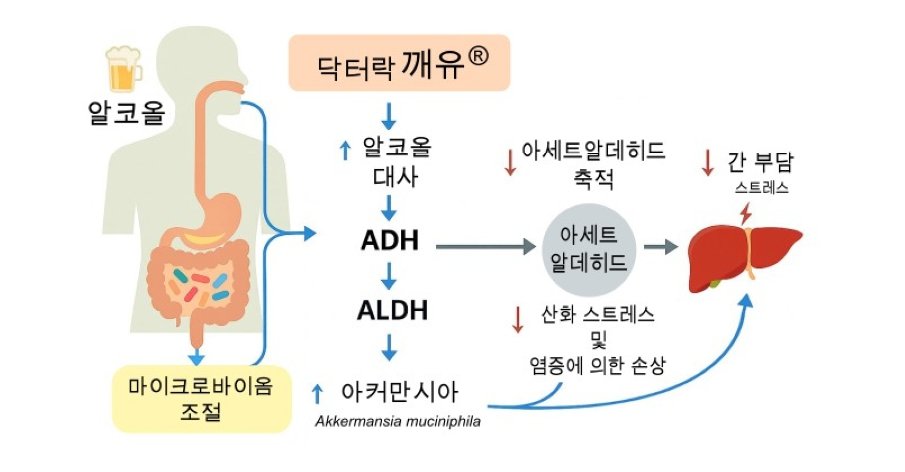
Professor Kim Won-yong of Chung-Ang University College of Medicine launches microbiome-based hangover remedy ‘Dr.Lac KYOU’Against this backdrop, LuxBiome, a microbiome-based R&D company, is attracting attention. LuxBiome, founded by CEO Kim Won-yong, a professor at Chung-Ang University College of Medicine, launched on the 12th a hangover remedy whose mechanism of action has been identified as alcohol breakdown → acetaldehyde reduction → alleviation of liver inflammation.
CEO Kim has studied the microbiome for the past 30 years, has 242 SCI papers and 55 patents to his name, and is known as the developer of an “anti-rotavirus infant formula,” which won the Jang Young Sil Award in 2018. The microbiome refers to the entirety of the genetic information of microorganisms residing in the human body, or the microorganisms themselves, and is a portmanteau of microbiota—microorganisms that live symbiotically in the human body—and genome.
LuxBiome joined forces with Oracle, a software and cloud services company, and based on CEO Kim’s past research data, developed “PANGENOME MINER AI,” an AI-based microbiome target material platform. The platform works by having AI quickly identify and match suitable target materials to treat specific diseases. While using PANGENOME MINER AI to search for therapeutic agents for liver diseases, LuxBiome identified strains (LB1022 and LB1025) possessing alcohol and acetaldehyde metabolism genes. These strains carry alcohol metabolism-related genes such as adh, adhE, and adhR, and the mechanism of action from alcohol breakdown → acetaldehyde reduction → alleviation of liver inflammation at the microbiome level has been elucidated.
LuxBiome further validated this mechanism with additional data through joint research with the Microbiome Center at Columbia University Irving Medical Center in the United States and reported that it also demonstrated an increase in beneficial intestinal bacteria (Akkermansia) and improvement of the gut-liver axis. The company added that it has secured reliability by obtaining dual alcohol and acetaldehyde degradation patents in Korea, the United States, Europe, and China.
Mechanism of the hangover remedy Dr.Lac KYOU identified by LuxBiome / Source = LuxBiome
CEO Kim said, “I have found it rewarding to develop products that benefit people, such as microbiome-based infant formula for suppressing enteritis, drawing on the outcomes of my research. Observing the increasingly murky hangover remedy market, I concluded that there was a need to introduce scientifically proven products to reshape the market, which led to the launch of the hangover remedy Dr.Lac KYOU,” adding, “What was particularly interesting in developing Dr.Lac KYOU was that its technology is connected to the genetic characteristics of East Asians. For example, the global population carrying the ALDH2*2 variant is about 500 million, with 30%–50% of the populations of Korea, Japan, China, and Taiwan exhibiting this variant at a high rate. This variant reduces the body’s ability to break down acetaldehyde, causing discomfort such as facial flushing or heart palpitations after drinking. In other words, those with severe hangovers even after small amounts of alcohol do not simply have individual differences, but a genetic structural issue. A microorganism-based product carrying alcohol and acetaldehyde metabolism genes has a highly meaningful mechanism of action for populations with this constitution.”
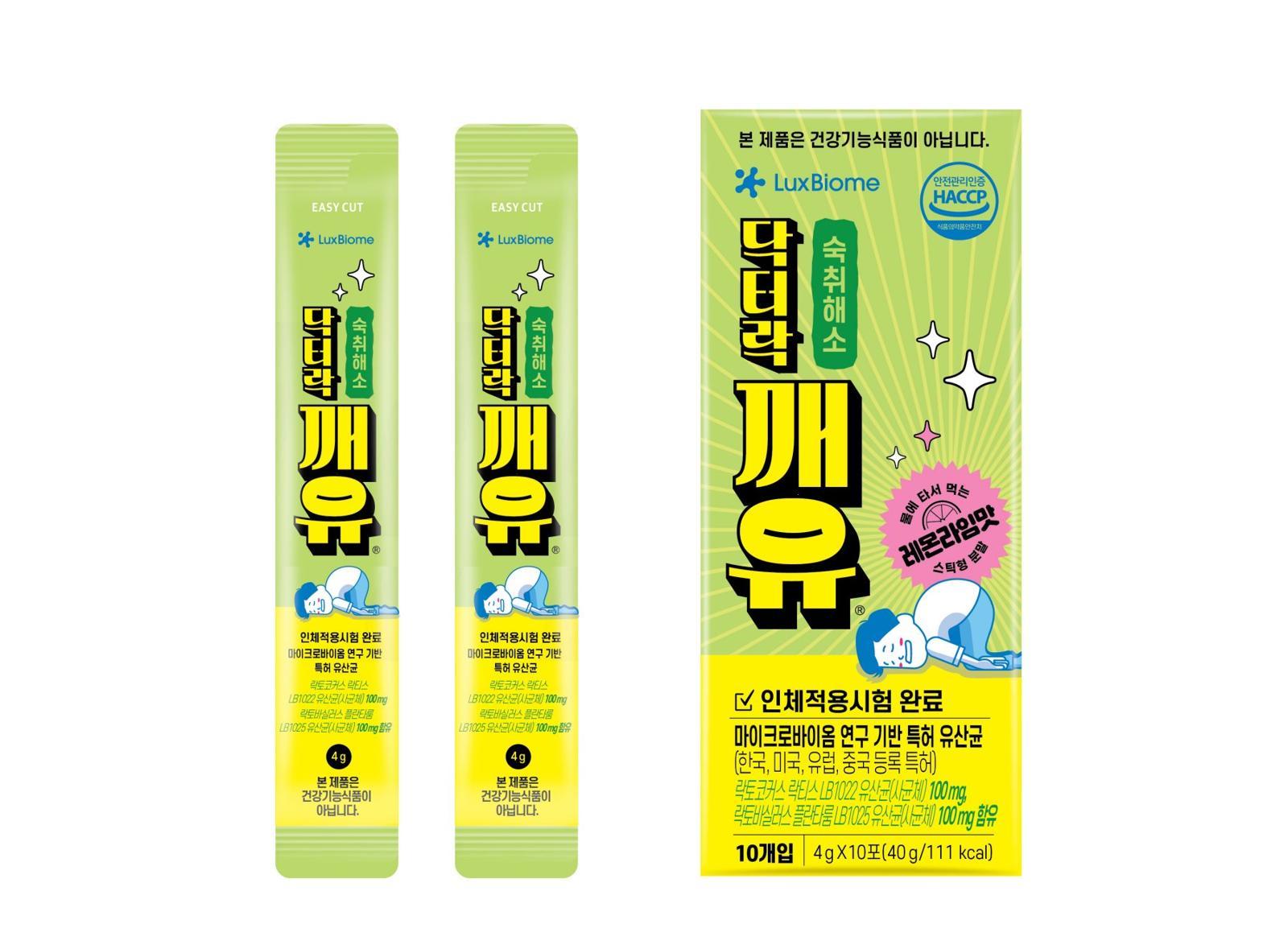
Hangover remedy Dr.Lac KYOU launched by LuxBiome / Source = LuxBiome
He continued, “After ingesting Dr.Lac KYOU, a human application trial conducted at Chung-Ang University Hospital found a statistically significant improvement in the speed of alcohol elimination, as well as a reduction in blood acetaldehyde levels, which are known as a cause of hangovers. Subjective relief of hangover symptoms such as headache, fatigue, and nausea was also confirmed through surveys. Going forward, hangover remedies should be developed based on such transparent mechanisms and clinical evidence, as well as reproducible data grounded in genomics, patents, and peer-reviewed papers, and technological capabilities that meet global standards,” adding, “LuxBiome will build a medifood and new drug pipeline that can be expanded to different diseases based on this underlying technology, clinical research, and AI-based microbiome platform. The company aims to advance toward completing a data-driven healthcare model and a global research network.”
IT Donga reporter Kim Dong-jin (kdj@itdonga.com)
ⓒ dongA.com. All rights reserved. Reproduction, redistribution, or use for AI training prohibited.
Popular News